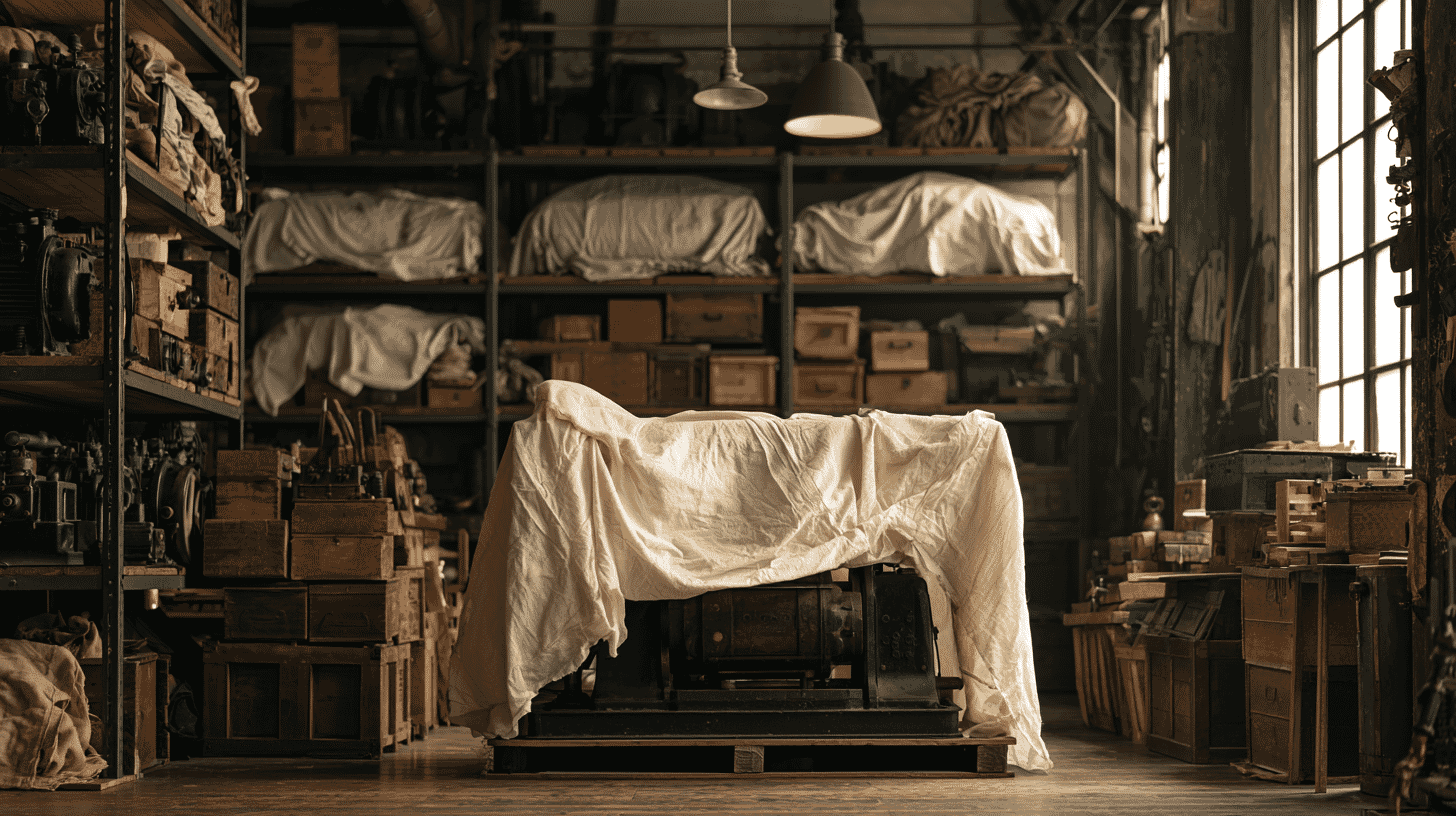
🔧 Japan has a Machine Day. It is not a public holiday; the country's mechanical engineers simply set one aside for themselves. Every year on that day a small number of machines are chosen as worth keeping. The 2026 list of six includes a camera that shot 20,000 frames a second in 1926 and 45,000 with its successor, and a micrometer that its maker kept on the Buddhist altar at home.
Machines get a heritage list too
The Japan Society of Mechanical Engineers, founded in 1897, is an academic body with about 30,000 members. In 2007, for its 110th anniversary, it launched something called Mechanical Engineering Heritage: a program that certifies surviving objects of historical significance in Japanese mechanical engineering so that they do not simply get thrown out. With the six items announced on July 27, 2026, the running total reached 138. This was the twentieth round.
There are four categories. Site, for machines that form part of a historic landscape. Landmark, for symbolic buildings and structures containing machinery. Collection, for machines that have been preserved or gathered together. Documents, for machinery-related records of historical importance. Nominations come from members, are screened and evaluated by a heritage committee, reviewed by a supervisory committee, and finally approved by the board. Past entries include a Series 0 Shinkansen car and the Washlet G.
The certification date is August 7, which the society designated as Machine Day in 2006, with August 1 to 7 as Machine Week. Why that date? It falls on the month-delayed version of Tanabata, the star festival. Tanabata descends from the Chinese observance of Kikkoden, a night for praying to become better at sewing and craft, and the Japanese reading "tanabata" is said to come from the tanabata, a loom used to weave robes offered to the gods. Japan's Machine Day, in other words, is named after a loom. The 2026 ceremony was held on August 7 at the Railway Museum in Saitama.
45,000 frames a second, in the 1920s
Heritage No.133 is a high-speed camera built by Toyotaro Suhara at the Aeronautical Research Institute of Tokyo Imperial University. He wanted to see the airflow around aircraft propellers. Past a few hundred frames per second, shutter timing and the tensile strength of film both become limits, and the conventional method of stopping the film for each frame breaks down. Suhara's answer was a rotating-mirror design.
Type I, from 1926, reached 20,000 frames per second. Type II reached 45,000, and Type III 60,000. He was granted a patent in 1928 and received the Asahi Prize the following year, in 1929. Footage from the cameras was screened for general audiences as films. Suhara wrote up the work himself in English for the Proceedings of the Imperial Academy in 1929, describing a camera that could shoot at up to 40,500 frames a second. In 1937 the design was mentioned in a US applied physics journal; one unit crossed the Pacific at the request of the American Society of Mechanical Engineers, and another went to Göttingen University in Germany. According to the JSME certification booklet, high-speed cameras were still a developing technology worldwide at the time and nothing else reached the Suhara speeds. Types I and II now sit at the National Museum of Nature and Science in Tsukuba, Ibaraki. They are not open to the public.
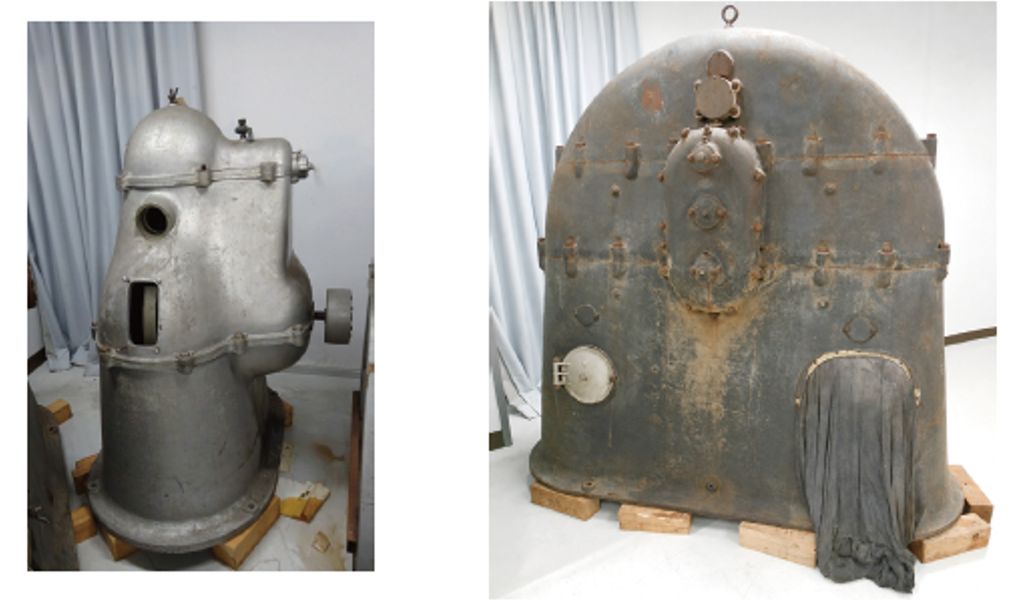
Photo courtesy of The Japan Society of Mechanical Engineers
The micrometer that lived on a Buddhist altar
No.134 is a Mitutoyo micrometer, an instrument for measuring length that Japan was still importing from Europe and America in the 1930s.
Yehan Numata was the third son in a Jodo Shinshu temple family in Hiroshima. He sailed for the United States at 19 and studied at the University of California, Berkeley. Wanting to explain Buddhism to English-speaking readers, he started a magazine, which folded after four years for lack of money. The lesson he drew was that he needed a business first. Back in Japan, he set up a research laboratory in 1934 and began developing micrometers. In 1936 he opened a plant in Kamata, renamed the firm Mitutoyo, and that December completed a domestic micrometer modeled on the Swedish gauge maker Johansson.
The certified unit is one of the first lot of seventeen: a range of 0 to 25 mm and a resolution of 0.01 mm. Of the first hundred units that passed inspection, only seventeen were judged flawless enough to keep. The society's booklet says the remaining 83 were scrapped. Numata put unit No.17 in a wooden box and kept it on the Buddhist altar at his home.
Sales began in January 1937, more than 5,000 units went out that year, and by December 1938 the plant was making a thousand a month. Mitutoyo today lists over 5,500 kinds of precision measuring instruments. And in 1965 Numata finally did what the business had been for all along, founding the Society for the Promotion of Buddhism, known for placing copies of "The Teaching of Buddha" in hotel rooms much as Gideon Bibles are placed in American ones. The micrometer is at the Mitutoyo Museum and Numata Memorial Hall in Kawasaki, free to visit with an advance reservation.
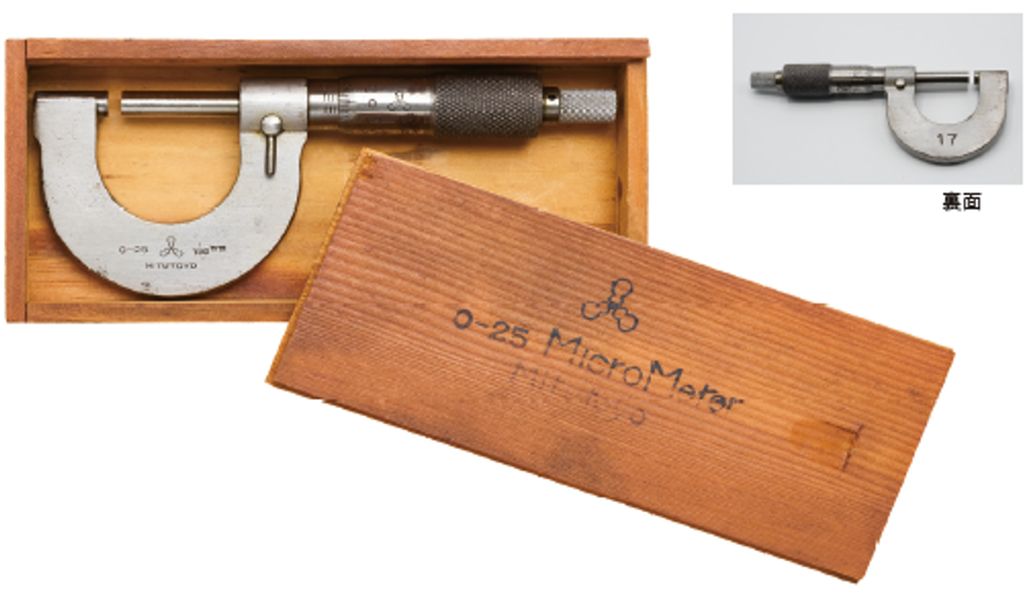
Photo courtesy of Mitutoyo Corporation
The music box that came back from Arizona
No.135 is an 18-note music box movement in a lacquered wooden box. It plays "China Night," a song released in 1938 that became widely popular during the war years. The word for China in the Japanese title is an older term that is now avoided; JSME's own English page renders it as "China Night."
It was made by Sankyo Seiki, founded in 1946 in Shimosuwa, Nagano, and now known as Nidec Instruments. The company succeeded in producing movements domestically in 1948, and this one is thought to date from around 1951, the earliest period of production. Suwa was a cluster for cameras, watches and music boxes, and in those years people called it the Switzerland of the East.
During the occupation and the Korean War, American soldiers passing through Japan carried music box products home as souvenirs, and demand in the United States took off. The society's booklet says Japanese makers drove their costs down and their quality up to meet the volume of orders, and that by around 1960 Japan was the largest producer in the world. A Japanese woman who moved to the US in 1990 came across it in Arizona around 2000, used it for years as a jewelry box, brought it back with her in 2024 and donated it to the company. Nidec Instruments still builds movements in the Suwa area, and the booklet describes it as the only domestic maker left. This one is also closed to the public.
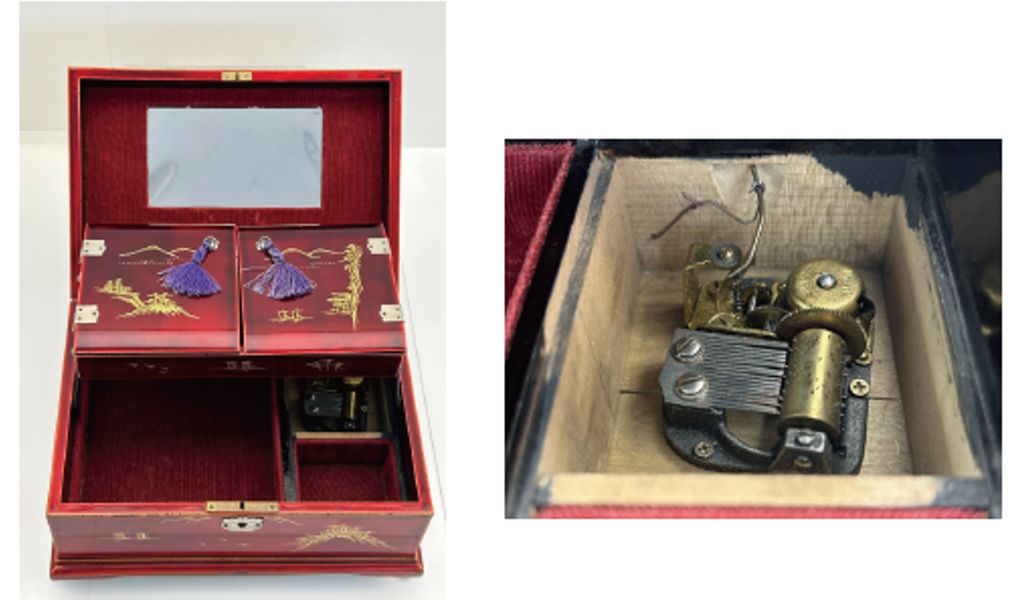
Photo courtesy of Nidec Instruments Corporation
Two machines that worked around their limits
The remaining two machines both take a hard technical constraint of their day and go around it rather than through it.
No.136 is an elevator traction machine built by Mitsubishi Electric in 1938. An elevator carries people, so it has to start and stop slowly while traveling fast in between. A DC motor does that, but costs more. This machine instead uses a two-speed AC motor with two sets of windings on a single shaft, switching between 205 and 550 rpm. It runs at 45 meters per minute with a capacity of 1,600 kg, and carries one patent and three utility models. Installed at the Mitsubishi Mining central research laboratory in what was then the town of Omiya in Saitama, it was pulled out during a 1986 equipment renewal, held for a time by the Nippon Institute of Technology's industrial technology museum, and now sits inside SOLAÉ, the elevator test tower that Mitsubishi Electric Building Solutions operates in Inazawa, Aichi. That tower was completed in 2007, stands 173 meters tall, is equivalent to a 40-story building, and is where the company tests its ultra-high-speed elevators. Access is generally closed and arranged case by case.
No.137 is a tablet press from Kikusui Seisakusho in Kyoto, certified under the name First Domestically Produced Rotary Tablet Press No.8A-2. It fills dies on a rotating turret with powder and compresses it into tablets. The model line ran from 1932 to 1983, and this surviving unit was built in 1955. It has 16 punches and a 1.5 kW Mitsubishi Electric motor. At 25 turret revolutions per minute, those 16 punches work out to 400 tablets a minute. Imported machines rotated clockwise; this one goes the other way.
Machining accuracy at the time made it hard to align the die holes in the turret with the punch holes above them, so the builders used special set punches whose position could be adjusted in an upper holder. Changing products means swapping only the punch tips, which also lowers running costs. And the roll height adjustment that determines tablet thickness uses a 6-degree tapered wedge borrowed from the carpentry of Kyoto's temples. The press was used at Tanabe Seiyaku, now Tanabe Pharma, kept afterward, and donated to Kikusui in October 2023. It is displayed in running order, and as of the certification the company was still preparing for public access.
How an 80-sen booklet became heritage
One of the six is not a machine at all. No.138 is the first printing of the first edition of the society's own Steam Table and Diagrams, published in 1934, and the booklet lists it as this year's only entry under Documents.
Steam tables are numerical tables relating the temperature, pressure and energy of steam. They look dull, and without them you cannot design a steam turbine or a boiler. Around 1930, research results appeared in several countries in quick succession, leaving rival steam tables in circulation and calculations that disagreed. Conferences in London in 1929 and Berlin in 1930 adopted an international skeleton table, but Japan still had no domestic standard.
The society set up a steam table committee in 1933, took Sugao Sugawara's new steam table as its base equations, and finished the work in about a year. The manuscript was completed in August 1934 and the first edition published that October: A4 format, 18 pages of text and tables, plus a single sheet of steam diagrams, priced at 80 sen. A sen was one hundredth of a yen. Schools, laboratories and industry used it as the national reference, and it carried through to revised editions and later SI steam tables. Writing in the society journal in 1937, JSME president Masao Kamo noted that Japan had published this compilation of the newest research ahead of the world's industrial nations.
But can you actually go and see them?
The society asks people to visit the heritage in person and see it with their own eyes. With this year's six, that wish is a little hard to grant. Going by the certification booklet issued in August 2026, the high-speed camera and the music box are closed to the public, the elevator hoist is closed in principle and handled by arrangement, and the tablet press is still preparing for visitors. Only two, the micrometer and the steam tables, can actually be seen by making contact in advance.
That is also an honest reflection of what the program is. Much of this material is not museum stock; it sits on the grounds of working companies. Certification is partly a mechanism for creating a reason not to throw something out at the next equipment renewal or building replacement. The 1938 hoist survived because somebody in 1986 chose to take it away instead of scrapping it. The music box came back because a stranger in Arizona liked the look of it. Neither was guaranteed.
Other countries run something similar. The American Society of Mechanical Engineers has been designating Historic Mechanical Engineering Landmarks since 1971 and, by its own count, lists more than 280. Browse the topic index and large installations dominate: power plants, pumping stations, railways, ships. The Tokaido Shinkansen is on it too, entered under 1964. JSME has reached 138 in the nineteen years since 2007, the quicker pace of the two. And all six of this year's Japanese picks were objects you could carry rather than places you visit.
Does your country keep a list of the machines it intends to hold on to? And if you were the one writing it, what would you put on it first?
References
- https://www.jsme.or.jp/kikaiisan/
- https://www.jsme.or.jp/20260727-2/
- https://www.atpress.ne.jp/news/617661
- https://www.atpress.ne.jp/releases/617661/att_617661_1.pdf
- https://www.jsme.or.jp/event_project/machine-day/
- https://www.jstage.jst.go.jp/article/pjab1912/5/8/5_8_334/_pdf/-char/en
- https://www.mitutoyo.co.jp/exhibitions-and-events/museum/
- https://www.bdk.or.jp/english/about/numata.html
- https://suwanone.jp/suwa_musicbox/suwa
- https://www.mitsubishielectric.co.jp/elevator/info/inazawa/index.html
- https://www.asme.org/about-asme/engineering-history/landmarks





Global Discussion
4 comments