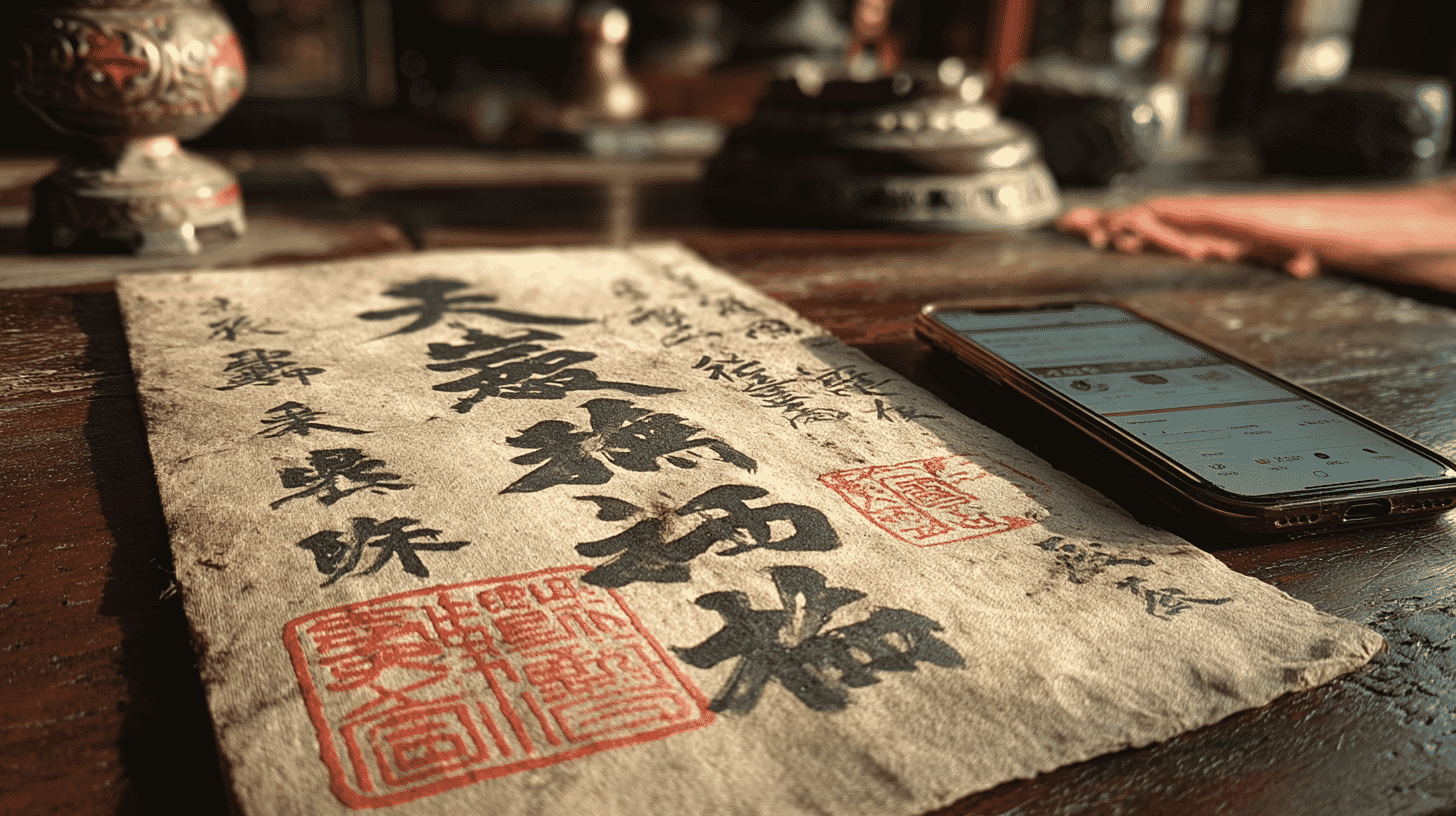
A goshuin, hand-brushed with care at a shrine, is being resold for 5,000 yen (about $33) on a flea-market app. The "proof of worship" that underpins Japan's temple and shrine culture has become merchandise for the resale trade. In the gap between faith and commerce, where the law struggles to intervene, what exactly is Japan being asked to confront?
What Is a Goshuin? The Prayer Behind the Proof of Worship
A goshuin is a special inscription given to those who visit a Shinto shrine or Buddhist temple in Japan. A vermilion seal and the ink-brushed name of the shrine, along with the date, are set down on a sheet of washi paper, either written directly into the visitor's goshuin book or handed over as a pre-written sheet.
Its origins are said to trace back to the Nara and Heian periods. Originally, a goshuin was given as proof that a worshipper had submitted a hand-copied sutra (shakyo) to a temple. In other words, it is neither a mere stamp nor a souvenir, but evidence of a "bond" forged with the gods or Buddha, with religious meaning woven into every single one.
The offering that accompanies it, called hatsuho-ryo, typically runs from about 300 to 500 yen (roughly $2 to $3.30). This is fundamentally an offering "from the heart," different in nature from a commercial transaction.
The Goshuin Boom and Its Dark Side
In 2013, the overlap of the Ise Grand Shrine's periodic rebuilding (shikinen sengu) and Izumo Taisha's Heisei-era grand renovation sparked a major goshuin boom, especially among younger people. The term "goshuin girl" was coined, and beautifully designed, social-media-friendly goshuin became a talking point.
But as the boom overheated, problems surfaced. Long lines formed for seasonal and event-limited goshuin, and abuse directed at staff, along with bulk acquisition for resale, began to spread. In 2019, Asakusa Shrine in Tokyo took the unusual step of canceling distribution of its special Sanja Festival goshuin. The direct cause was rampant resale and breaches of etiquette.
Eiko Kano's Plea: "Please, Just Stop"
On February 12, 2026, Eiko Kano, a comedian who is also a Shinto priest at a shrine in Miyagi Prefecture, spoke out about the goshuin resale problem. Appearing at an event, Kano described writing 1,300 goshuin by hand himself over the New Year period, and pleaded: "Sometimes the goshuin I wrote turn up for sale on Mercari, going for around 5,000 yen (about $33) each. Please don't buy them."
As a comedian, he gave up the lucrative New Year television season and spent three days brushing each goshuin with devotion. His anguish at seeing them resold struck a chord with many.
Can the Law Crack Down on Goshuin Resale?
What complicates the issue further is the ambiguity of its legal standing. Tsunehiko Maeda, a former chief prosecutor in a special investigation unit, has laid out the legal points of goshuin resale as follows.
In principle, it is "legal." A goshuin has the character of a physical "object" written on paper, and once properly received, it becomes the property of the recipient. Selling one's own property to another, ethics aside, is not an immediate crime.
But gray zones exist.
First, if a temple or shrine has explicitly stated "resale prohibited," selling in violation of that could amount to a breach of contract (a civil matter).
Second, receiving a goshuin with the intent to resell it from the outset may be seen as fraudulent, since it misrepresents the purpose of obtaining a proof of worship.
Furthermore, selling repeatedly for profit requires a license under the Secondhand Goods Business Act (kobutsu eigyo ho). That law regulates the buying and selling of used goods, and operating without a license carries up to three years in prison or a fine of up to 1 million yen (about $6,600).
The response from the flea-market apps, meanwhile, has been limited. Mercari has stated that "goshuin are not currently designated as prohibited items," and there is no mechanism in place to directly regulate their resale.
How Temples and Shrines Are Responding
With legal regulation difficult, many temples and shrines are pursuing their own countermeasures.
Tsubonuma Hachiman Shrine in Sendai introduced a system in which visitors write their name on the back of the goshuin paper and receive a number. It also capped distribution at one or two per person.
Other approaches vary from shrine to shrine: always recording the date and the worshipper's name on each goshuin, limiting the number of pre-written sheets, and introducing official mail-order services to meet demand from "those who cannot visit in person from afar."
Some argue that "if resale is going to spread anyway, perhaps temples and shrines should meet the demand directly through the internet." The idea is that by offering goshuin online themselves, shrines could reduce the very incentive to resell.
Between Faith and the Market Economy
The heart of the goshuin resale problem is not only the limits of the law. It is also a question tied deeply to Japan's spiritual culture: the unease of treating an object of faith as a commodity.
Japan has the phrase "bachi ga ataru," the old belief that acting irreverently toward the gods or Buddha invites divine punishment. It lies at the root of the aversion many Japanese feel toward goshuin resale.
At the same time, the modern market economy's logic of "where there is demand, there is supply" is hard to dismiss. Value gathers around limited items, and those who want them pay for them; this dynamic is common to all goods.
Yet a goshuin was never a "commodity" in the first place. It is part of a religious act, granted in a place of prayer. That gap in perception is what makes the problem so hard to resolve.
In Japan, a goshuin is treasured as proof of a bond with the gods and Buddha, and there is deep resistance to reselling it. In your country, what do you think about buying and selling religious or spiritual items?






Global Discussion
15 comments