📸 High-speed cameras have long forced a choice. Space the frames tightly and you catch the fine detail of an instant, but the recording runs out almost at once. Space them widely and you can watch for longer, but the decisive moment slips between two frames. A team at the University of Tokyo decided to change the spacing partway through the shot. With 11 frames, it linked everything from 100 femtoseconds to 10 nanoseconds, roughly 5 orders of magnitude in time, in a single exposure.
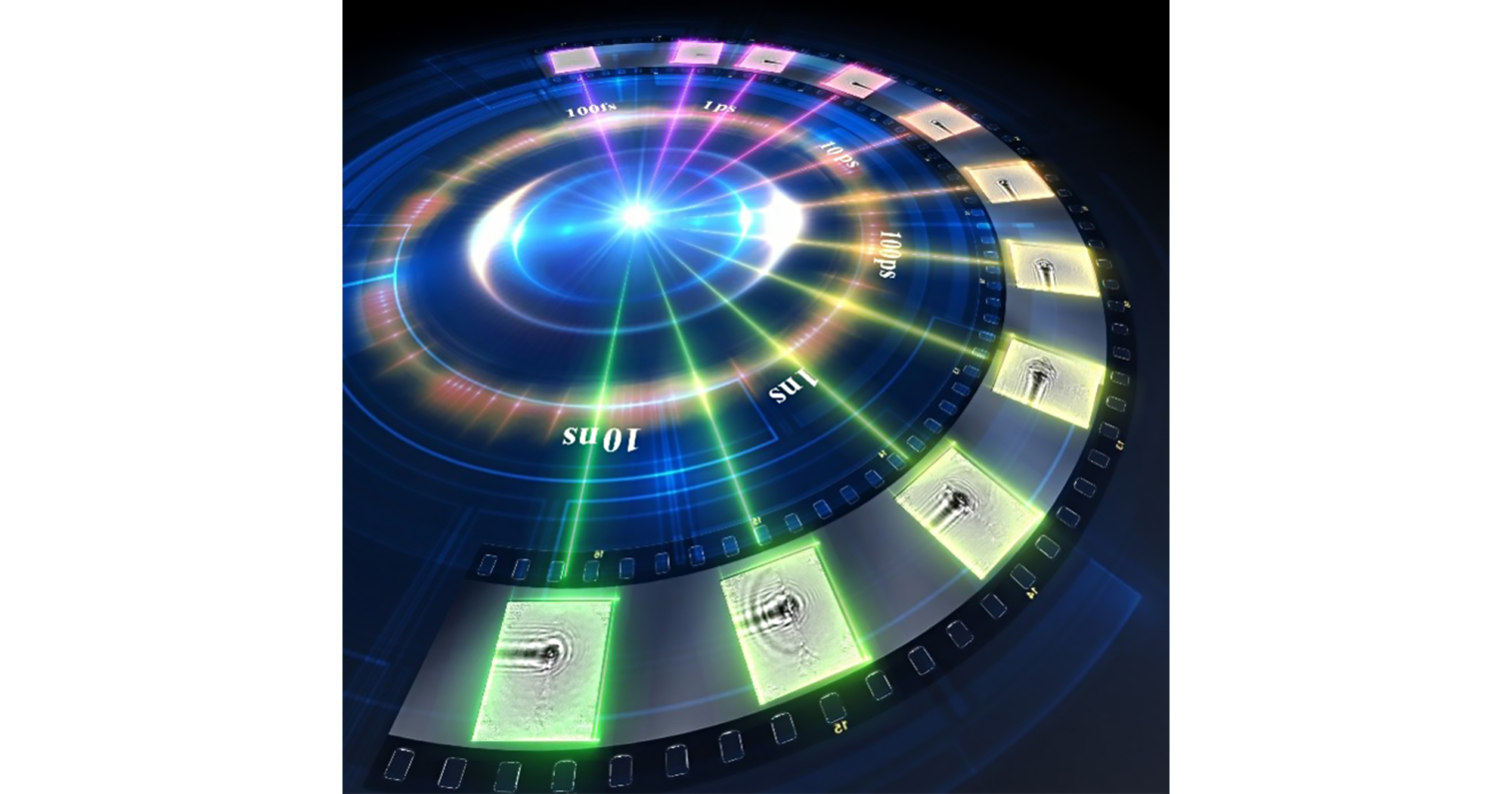
Source: University of Tokyo Graduate School of Engineering
How short is 100 femtoseconds?
A femtosecond is a quadrillionth of a second. A picosecond is a trillionth, and a nanosecond is a billionth. Measured in distance, light travels about 0.03 millimeters in 100 femtoseconds, less than the width of a typical human hair. In 10 nanoseconds it covers about 3 meters.
That is a gap of 100,000 times. As an analogy, stretch 100 femtoseconds out to one second, and 10 nanoseconds becomes about 28 hours.
The habit of even spacing
Camera frames are normally evenly spaced. That goes for a home camcorder and for most research-grade ultrafast cameras too. On top of that, an ultrafast camera can only take a limited number of frames per shot, so with even spacing it cannot have both fine detail and a long record.
This becomes a particular problem when a laser hits a material. The first changes are extremely fast. They then lead into plasma (a state in which electrons have broken free of their atoms), shock waves, and the deforming and scattering of material, each stage slower than the last. Whatever spacing you pick, some part of the story goes missing.
Keitaro Shimada, a project researcher at the time of the study, Associate Professor Keiichi Nakagawa and colleagues at the University of Tokyo Graduate School of Engineering focused on a different question: at what moments should a limited number of frames be spent? They stopped spacing frames evenly. Frames are packed densely at the start, when things change fastest, and placed progressively farther apart later on. The method is called logarithmic ultrafast photography. The university's concept image marks the timeline in steps of ten, 100 femtoseconds, 1 picosecond, 10 picoseconds and so on, the same way a logarithmic scale is laid out.
An everyday comparison: if you were documenting a seed that has just sprouted, you might take a photo every hour on the first day, then once a day, then once a week. Doing it in a camera whose shutter is effectively a flash of laser light, though, required new optics.
Different colors, different detours
The optical technique the team built is called BRIDGE, short for band-resolved individual delay generation. The idea of shifting arrival times by color carries over from a method Nakagawa's group published in 2014 (more on that below). An extremely short laser pulse is split by color, and each color is made to reach the target at a slightly different moment. The image sensor records a separate image for each color, so a set of images taken at different times arrives all at once. Each color becomes one frame.
BRIDGE sets the path length for each color individually. The longer the detour, the later that color arrives. Because each path can be set on its own, so can the timing of each frame. According to the announcement, this lets the frame spacing be set flexibly anywhere from 100 femtoseconds to 10 nanoseconds.
What the 11 frames showed
In the demonstration, the team fired femtosecond laser pulses at glass and at hydroxyapatite, the main component of bone and teeth. When a laser strips material off a solid surface in an instant like this, it is called laser ablation.
Right after the pulse come fast changes such as plasma formation. Shock waves and flying debris follow. Instead of splitting these into separate experiments, the team observed them as one continuous sequence of 11 images from a single laser shot. Over time, the images also show glass and hydroxyapatite spreading out in noticeably different ways. The team used the same 11-frame approach to capture plasma and shock waves forming in water.
Materials vary from sample to sample, and some changes happen at random. When an event cannot be repeated exactly, splitting the observation across experiments means the early frames and the late frames may be showing two different events. The release says the method is especially useful for things that are hard to reproduce, and lists applications including laser processing, the mechanical response of living tissue, and plasma and shock-wave research. The work was published in the journal Optica on September 25, 2026, and announced by the University of Tokyo and the Japan Science and Technology Agency (JST) on October 1, 2026. The research was supported by JST's ACT-X program and by the Quantum Leap Flagship Program (Q-LEAP) of Japan's education and science ministry (MEXT).
From a race for speed to a question of budget
In Japan, cameras have been measured by frames per second for a century. At Tokyo Imperial University, Toyotaro Suhara built a rotating-mirror camera that reached 20,000 frames per second in 1926, then 45,000 with the next model. That camera was named Mechanical Engineering Heritage by the Japan Society of Mechanical Engineers in 2026 (related article).
In 2014, Nakagawa and colleagues reported a method called STAMP in Nature Photonics, shooting bursts at about 4.4 trillion frames per second. The standard technique until then, the pump-probe method, sets off the same event over and over, nudging the timing each round and taking one frame per repeat. It fails on events that cannot be repeated. STAMP captured a burst in a single shot, but the first device managed 6 frames.
The same year, Professor Lihong Wang and colleagues at Washington University in St. Louis described compressed ultrafast photography (CUP) in Nature. It rebuilds images computationally, and it reached 100 billion frames per second and up to 350 frames. Its strength was the number of frames per shot.
In 2023, the Tokyo group published work in Science Advances that filmed laser processing across timescales by combining three spacings: 25 picoseconds, 2.0 nanoseconds and 1 millisecond. BRIDGE goes a step further and sets the timing of each frame, one by one, inside a single optical system. Shimada, the paper's first author, is now a postdoctoral researcher at Lawrence Berkeley National Laboratory in the United States.
In the labs and factories where you live, which process would you most want to see from its first instant to its aftermath in a single shot?
References
- https://www.t.u-tokyo.ac.jp/press/pr2026-10-01-002
- https://www.t.u-tokyo.ac.jp/en/press/pr2026-10-01-002
- https://www.jst.go.jp/pr/announce/20261001-2/index.html
- https://doi.org/10.1364/OPTICA.610944
- https://www.t.u-tokyo.ac.jp/en/press/pr2023-12-21-001
- https://doi.org/10.1038/nphoton.2014.163
- https://www.optica-opn.org/home/articles/volume_25/december_2014/extras/motion_picture_femtophotography/
- https://www.guinnessworldrecords.com/world-records/67221-fastest-camera
- https://pmc.ncbi.nlm.nih.gov/articles/PMC4270006/
- https://source.washu.edu/2014/12/worlds-fastest-2d-camera-may-enable-new-scientific-discoveries/
- https://www.atpress.ne.jp/releases/617661/att_617661_1.pdf






Global Discussion
4 comments