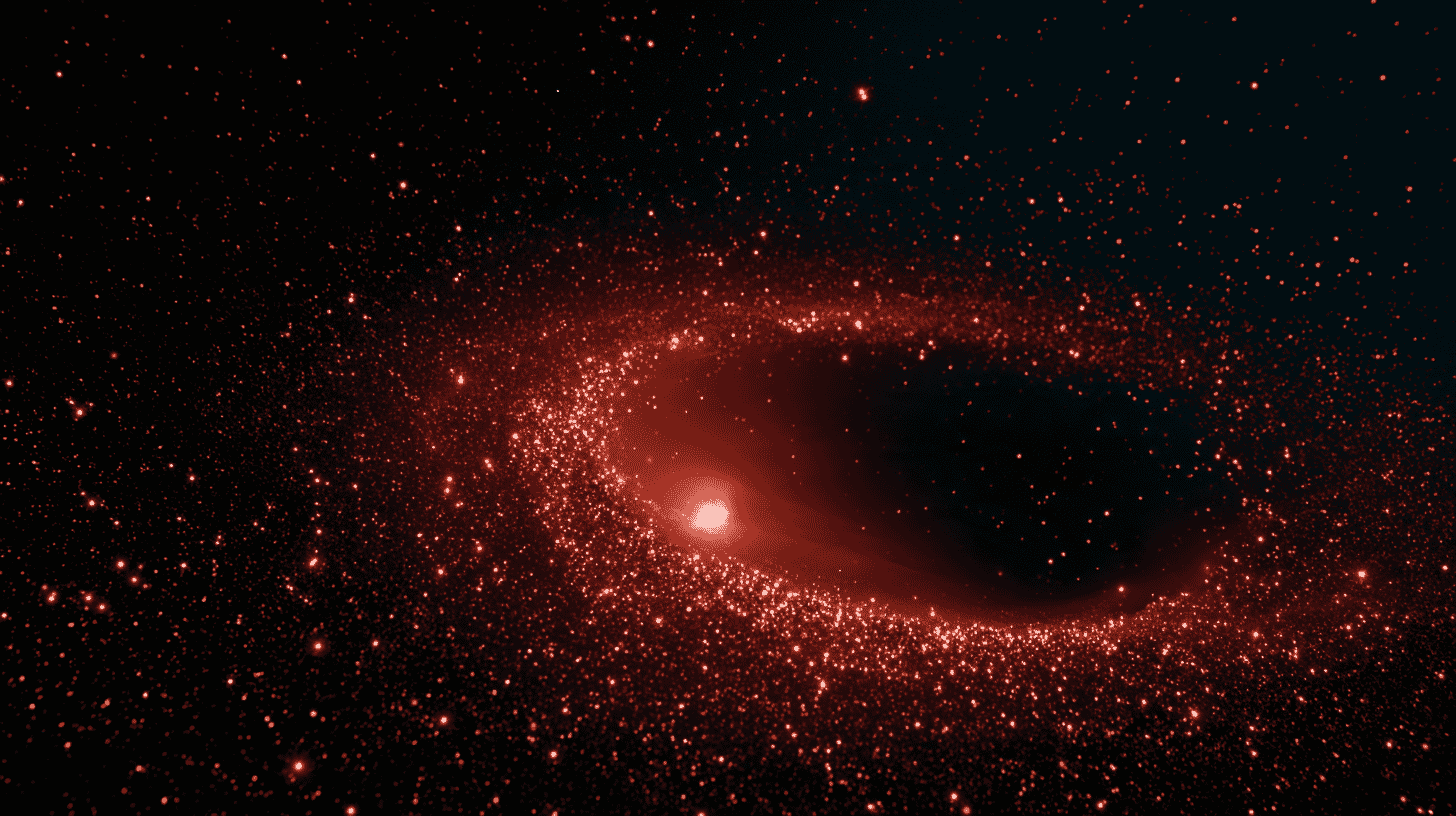
🔴 Deep images from the James Webb Space Telescope keep turning up tiny red specks, and astronomers still can't agree on what they are. In September 2026, a team led from Germany used Japan's astronomy supercomputer ATERUI III to show how a newborn black hole could end up looking exactly like one. Read the Japanese and English press releases side by side, though, and you get two different answers to the question of how much has been solved.
A Name That Admits Nobody Knows
The James Webb Space Telescope (JWST), an infrared space telescope operated jointly by NASA, ESA and the Canadian Space Agency (CSA), began full science observations in 2022. Almost immediately, astronomers noticed compact points of red light in its pictures of the distant universe. According to Quanta Magazine, one or two turn up in nearly all of Webb's images.
They were named "little red dots," or LRDs, a name that describes what they look like, not what they are.
Surveys of Webb data show them appearing about 600 million years after the Big Bang and dropping off sharply by about 1.5 billion years. Part of their color comes from distance: as the universe expands, light crossing it gets stretched toward longer, redder wavelengths, an effect called redshift. But as Harvard Magazine notes, what makes these objects red in themselves is still an open question.
Three Suspects, No Verdict
At first, some astronomers read the dots as bright galaxies. The trouble was that a galaxy shining that brightly would need to be enormous, and nobody knew how they could have grown so big in only a few hundred million years. Others have proposed explanations built on intense star formation rather than black holes.
Then came the spectra, which split light into its component colors. In many dots, the light of hydrogen is smeared across a wide range of colors. Such "broad lines" usually signal gas whirling around a black hole. That pointed to an active galactic nucleus (AGN), a feeding supermassive black hole at the heart of a galaxy. Cambridge astronomer Roberto Maiolino argues that standard black holes can explain the dots, and that the reddest ones may simply be seen from an angle that hides their centers.
A third camp, including Anna de Graaff of the Max Planck Institute for Astronomy in Heidelberg and Rohan Naidu of the University of Hawai'i, proposed something new in March 2025: a "black hole star." Seen from outside, it would resemble a huge ball of hydrogen gas, but a hidden black hole would be doing the work inside.
The dots are odd as black holes, too. They give off very little X-ray light and hardly flicker. And if they are black holes, they are far too heavy for the stars around them. Japan's National Astronomical Observatory (NAOJ) calls these "overmassive" black holes and says their origin has become a major puzzle.
What ATERUI III Calculated
The new study, published in Nature on September 16, 2026, was led by Sunmyon Chon, a researcher at the Max Planck Institute for Astrophysics (MPA) in Germany. Co-authors include Shingo Hirano of Kanagawa University, Tomoaki Ishiyama of Chiba University and Volker Springel, director of MPA.
The heavy computing ran on ATERUI III, a supercomputer dedicated to astronomy. NAOJ has operated it since December 2, 2024 at its Mizusawa campus in Oshu, Iwate Prefecture. It is named after Aterui, an Emishi chief of the Mizusawa area who stood up to imperial military campaigns in the Heian period. (The Emishi were people of northeastern Japan who resisted the imperial court's expansion.)
According to NAOJ, earlier simulations assumed a black hole was already there and followed its growth. This team instead started from the Uchuu mock universe, built on the earlier ATERUI II, and searched it for crowded regions of young galaxies. The paper reports 60 candidate regions that met their criteria. They followed the fastest-growing one in detail, calculating gravity, gas and radiation together, from regions hundreds of millions of light-years across down to gas clouds a few light-years wide.
In the simulation, ultraviolet light from bright neighboring galaxies kept a nearby gas cloud from cooling and forming ordinary stars. Meanwhile, the gravity of dark matter kept pulling gas in. The result was a supermassive star 500,000 to 900,000 times the mass of the Sun, which collapsed into a "seed" black hole of about a million times the mass of the Sun.
Wrapped in a thick disk of gas, that seed swallowed gas at dozens of times the Eddington limit, the rate at which a black hole's own radiation normally pushes incoming gas away. It reached about 30 million solar masses by roughly 600 million years after the Big Bang. Light seeds left by the first stars, about 800 solar masses, barely grew.
The link to Webb is the gas cocoon. Dense gas absorbs and scatters the light, making it red and broadening hydrogen lines through electron scattering. Those are the signature features of LRDs. "At first I didn't think objects like LRDs could be reproduced in a simulation," Chon said in NAOJ's Japanese release.
Same Study, Two Tones
NAOJ's Japanese press release is titled, roughly, "Closing in on the identity of the mysterious 'small red dots.'" Its detailed version says LRDs may be what a giant black hole looks like right after its birth in the early universe.
NAOJ's English release on the same study says the simulations "have explained the nature of the Little Red Dots" and that "the LRDs are the answer to the black hole growth mystery." MPA's release quotes Chon: "This is a perfect match."
What the study showed is that a plausible chain of events, starting from ordinary early-universe conditions, produces an object that looks like an LRD. According to NAOJ, it is the first to link seed birth, rapid growth and the LRD appearance in one continuous process.
But the detailed run followed only the one region picked for its fast growth. That shows such a path is possible, not how many of Webb's dots took it. NAOJ's Japanese text itself lists that as the next job: testing what share of LRDs this explains, and whether they become quasars above a billion solar masses. The study supports the black hole explanation without proving it.
The "Too Heavy" Problem May Be Shrinking
In January 2026, a team led by Vadim Rusakov of the University of Manchester published a separate analysis in Nature. Looking at the best Webb spectra, they concluded that broad lines mostly come from electron scattering, not fast orbital motion. If so, black hole masses are about 100 times lower than earlier estimates (100,000 to 10 million Suns), easing much of the mass and growth problem.
The new simulation also explains the broad lines through electron scattering. Read together, the two papers suggest that the premise itself is still moving. The question may be shifting from "How did such heavy black holes form so early?" toward "How heavy are they, really?" Neither team draws that conclusion.
"The field has gotten very polarized," Anna-Christina Eilers of the Massachusetts Institute of Technology (MIT) told Quanta. Dale Kocevski of Colby College suspects the dots may not all be one kind of object. "I have a sneaking suspicion that we're both right," he said.
Black Holes That Have to Grow Up
The dots matter because of a decades-old puzzle. Supermassive black holes of millions to billions of solar masses were already in place within the first few hundred million years of cosmic history. How they got so big so fast has never been settled.
There are two broad ideas. Light seeds start as first-star remnants of tens to hundreds of Suns and must feed nonstop at extreme rates. Heavy seeds are born big; the classic version is a gas cloud collapsing directly into a black hole of about 100,000 Suns. The ATERUI III result lands on the heavy-seed side by a slightly different road: its seed passed through a short-lived supermassive star and came out at about a million Suns, which the paper says is an order of magnitude above typical theoretical expectations. If it holds up, Webb's red dots are black holes in childhood, caught in a short, hidden growth spurt.
How did the news where you live frame Webb's little red dots: mystery solved, or one strong suspect?
References
- https://sorae.info/astronomy/20260922-lrd-aterui-iii.html
- https://www.nao.ac.jp/news/science/2026/20260917-cfca.html
- https://www.cfca.nao.ac.jp/pr/20260917
- https://www.nao.ac.jp/en/news/science/2026/20260917-cfca.html
- https://www.mpa-garching.mpg.de/1154783/news20260917
- https://doi.org/10.1038/s41586-026-10985-8
- https://doi.org/10.1038/s41586-025-09900-4
- https://www.quantamagazine.org/black-holes-or-black-hole-stars-astronomers-spar-over-webb-telescopes-little-red-dots-20260914/
- https://www.harvardmagazine.com/five-questions/harvard-little-red-dots-black-holes-stars-early-universe-cosmology
- https://www.cfca.nao.ac.jp/pr/20241202
- https://bunshun.jp/bungeishunju/articles/h9530




Global Discussion
4 comments