🎮 What if the next competitive edge in esports isn't a faster mouse or more practice hours, but an acupuncture session and a sleep tracker?
A Tokyo esports club is betting that winning can be reverse-engineered. Working with the University of Tokyo and other research institutions, INSOMNIA wants to find out, with data, what actually separates a champion from everyone else.
Acupuncture, Sleep Logs, and the Science of Winning
On May 22, 2026, INSOMNIA, a professional esports organization based in Tokyo's Sumida ward, announced a joint research project called INS×LAB. Run together with the University of Tokyo and several other universities, it has a deceptively simple goal: figure out what makes a player perform at their peak and, in the club's own words, "scientifically acquire the repeatability of victory."
Source: INS Inc. / PR TIMES press release
INSOMNIA has been competing since 2021, though its operating company, INS Inc., was incorporated only in January 2024. Young as the organization is, its competitive record is real. Its Pokémon UNITE division won the Pokémon UNITE Asia Champions League 2025, taking the continental title and a ticket to the world stage. Its VALORANT division, relaunched in 2026, climbed out of the Advance Stage into the main stage of VALORANT Challengers Japan 2026 Split 1, then finished second in Phase 2 to reach the playoffs. The club also fields divisions in Brawl Stars, Mobile Legends, Super Smash Bros. and streaming.
The organization's mission statement is a pun on its own name: "excitement that keeps you up at night." INS×LAB flips that idea on its head, because the project's first concrete interest is, quite literally, how well its players sleep.
For years, esports training has leaned on instinct and accumulated habit: practice hard, sleep when you can, tweak your settings until they feel right. INS×LAB treats that gut-feel approach as the problem to be solved. By bringing in expertise from medicine, cognitive science and data science, the club wants to replace "this feels good" with "the data says this works."
Two Teams, Two Ways to Decode a Champion
INS×LAB starts with two research tracks, each run by a different group of specialists.
Watching where a player looks
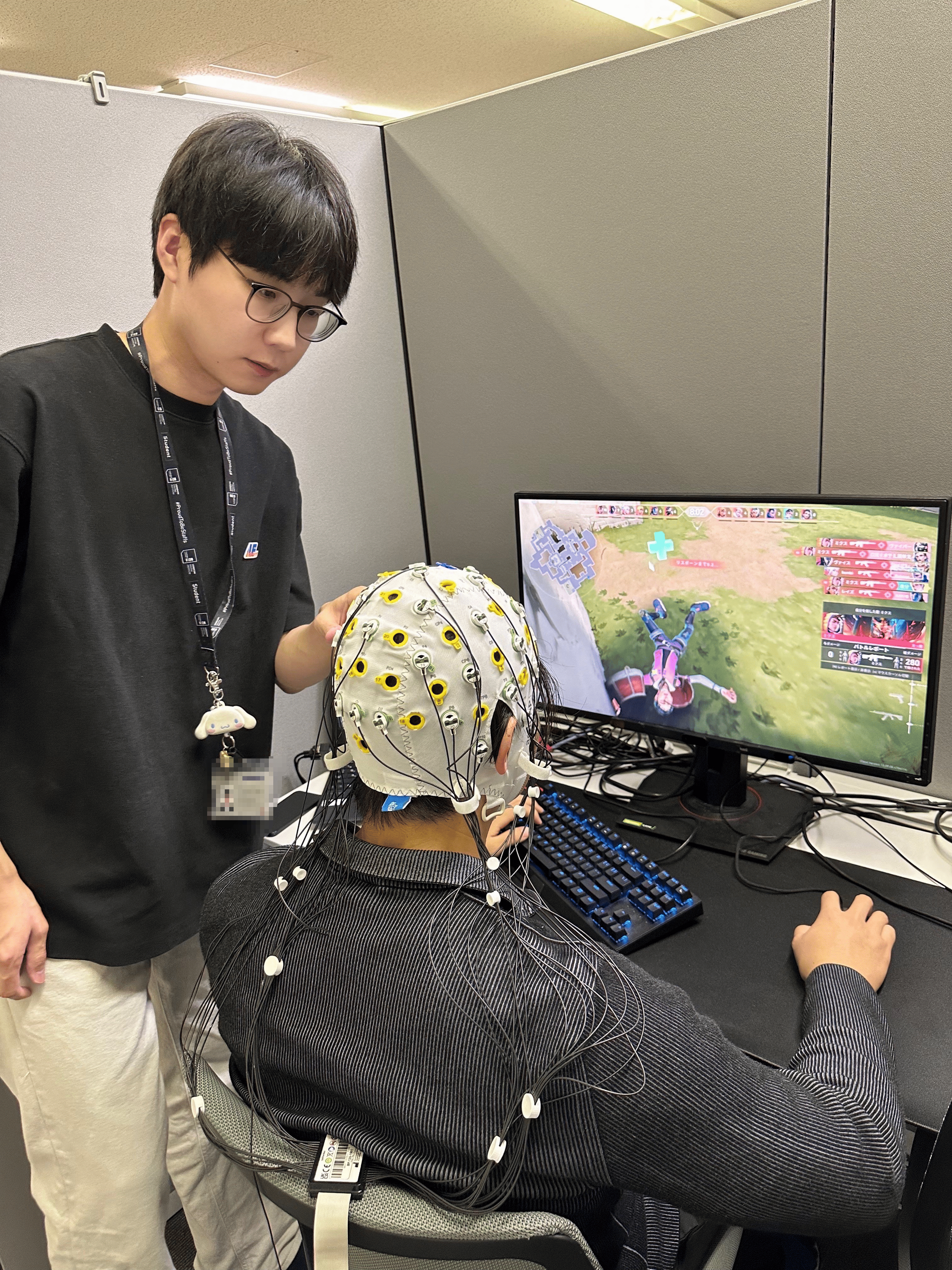
The first track tries to decode elite play from the inside. What is the brain of a great competitor actually doing? This work is led by a joint team from the Kochi University of Technology and the University of Tokyo, headed by researcher Inhyeok Jeong.
Source: INS Inc. / PR TIMES press release
During matches, the team measures where a player's eyes move and how their concentration shifts, then analyzes that data against the speed and accuracy of their in-game decisions. The aim is to find the invisible patterns: the difference between a player who reads a situation a fraction of a second faster and one who doesn't. From there, the researchers want to build training methods tailored to each player's specific weaknesses, and eventually a player-development and evaluation system that goes beyond simply counting wins and kills.
Jeong frames esports as a genuinely interesting subject for human science, demanding cognitive sharpness, instant motor control and mental resilience all at once. The plan, he says, is to use scientific measurement to uncover the roots of competitive skill, then push players' abilities further and their careers longer.
Tracking the body off the screen
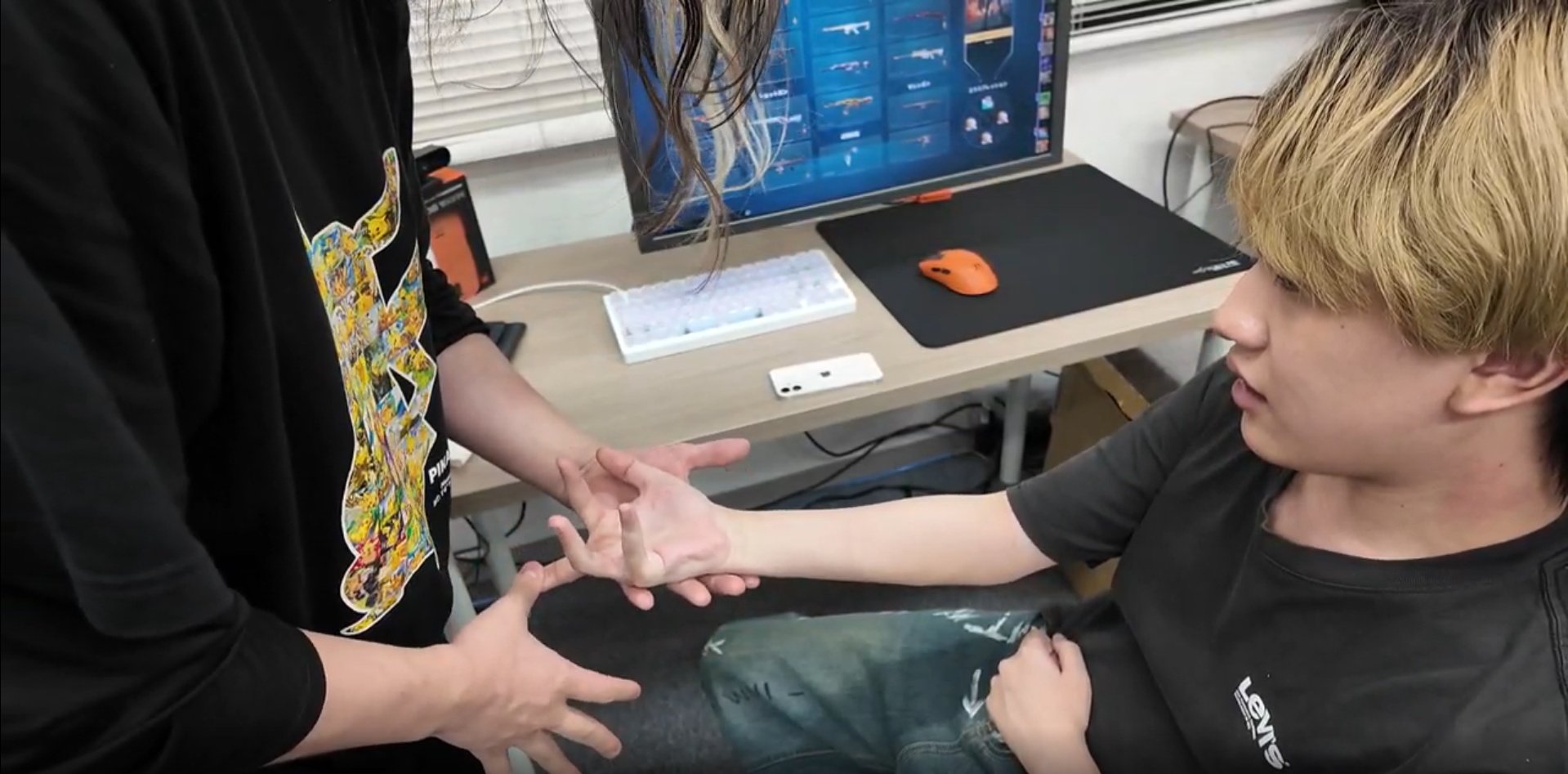
The second track looks away from the screen entirely. It is led by You Hiramatsu, an acupuncturist who is also a doctoral candidate at Keio University's Graduate School of Media Design.
Source: INS Inc. / PR TIMES press release
Here the data is everyday life. Researchers collect players' sleep patterns and activity levels and study how those daily habits ripple into in-game performance, and even into how well teammates communicate. Muscle strain is measured while players actually operate a mouse. The end point is a conditioning method built specifically for esports: personalized recovery routines, body care and, where it helps, acupuncture treatment.
That last detail is what makes the project stand out. Plenty of esports organizations talk about player health. Very few are placing an acupuncturist's table next to the gaming chair and calling it research. Hiramatsu notes that esports has a real physical-strain problem, and players do retire over conditioning issues. He argues the answer is to make the day-to-day reality of a player's body visible, so teams can act before something breaks rather than after.
Why a Team Decided to Become a "Club"
Alongside the research announcement, INSOMNIA changed how it describes itself. It is no longer an esports "team" but an esports "club."
The word choice is not just branding. INSOMNIA calls itself Japan's first "public-private-academic" esports club, and it has been building toward that identity for a while. In November 2024 it began a community project in Sumida ward with iU, a professional university, aiming to root esports in the local area the way a football club belongs to a town. INS×LAB extends the academic leg of that stool.
For readers in Europe especially, the logic will feel familiar. A football club isn't only its first team; it is youth academies, medical staff, sports scientists and a civic identity. INSOMNIA is openly reaching for that model. "For esports to grow into a true athletic discipline, the power of science is essential," said INS CEO Sota Motohashi, framing INS×LAB as a step toward developing not just current players but the next generation.
What Korea and the Nordics Already Figured Out
Japan is not first to this idea, and INS×LAB does not pretend otherwise.
South Korea, the original esports superpower, has treated competitive gaming as a structured profession for two decades. Its esports federation is government-recognized, and top organizations run team houses staffed with trainers and psychologists. Korean universities have explored the science side too: one well-known project studied how to optimize input devices, such as mouse sensitivity, to each player's individual characteristics rather than leaving it to trial and error. The Korean model is highly systematized, but much of the resulting knowledge stays inside organizations as a competitive secret.
The Nordic countries took a different route. In Denmark, esports has been one of the fastest-growing organized sports, and Danish universities have produced peer-reviewed research on very physical questions, such as how common musculoskeletal pain is among competitive players. Across Finland, Sweden and Norway, esports tends to sit inside national federations and even school systems, with university researchers studying player wellbeing and learning. The knowledge is more openly published, and esports is treated less like a private business and more like a community sport.
INS×LAB sits somewhere between these two worlds. It has Korea's club-and-organization structure, but it borrows the Nordic instinct to publish, and it spreads the work across multiple universities rather than keeping it in one lab.
Can Japan Turn Esports Into a Science?
What happens to the findings matters as much as the findings themselves.
INSOMNIA says INS×LAB results will first feed back into its own players' training and match preparation. After that, the club intends to publish the work as papers and white papers, with the explicit goal of strengthening esports development across Japan, not just its own roster. It even floats a longer-term ambition: that insights from elite players, who operate at the edge of human cognitive and motor performance, could transfer to anyone whose work depends on sustained digital focus.
This is also part of a clear trend rather than a one-off. In March 2026, ZETA DIVISION announced its own joint research with the University of Tokyo, focused on extending the competitive lifespan of esports players. (You can read our coverage of that partnership here.) Within a few months, two Japanese esports organizations have decided that the path forward runs through a university lab.
A note of caution is fair. An announcement is not a result, and "we launched a research project" is an easy headline to produce. The real test for INS×LAB will be whether those white papers actually appear, and whether they say anything a coach couldn't have guessed. But if gaze data really can be turned into better training, and if sleep logs and acupuncture really do extend careers, then the most Japanese version of esports science may turn out to be one of its most useful.
In Japan, esports is being pulled toward the lab, the clinic and the acupuncture table. How is competitive gaming treated where you live: as entertainment, as a sport, or as something science should be studying?







Global Discussion
4 comments