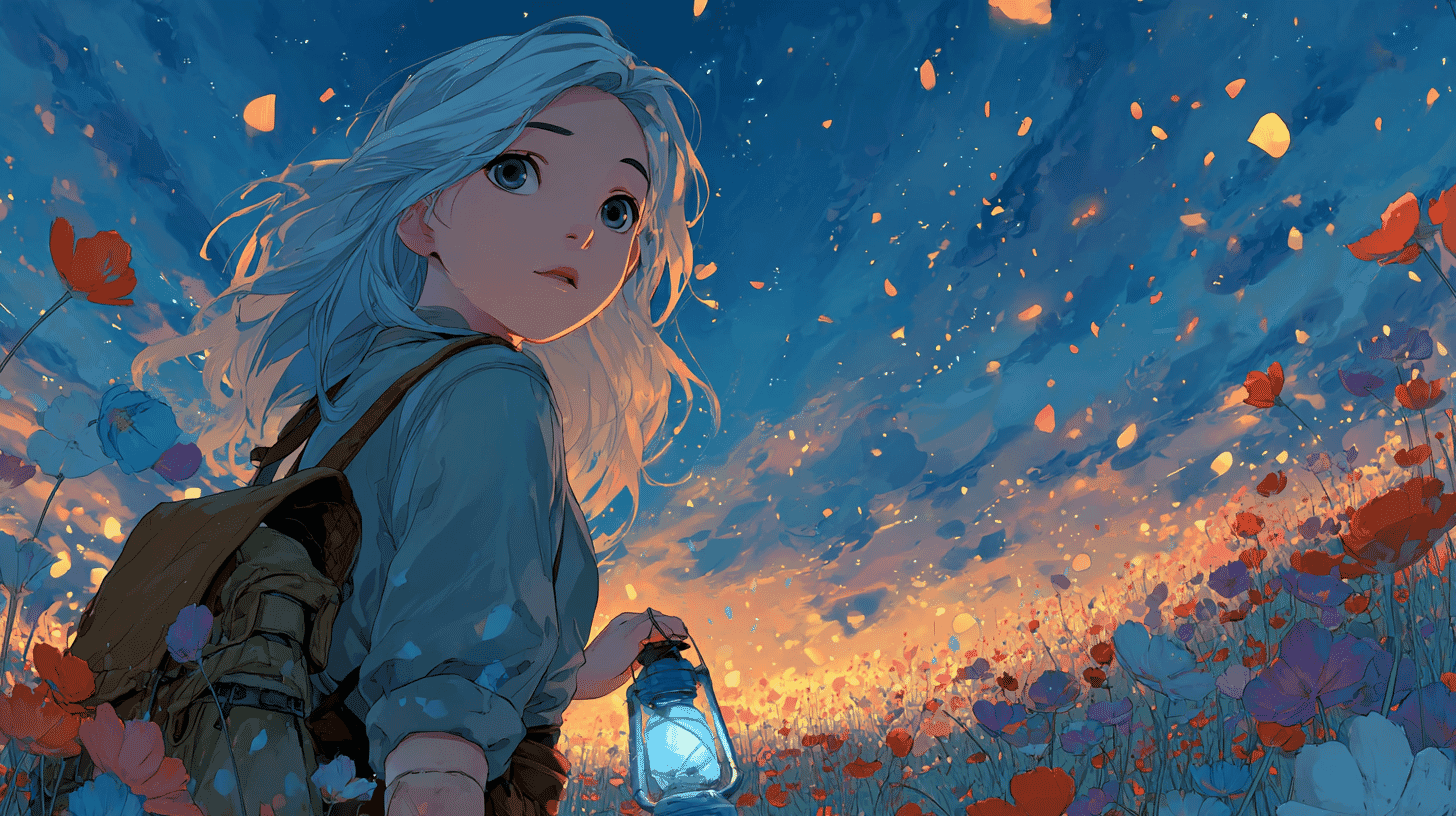
You might not expect an anime theme sequence to hide this much. Japanese fans have been arguing over a reading in which the opening and ending of Frieren season 2 are actually one continuous piece: the colors of the petals standing in for the memories of her companions, the blue flame in the lamp standing in for something else entirely. Here is the debate as it is playing out in Japan, arguments over the songs included.
Two Theme Songs, One Shared Theme
Frieren: Beyond Journey's End Season 2 began airing on January 16, 2026, on Nippon Television's "Friday Anime Night" slot. The opening theme, "lulu." by Mrs. GREEN APPLE, and the ending theme, "The Story of Us" by singer-songwriter milet, have both drawn intense fan scrutiny, not just as individual songs, but as a connected pair.
Mrs. GREEN APPLE vocalist Motoki Omori, a self-proclaimed fan of the original manga, described "lulu." as a song about "lives, treasures, memories, and wills being passed from one person to another, connecting today to tomorrow, with the strength to move forward while holding your homeland close to your heart." Meanwhile, milet, returning from Season 1's ending theme "Anytime Anywhere", said she wrote "The Story of Us" with the wish that "every step forward, every pause, and every moment of looking back has meaning," hoping the song could serve as a kind of "protective charm" for listeners.
What's fascinating is how these two songs don't compete but complement each other. Japanese analysts note that "lulu." illuminates the present moment of carrying forward what was inherited, while "The Story of Us" affirms the hesitations and reflections within that journey. In other words, the OP and ED together form a complete picture of time as Frieren understands it.
Decoding the Flower Petals in the Opening
The most discussed visual element among Japanese fans is the flower petals in the OP sequence.
The opening sequence was storyboarded and directed by Tomoya Kitagawa, who also directs season 2 itself.
In the opening moments, softly glowing petals drift down onto Frieren's open palm. Rather than simple seasonal imagery, fans interpret these as symbols carrying the memories of her journeys, particularly with the hero Himmel. The uniformity of petal colors in the early frames is seen as an abstraction of Frieren's millennia of farewells, designed so viewers might project their own experiences of loss onto the imagery.
The truly revealing moment comes near the end of the sequence: Frieren's palm already holds blue-tinged petals, and then red and purple petals join them. Fan consensus interprets blue as representing Himmel, purple as Fern (Frieren's apprentice), and red as Stark (the young warrior). This visual layering suggests that memories don't exist in isolation, multiple timelines fold together into a single present.
This reading transforms "lulu." from a song about Himmel's perspective into one about Frieren's current state: someone carrying inherited feelings as she walks forward. The lyrics reinforce this, with phrases about warmth that lingers and someone who is always present behind one's eyes.
The Blue Flame in the Ending: Himmel's Undying Feelings
The ED sequence introduces its own key symbol: a blue flame inside a lantern.
The ending opens with what appears to be Himmel writing in a diary. The blue of his quill pen transforms into a blue flame that settles into Frieren's lantern. Scientifically, blue flames burn hotter than red ones despite appearing calmer, a detail fans believe is intentional. The blue flame is read as symbolizing both quiet remembrance and the intensity of Himmel's feelings, which haven't faded despite the passage of time.
The lyrics of "The Story of Us" support this reading, containing language about wanting to protect someone, about bravery, and about traces left behind. The flame, then, represents a "trace" (or holy trace, as the lyrics put it), evidence that what was shared hasn't disappeared.
The "Hands" That Connect OP and ED
When fans watch both sequences together, a shared motif becomes clear: hands.
In the OP, Frieren's hand receives petals. It's the hand of someone who carries what was given to them. In the ED, Himmel's hand writes. It's the hand of someone leaving behind memories and feelings. The hand that moves forward and the hand that records, together, they restate what Frieren has always been about: memory isn't something locked in the past but something passed from person to person, changing form while continuing to shape the present.
This connection is reinforced by the anime-edition CD jacket for "The Story of Us," which depicts Frieren walking among scattered petals, looking back to see Himmel smiling. The petals echo the OP's imagery, suggesting the official artwork itself bridges the two sequences.
The "lulu." Controversy: Why Mrs. GREEN APPLE Divided Fans
The OP artist selection sparked one of the most heated debates in the Japanese anime community this season.
When Mrs. GREEN APPLE was announced as the Season 2 OP artist, social media immediately erupted with criticism. The main complaint: Mrs. GREEN APPLE's pop-forward, stadium-scale sound didn't match Frieren's quiet, melancholic atmosphere. Many fans pointed to Season 1's second OP, "Haru" by Yorushika, as the gold standard, a track whose gentle, literary quality felt perfectly married to the show's tone. "Mrs. GREEN APPLE is too loud for Frieren," was a common refrain. Others went further, accusing the choice of being commercially motivated rather than artistically driven.
However, defenders were equally vocal. "If you actually watch the OP sequence with the song, the impression completely changes," argued many fans. Some noted that this exact pattern had played out before, YOASOBI's "Yusha" (The Brave) was similarly criticized when announced for Season 1 but became beloved after airing. Music analysts wrote detailed breakdowns showing how "lulu." alternates between light, everyday textures and grand orchestral swells, mirroring Frieren's own structural rhythm of mundane moments punctuated by profound emotional depth.
By the time the show had aired several episodes, the discourse had shifted noticeably. As OP analysis deepened and fans began connecting the petal symbolism to the lyrics, appreciation grew. The "controversy" became a case study in how first impressions of anime theme songs often evolve dramatically once experienced in context.
The Colored Pencil Miracle: ED Animation by Aoume Mimei
One element that has generated near-universal praise is the ED animation, entirely hand-drawn in colored pencil by animation artist Aoume Mimei.
Aoume revealed on social media that the entire ED sequence was created using colored pencils, with each few-second scene requiring dozens of individual illustrations. Her post garnered over 17,000 likes, and she also shared photos of the stacked originals, a striking visual testament to the labor-intensive process behind the dreamlike footage.
In an era dominated by digital animation, this analog approach feels deliberately chosen to represent the texture of Frieren's memories, warm, imperfect, and irreplaceable, like something touched by hand rather than processed by machine. The combination of Aoume's ethereal visuals, milet's vocal and the score Evan Call has written for the series since season 1 has led many fans to call the ED "the weekly highlight" of the show. The music video for "The Story of Us," incidentally, was shot in Prague, a city that looks like it wandered out of Frieren's world.
How Japanese Fans Are Reacting
Japanese fan reactions span a wide spectrum:
The analysis community (known as kousatsu-zei, or "analysis faction") is deeply engaged, debating everything from individual petal colors to the frame-by-frame symbolism of lantern flames. Music-focused fans appreciate how the contrasting textures of Mrs. GREEN APPLE's grandeur and milet's intimacy create a multi-layered emotional frame for Season 2's story.
Casual viewers, meanwhile, push back against what they see as over-interpretation, with comments like "Just enjoy the anime" or "Not everything has hidden meaning." This range of engagement itself reflects the breadth of Frieren's audience, from hardcore manga readers to viewers who simply love a good story.
What's remarkable is how Frieren continues to generate this level of discourse not through shock value or plot twists, but through quiet visual and musical craft. The fact that fans are writing essays about petal colors in an OP sequence speaks to the extraordinary care the production team brings to every element.
Do anime fans in your country analyze OP and ED sequences this deeply? Does your culture have a tradition of reading hidden meaning in animation? We'd love to hear your perspective, share your thoughts!


Global Discussion
15 comments