
🐧 JR East asked the public to choose who replaces the Suica penguin. Within hours, the answer that kept coming back on Japanese social media was: none of the above. Roughly 58% of posts mentioning the penguin skewed negative. That number is real, and it is also almost certainly temporary, because Japan has run this exact play before.
Japan looked at three candidates and asked for the penguin back
At 3 p.m. on September 8, 2026, East Japan Railway Company published three draft candidates for the character that will front Suica, the tap-to-ride card that has been part of daily life in eastern Japan since 2001. Voting is open on a dedicated site until 11:59 p.m. on September 23. One vote per person, and the company says anyone can take part regardless of age, gender, occupation or nationality, which means you can vote from Manila, Madrid or Milwaukee. The winner gets announced on November 18, the day Suica turns 25. The penguin graduates on March 31, 2027; its successor starts the next morning.
The three are an orange squirrel whose markings run head to tail as one unbroken line, a nod to a railway; a purple rabbit described as listening to the voices around it and leaping toward the future; and an orange character carrying a mole in a shoulder pouch, the idea being that a creature who has only ever seen the underside of soil deserves to see somewhere else.
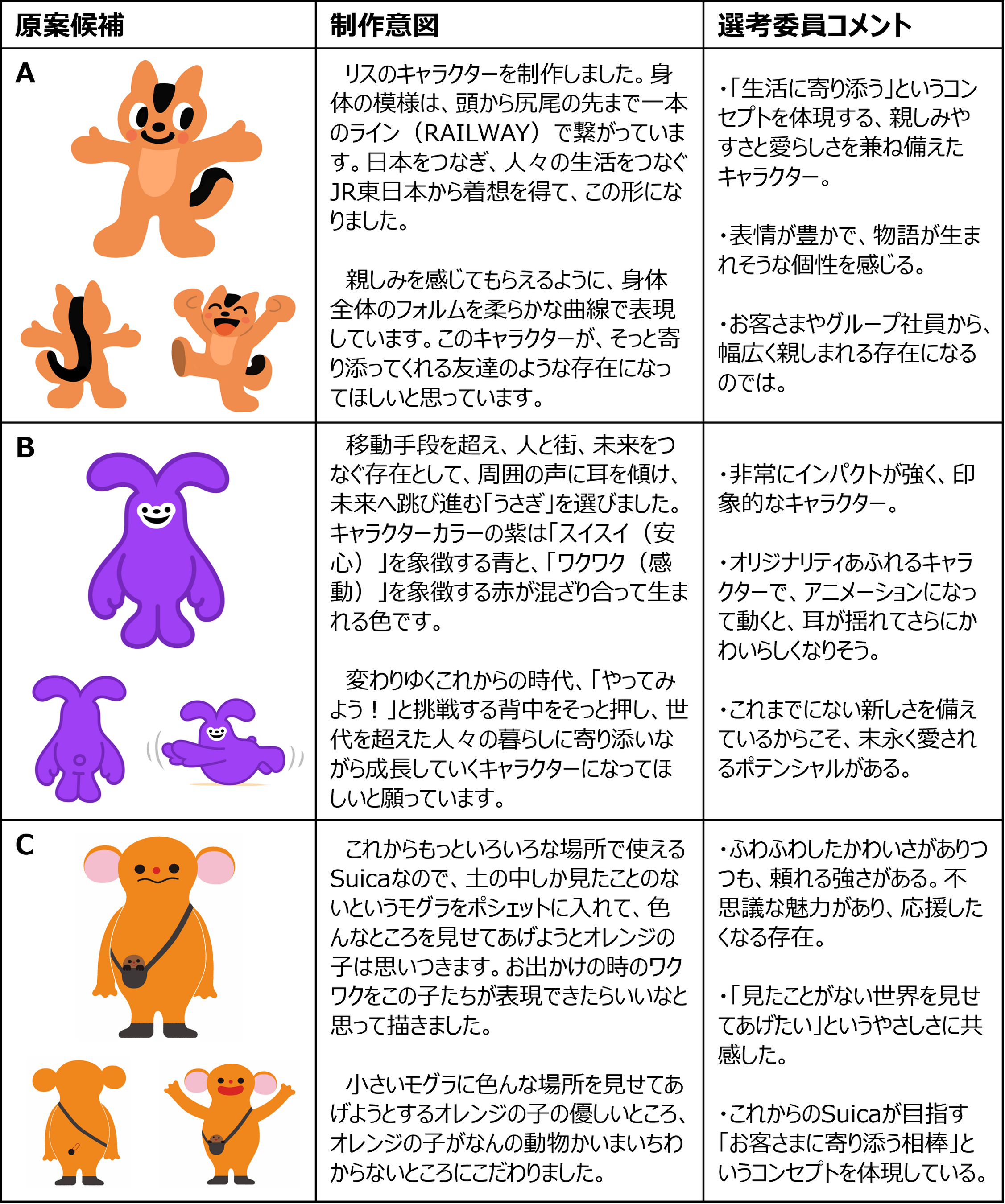
Source: JR East press release
Japan looked at all this and, according to ITmedia, replied with variations on give the penguin back, this fell short, and the current one was fine. ASCII.jp put a number on it: as of 11 a.m. on September 9, about 58% of posts mentioning the Suica penguin on Yahoo Real-Time Search leaned negative.
Each candidate collected a defender for every critic. The squirrel was called dated and cheap by some and the one that fits JR best by others. The rabbit drew both creepy and it does not even look like a rabbit and creepy-cute, very Myaku-Myaku. The mole carrier got looks unmotivated and it is cute once you actually look at it.
The penguin JR East borrowed
The Suica penguin was not drawn for Suica. It came out of a 1998 picture book by illustrator Chiharu Sakazaki, and was pulled into the launch campaign afterward. The copyright line still reads (C) Chiharu Sakazaki / JR East / dentsu, artist first. It has no name, no gender and no strong personality, and that was deliberate. Sakazaki has explained to the magazine Brain that this was the point: it was meant to be a symbol of the person tapping the card, not a character with a life of its own.
That is a hard act to follow, and the brief for the successors seems to run in the opposite direction. In JR East's own announcement, committee chair Kundo Koyama says the panel asked whether a character could stay loved for a long time, whether it carried enough diversity to reach a wide range of people, and whether you could imagine a rich story for it. Each of the three candidates arrives with a little story attached. The penguin's whole trick was that it had none, so anyone tapping through a gate could project whatever they wanted onto it.
Why change at all? JR East frames it as part of Suica Renaissance, its push to turn Suica from a device for travel and small payments into a device for daily life. By figures compiled by nippon.com, roughly 120 million Suica had been issued as of the end of October 2025, accepted at about 2.18 million shops, with a single-day record of about 11.83 million taps in July 2025.
Why nobody trusts the vote
The suspicion running under the disappointment is that the vote is theater. Posts calling it a fixed race started appearing within a day, and they are not paranoid so much as experienced.
In 2018, JR East ran a public naming contest for a new Yamanote Line station. It received 64,052 entries. First place, with 8,398 votes, was Takanawa. The name JR East announced on December 4 that year was Takanawa Gateway, which had finished 130th with 36 votes. The company explained it had a selection committee and a vision about international gateways. The public heard something else, and nearly eight years later it still remembers.
This time the wording is tighter. The official page states that the candidate with the most votes becomes the new character. Whether that sentence holds is what a lot of people are actually voting on.
Japan hated Myaku-Myaku too
That 58% reads like a verdict. It is closer to a first reaction.
When the mascot for Expo 2025 Osaka Kansai was unveiled, people on the street in Osaka called it gross, scary and too much of a joke. It was a ring of eyeballs on a blue-and-red blob. By the time the Expo actually opened, Myaku-Myaku was a phenomenon. A goshuin stamp book, a product where 100 copies a month counts as a hit, sold more than 7,000 in under two months. An associate professor at Kyoto Saga University of Arts, speaking to Kansai TV, argued that it worked precisely because it ignored the yuru-kyara rulebook of infant proportions and enormous eyes.
The same thing appears to be starting already. Fan art of Candidate B, the purple rabbit, began circulating almost immediately, and one widely shared post called it the Inochi no Kagayaki phenomenon, after Myaku-Myaku's original name. People who mocked the rabbit on Tuesday were drawing it on Wednesday. Whatever the 58% means, it is not stable.
Your last year with the penguin
The penguin's own pilgrimage site is Pensta, a shop given over entirely to Suica penguin goods, inside the ticket gates on the third floor of JR Ueno Station, open 9 a.m. to 9 p.m. and until 10 p.m. on Fridays, with a cafe area attached. Expect gaps on the shelves. When the graduation was announced on November 11, 2025, JR East's online store hit a queue of 3,000 people the same night.
JR East is also running a send-off program called Penguin Years: a digital stamp rally, a special Yamanote Line wrap, a fan appreciation event, and, into 2027, greeting appearances across the Tokyo area, Tohoku and Shinetsu. The graduation itself is set for March 31, 2027.
Does your transit card have an animal?
This is not a Suica quirk. Japan's IC cards are a small zoo. ICOCA in western Japan has Ico-chan, a platypus. SUGOCA in Kyushu has a frog. TOICA around Nagoya has a chick. Kitaca in Hokkaido has an Ezo flying squirrel. Fukuoka's nimoca has a ferret. Switching regions in Japan means switching animals.
Which is why the argument over the three candidates is not really about whether the drawings are any good. A quarter of a century of tapping through a gate with the same small bird on the card turned a payment product into something people feel about.
Pull out whatever card gets you onto your bus, metro or train. Is there an animal on it? And if your operator announced tomorrow that it was retiring the design, would anyone in your city notice?
References
- https://www.jreast.co.jp/press/2026/20260908_ho01.pdf
- https://www.jreast.co.jp/suica-new-character-vote/
- https://trafficnews.jp/post/706943
- https://www.itmedia.co.jp/news/article/2609/08/2000001290/
- https://ascii.jp/elem/000/004/433/4433404/
- https://smhn.info/202609-suica-new-character-vote-b-fan-art
- https://www.j-cast.com/2018/12/04345249.html
- https://www.ktv.jp/news/feature/250606-myakumyaku/
- https://www.nippon.com/ja/japan-data/h02630/
- https://ja.wikipedia.org/wiki/Suica%E3%81%AE%E3%83%9A%E3%83%B3%E3%82%AE%E3%83%B3
- https://www.advertimes.com/20251111/article521499/
- https://www.ecute.jp/ueno/shop/4481
- https://j-town.net/2025/11/12365793.html
- https://sumaholife-plus.jp/life/48807/








Global Discussion
3 comments