
🌑 The Moon has almost no air, which makes living there hard. A team in Osaka wants to turn that emptiness into a tool. Researchers at the University of Osaka and Kindai University heated an iron oxide mineral to 1,200°C in a hard vacuum and drew oxygen out of it without melting it. From 1 gram of mineral they got 0.03 grams of oxygen. That is a tiny amount, but the process consumes nothing that has to be shipped from Earth: no hydrogen, no carbon, no electrolyte.
What the experiment actually did
Japanese headlines on October 22 said the team had made oxygen from "Moon sand." That is not quite it. The paper, published in Scientific Reports on September 15, 2026, used no lunar soil and no simulant. The team pressed reagent powders into pellets about 1 centimeter across: hematite (Fe2O3), a red iron oxide, and fayalite (Fe2SiO4), the iron-rich member of the olivine family, which does occur in lunar soil. The authors note that hematite is only a minor phase on the actual Moon. They picked it because its chemistry is simple and it gives up oxygen easily.
Each pellet went into an electric furnace hooked up to vacuum pumps that brought the pressure down to about one hundred-millionth of an atmosphere. At 1,200°C, the hematite began to release oxygen gas. A mass spectrometer read 50 to 100 times more oxygen than in the same chamber with no sample inside. After about an hour and a half, the red pellet had turned dark grey. X-ray analysis showed it had been completely reduced to magnetite (Fe3O4), an iron oxide that holds less oxygen. The 1-gram pellet had lost 0.03 grams (30 milligrams) of oxygen, and it stayed solid the whole time.
Fayalite was messier. At the same pressure it melted at 1,330°C, and the team confirmed oxygen release from it at 1,500°C.
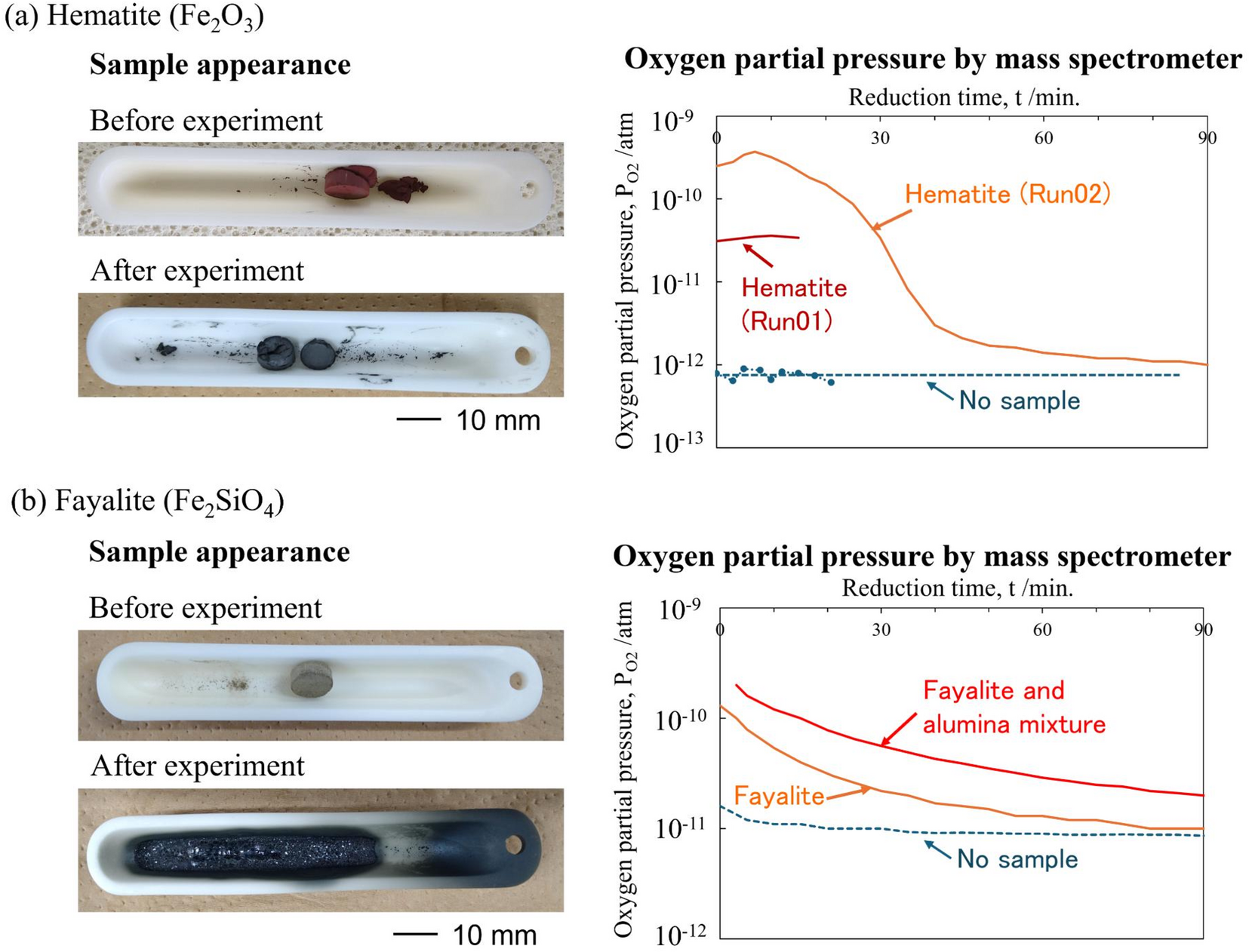
Source: Suzuki et al., Scientific Reports (2026), CC BY 4.0
Hematite is about 30% oxygen by mass, so those 30 milligrams are roughly a tenth of the oxygen in the pellet (our arithmetic, not the paper's). Going further, down to metallic iron, needs a much stronger vacuum than the lab could produce.
A vacuum the Moon already has
Heat a metal oxide and drop the surrounding pressure low enough, and the oxide starts shedding oxygen on its own. The team's thermodynamic calculations say this works far better at one quadrillionth of an atmosphere, a pressure the paper describes as comparable to the lunar surface. Under those conditions, they predict, the iron in Moon-like soil would reduce all the way to metal and release oxygen between 1,050°C and 1,300°C, before the soil melts. For a model soil based on the average composition of Apollo 17 samples, the calculation gives about 15 grams of oxygen per 100 grams of soil.
On Earth, a vacuum like that takes heavy pumping. On the Moon it is already there.
Heating lunar soil in a vacuum is not a new idea. Earlier "vapor pyrolysis" concepts push the soil above 2,000°C until it vaporizes completely. The Osaka and Kindai group wants to stay below 1,500°C and keep the minerals solid. As the paper points out, melting and sintering shrink the surface area through which oxygen can escape.
The paper also sketches how this might run on the Moon. A wide Fresnel lens would concentrate sunlight into optical fibers aimed at the ground. A ceramic membrane known as a solid electrolyte, driven by a small voltage, would then pump the released oxygen into a habitat. By the team's estimate, a collector 11 meters on each side could deliver 100 kilowatts and heat 8 kilograms of soil to 1,450°C in 100 seconds. So far only the optics have been tried: on the ground, a 2-by-2-meter Fresnel lens melted a spot on a stainless-steel plate.
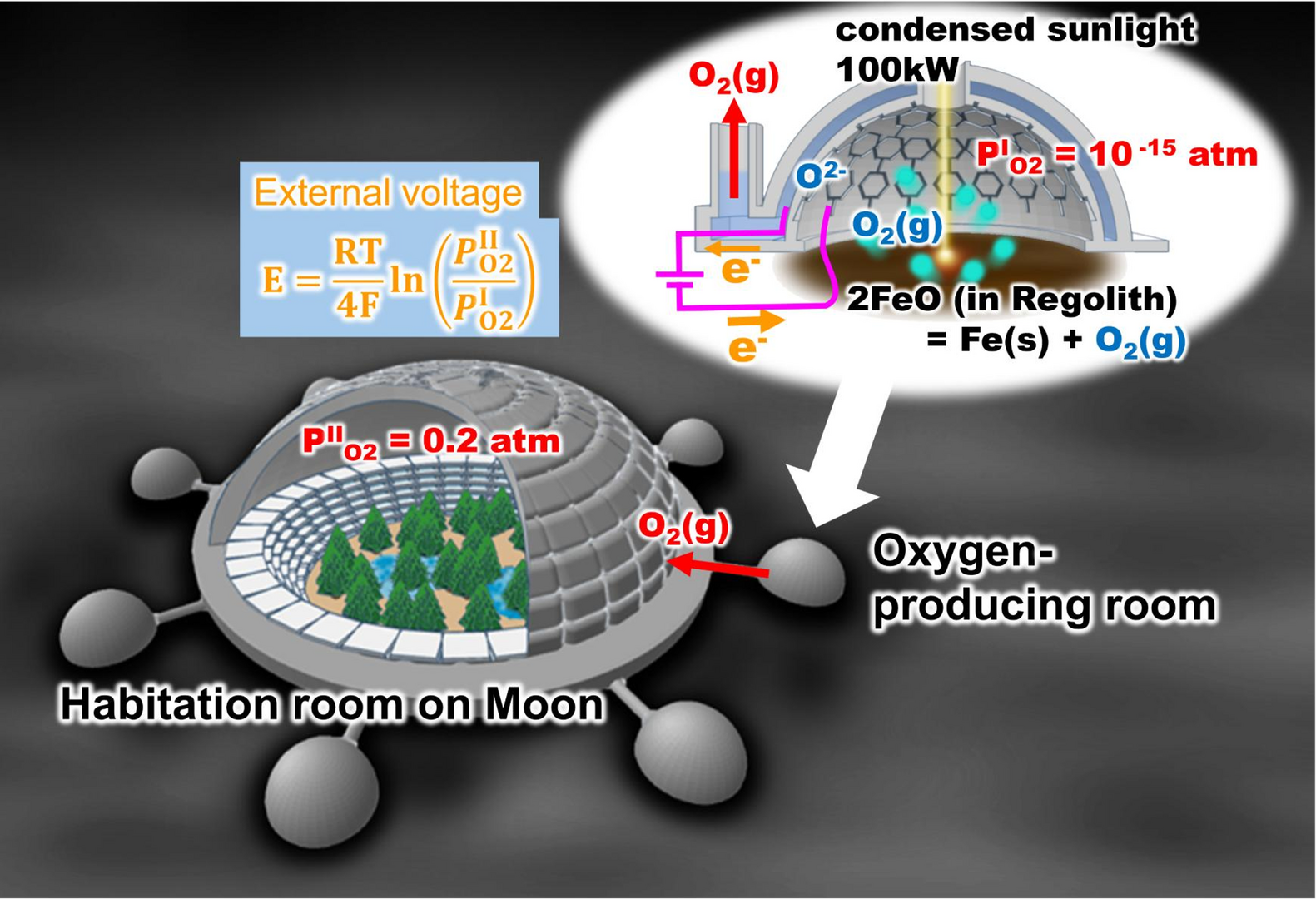
Source: Suzuki et al., Scientific Reports (2026), CC BY 4.0
One problem, several recipes
Oxygen makes up 40 to 45% of lunar soil by weight, according to the European Space Agency (ESA).
| Method | How it works | What it needs besides soil and energy | Notable result |
|---|---|---|---|
| Hydrogen reduction | Hydrogen strips oxygen from iron oxide as water, which is then split | Hydrogen brought from Earth to get the cycle going | Reacts only with the iron oxide in the soil |
| Carbothermal reduction | Carbon reacts with hot soil to make carbon monoxide, later turned into oxygen | A carbon reactant | NASA's CaRD prototype confirmed carbon monoxide production using concentrated sunlight (February 2026) |
| Molten salt electrolysis | Solid soil sits in molten calcium chloride at 950°C while a current pulls oxygen out | A salt electrolyte and plenty of electricity | ESA, using a process scaled up by the UK's Metalysis: 96% of the oxygen in simulant extracted over 50 hours |
| Molten regolith electrolysis | Soil is melted at 1,600–2,000°C and electrolyzed directly | Large amounts of electricity; the melt is corrosive | Ground tests only |
| Vacuum reduction (this study) | Heated minerals shed oxygen into a hard vacuum, ideally while staying solid | Heat and vacuum only | 0.03 grams from a 1-gram hematite pellet; soil tested only in calculations |
On yield, ESA's molten salt result is far ahead, and it used regolith simulant rather than a pure test mineral. The vacuum method's advantage is a shorter supply list, and the next round of experiments will have to show whether that makes up the difference.
None of these methods has made oxygen on the Moon yet. The nearest real-world precedent is on Mars, where NASA's MOXIE instrument made 122 grams of oxygen from atmospheric carbon dioxide between 2021 and 2023, enough for a small dog to breathe for about 10 hours. Different raw material, but even that effort, spread over more than two years, added up to grams.
How much soil does one astronaut need?
NASA's life-support design handbook assumes each crew member consumes 0.82 kilograms of oxygen a day. If the team's prediction for Moon-like soil holds (15 grams per 100 grams), that means processing roughly 5.5 kilograms of soil per person per day. At the 3% rate actually measured with hematite, it would be about 27 kilograms. These are our back-of-the-envelope numbers. They ignore losses and the electricity needed to push oxygen through the membrane, which the authors themselves flag as a challenge. Making rocket propellant would take far more.
Nobody has yet tested real or simulated lunar soil at one quadrillionth of an atmosphere; the authors say such experiments are not possible at the present stage, and they list tests with regolith simulant as the next step. Particle size, uneven composition and sintering could all slow the process down.
Japan's road to the Moon
Why Osaka? Hidetoshi Fujii, one of the paper's two corresponding authors, heads the University of Osaka's Joining and Welding Research Institute and its lunar city development research center, which started in May 2025 and became a university-wide body in spring 2026. According to the Nikkan Kogyo Shimbun, the center counts sunlight concentration through optical fibers, and the production of breathable air, among its main research themes. Lead author Masanori Suzuki moved from Osaka University to Kindai University in April 2026, which explains the two institutions on the paper.
Under an agreement signed on April 9, 2024, NASA offered Japanese astronauts two landing opportunities in the Artemis program, in exchange for a pressurized rover that Japan will provide and operate. NASA reshuffled the schedule on February 27, 2026, turning Artemis III into a crewed test in Earth orbit and making Artemis IV the first landing. As of October 21, 2026, NASA was targeting mid-2027 for Artemis III and early 2028 for Artemis IV. No date has been announced for a Japanese astronaut's first steps on the Moon.
Air is only one item on the list. We have also covered a Tohoku University team growing rice in simulated lunar soil. If you were planning a base on the Moon, which would you want made on site first: oxygen, food, or the walls around them?
References
- https://doi.org/10.1038/s41598-026-70347-2
- https://www.esa.int/ESA_Multimedia/Images/2019/10/Oxygen_and_metal_from_lunar_regolith
- https://www.nasa.gov/centers-and-facilities/johnson/sunlight-extracts-oxygen-from-regolith-using-solar-chemistry/
- https://ntrs.nasa.gov/citations/20180001338
- https://aeroastro.mit.edu/news-impact/oxygen-generating-experiment-moxie-completes-mars-mission
- https://www.livescience.com/space/space-exploration/nasa-announces-sweeping-overhaul-of-artemis-return-to-moon-targeting-a-2028-landing-and-a-2027-in-orbit-docking-flight
- https://www.space.com/space-exploration/artemis/when-will-spacex-and-blue-origin-fly-to-the-moon-nasa-reveals-lunar-lander-timelines-and-an-artemis-iii-update
- https://www.mext.go.jp/b_menu/activity/detail/2024/20240409_3.html
- https://newswitch.jp/p/49084
- https://researchmap.jp/eternalblue








Global Discussion
4 comments