🐸 Brown bears live on Hokkaido. Across a narrow strait on Honshu, the bears are Asian black bears. A British naturalist pointed out this break in Japan's wildlife in 1883, and it still carries his name. According to a new genetic study, only one amphibian species is known to live naturally on both sides of that line: a small green tree frog, whose ancestors crossed between 1 and 2.5 million years ago.
A Line Drawn in Water
Thomas Blakiston lived in Hakodate, on Hokkaido, and spent years studying the island's birds. In 1883 he read a paper to the Asiatic Society of Japan arguing that the animals of Hokkaido and those of the main islands had different origins. Hokkaido's bears and wolves resembled Siberian ones, and there were no monkeys on Hokkaido at all. At the suggestion of the seismologist John Milne, the Tsugaru Strait was named Blakiston's Line.
His explanation was geographic. The Tsugaru Strait is deeper than the Mamiya and Soya straits to the north, so, he reasoned, Hokkaido had once been joined to the continent through Sakhalin while the Tsugaru Strait stayed open water. In Japan's national wildlife distribution survey, brown bears appear only on Hokkaido, and Asian black bears only on Honshu and Shikoku.
In the mid-19th century another British naturalist, Alfred Russel Wallace, noticed that the strait between Bali and Lombok separated marsupials from tigers. ABC Science has called the Wallace Line the most famous biogeographical boundary in the world. Blakiston's Line is its smaller northern cousin.
One Frog on Both Sides
For amphibians, the line is especially sharp. Species that came from the north, through Sakhalin or the Russian mainland, stop at Hokkaido. Species of southern or western origin stop at Aomori or Akita, at the northern end of Honshu.
The Japanese tree frog is the exception. It lives on both sides of the strait, and its range covers five countries: Japan, South Korea, China, Mongolia and Russia. Yet salt water kills frogs, and they cannot fly.
The usual view of Japan's amphibians runs one way. Continental species are generally thought to have reached Japan over land bridges during glacial periods, when sea levels were low. When researchers reported in 2016 that the tree frog splits into eastern and western lineages, European researchers argued the movement might have run from the continent into Japan, and there was no consensus.
What the Genes Say
The new study, led by Hiroshima University's Amphibian Research Center, was published in Scientific Reports on September 24, 2026. The corresponding author is Ikuo Miura, a researcher and visiting professor at the center. Christophe Dufresnes of France's National Museum of Natural History, first author of the 2016 study, is among the co-authors, along with scientists in Australia, South Korea and China.
Between 2016 and 2018 the team collected 327 frogs at 100 sites across Japan and South Korea. They read two mitochondrial genes (cytochrome b and 16S rRNA) plus nuclear SNPs, and compared them with sequences already published for other countries.
Their reconstruction runs the other way. The species branched off from its continental relatives about 8.2 million years ago and settled in Japan. Around 5.2 million years ago it divided into an eastern and a western lineage, in the Kinki region of central Japan. Both lineages then went north across the sea. One western branch crossed via Tsushima to the Korean Peninsula around 1.7 million years ago and spread through China, Mongolia and Russia. The eastern lineage crossed the Tsugaru Strait to Hokkaido between 1 and 2.5 million years ago, and later the Soya Strait to Sakhalin.
People could not have carried frogs that long ago. The authors place the crossings in interglacial periods, when temperatures recovered, and describe them as overseas dispersal rather than a walk across dry land. How an animal for which seawater is lethal survived the trip is, the paper says, still an open question.
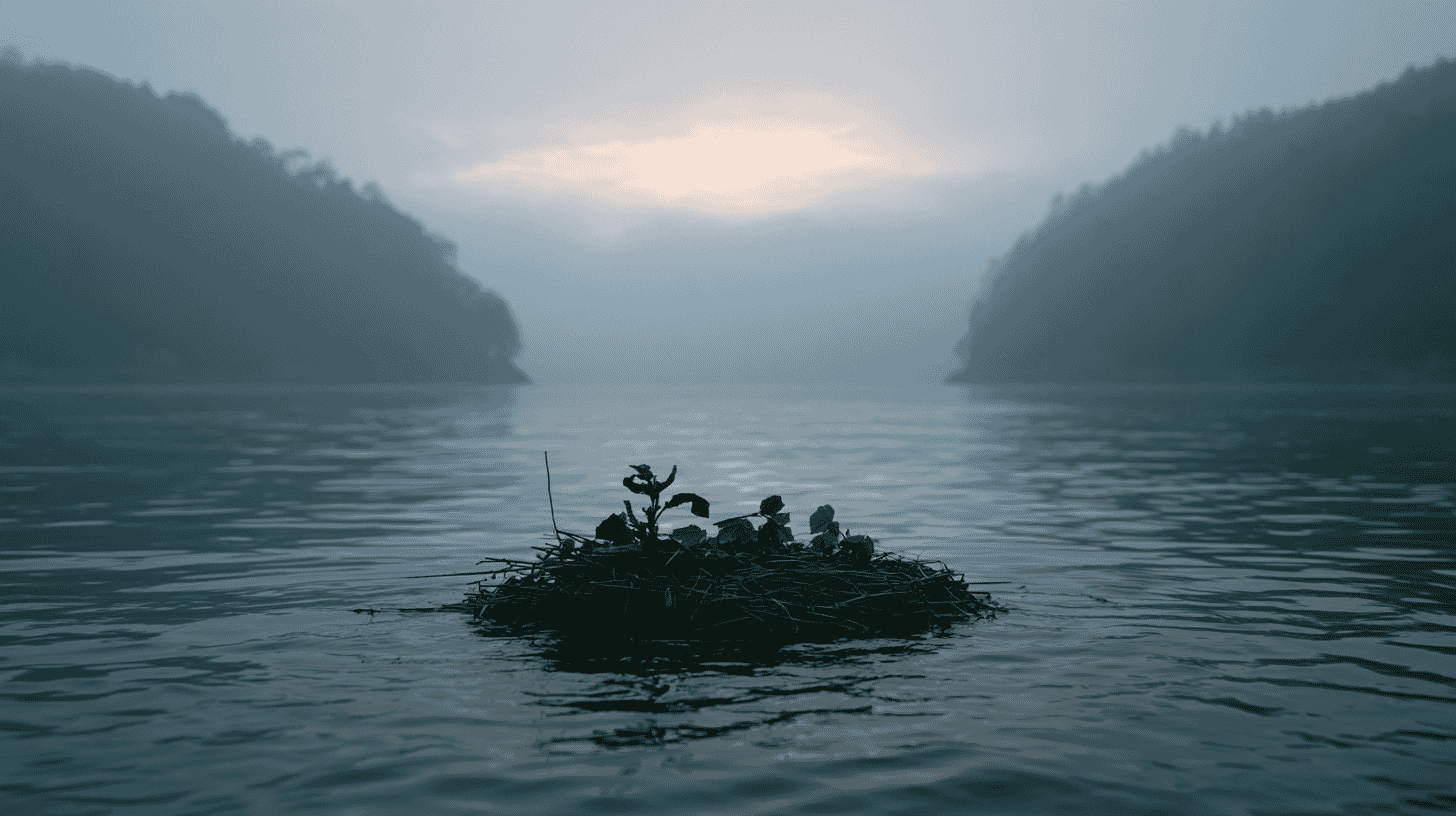
Hiroshima University's press release favors one idea: the frogs rode small floating islands of soil and plants. The species breeds in freshwater pools on the coast, which may give it more chances than other frogs to be swept out to sea, and the team found tadpoles in coastal areas of Yakushima, in southern Japan. The genes give the route and the dates, not the raft.
Which Frog Crossed?
In 2025, a team from Aichi University of Education and Kyoto University described the eastern populations as a new species, the East Japan tree frog (Dryophytes leopardus). They examined 19th-century type specimens collected by Siebold and others and held by the British Museum, and concluded that the western frogs are the original Japanese tree frog. Leopardus refers to the leopard-like spots often seen on the eastern frogs' thighs.
Under that classification, the frog that crossed Blakiston's Line is the East Japan tree frog. The Hiroshima paper still treats both lineages as one species, Dryophytes japonicus, but the university's release notes the new name for the eastern lineage.
The Crossing People Made Easy
Hokkaido now has other frogs from elsewhere in Japan, and they did not arrive on rafts. The Hokkaido government says the Japanese common toad (azuma-hikigaeru) did not originally live on the island and has recently turned up rapidly across it. In December 2015 the prefecture made it a designated alien species under its biodiversity ordinance. The new paper states that no other Japanese amphibian has spread beyond Blakiston's Line except with human help.
The same genetic tools can separate the two kinds of crossing. A study published in August found western lineages in more than 70% of Tokyo's Genji firefly populations, most likely because people moved fireflies while trying to bring them back. There, the genes pointed to people. For the tree frog, they point to a sea crossing more than a million years ago.
For wild amphibians, Blakiston's Line has held with one known exception. For animals that travel with people, it has become far easier to cross.
Where in your country does the wildlife change abruptly, at a strait, a river or a mountain range?
References
- https://www.hiroshima-u.ac.jp/news/100214
- https://doi.org/10.1038/s41598-026-69101-5
- https://academist-cf.com/journal/?p=2970
- https://www.aichi-edu.ac.jp/files/press_20250221.pdf
- https://en.wikisource.org/wiki/Blakiston,_Thomas_Wright_(DNB01)
- https://www.ulethbridge.ca/lib/digitized_collections/ourheritage/index_page_stuff/Following_Trails/Blakiston/Blakiston_Japan2.html
- https://www.env.go.jp/houdou/gazou/5533/6252/2141.pdf
- https://www.abc.net.au/science/archive/articles/2013/11/07/3885420.htm
- https://www.pref.hokkaido.lg.jp/ks/skn/alien/toad/azuma.html
- https://doi.org/10.1007/s10592-026-01833-3







Global Discussion
4 comments