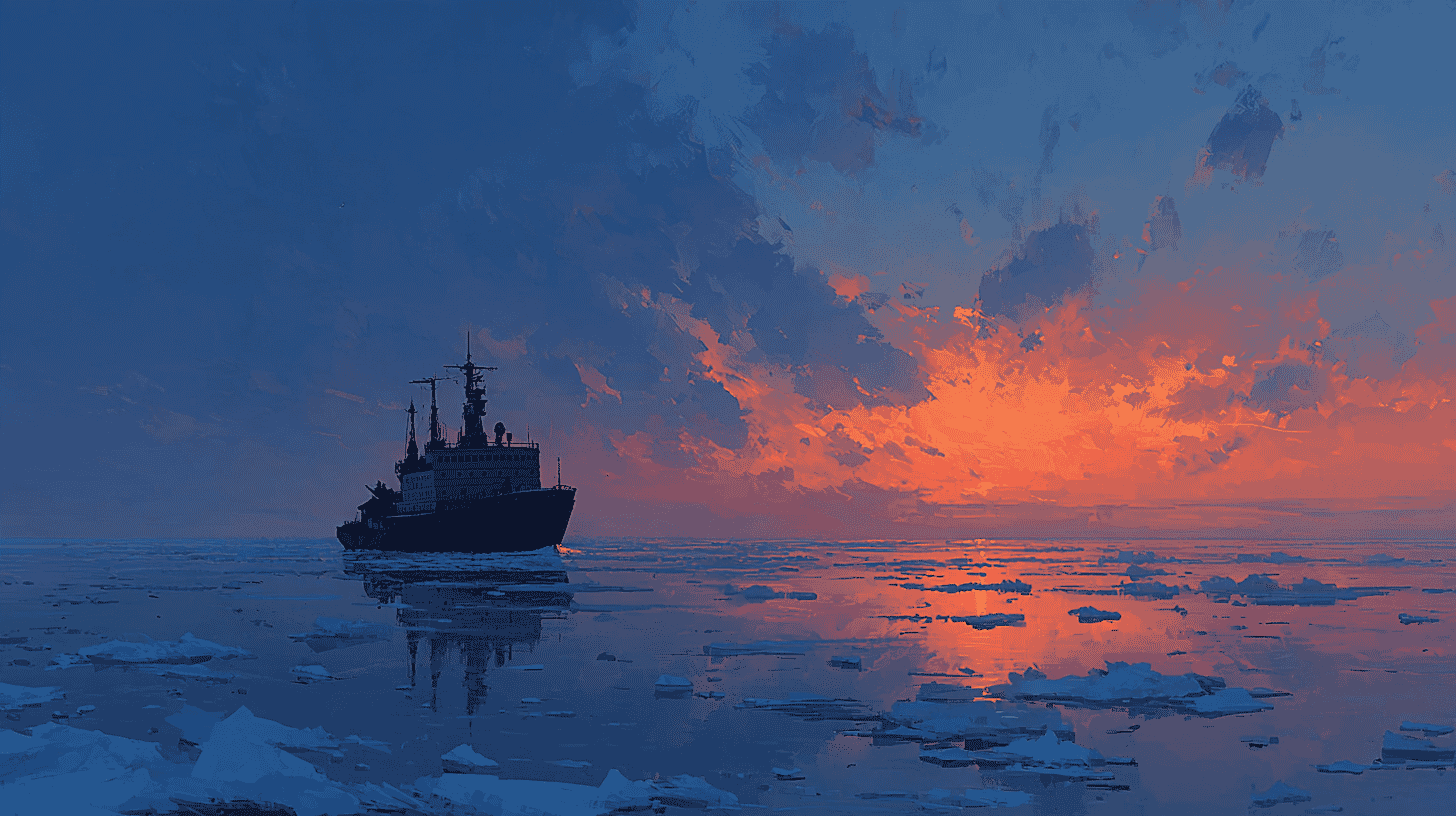
❄️ Deep inside Antarctica, on a rocky peak about 1,600 meters above sea level, the average annual temperature is minus 18 degrees Celsius, and even in summer the daily high does not rise above 0 degrees Celsius. There, on the underside of a yellow lichen clinging to the rock, Japanese researchers found a fungus that dots its host with dark specks just 30 to 70 micrometers (0.03 to 0.07 millimeters) across. They have described it as a new species and given it a name that means "of Antarctica."
"The strongest organism?"
On November 3, 2026, the Asahi Shimbun, one of Japan's largest newspapers, ran the story under the headline "The strongest organism?" The study itself did not measure toughness.
The paper appeared in the journal Polar Research on September 23, 2026. The lead author is Kensuke Tadome, an associate professor at Tokyo University of Agriculture, working with Yoshihito Ohmura of Japan's National Museum of Nature and Science and Satoshi Imura, deputy director-general of the National Institute of Polar Research. It is a taxonomic description. The team examined the fungus under two kinds of microscopes, compared it with specimens of related species held at the national museum, and showed that it matches none of them. It did not test how much cold or drought the fungus can take, and there was no DNA analysis.
Antarctica's tally of lichenicolous fungi stands at about 100, but most of those records come from the Antarctic Peninsula and nearby islands, where the sea keeps things milder, with an annual average of minus 3 to minus 1 degrees Celsius. At the new species' home, winter lows can reach minus 36 degrees Celsius.
A partnership with a lodger on top
A lichen looks a bit like moss, but it isn't a plant. It is a fungus and an alga (or a cyanobacterium) living together as a single body, and it is classified among the fungi, alongside mushrooms. About 20,000 lichen species are known worldwide, and about 500 in Antarctica.
Some fungi make their home on lichens. These are the lichenicolous fungi, and the paper says more than 2,400 have been reported worldwide. Some damage or discolor their hosts, but only a handful do enough harm to kill the lichen outright. According to the Asahi Shimbun, only a few dozen specialists worldwide study them.
The new species, Lichenosticta antarctica, lives on Candelaria murrayi, a yellow lichen. On the underside of the lichen's body, it forms scattered dark brown to black specks where it produces spores. The spores are teardrop-shaped and about 4 micrometers long, far too small to see. Yet Tadome sensed something was off by touch as early as when he was bagging the samples, according to the Asahi Shimbun.
The reference specimen was collected on January 19, 2020, on Mount Yukidori-toride in the Sør Rondane Mountains. Until this study, only two lichenicolous fungi had been reported from the whole range.
Lichens are tough. Bacteria are tougher
A European team kept the lichen Xanthoria elegans outside the International Space Station for about 18 months, exposed to vacuum, ultraviolet light, and cosmic radiation. Back on Earth, on average about 71 percent of the algal partner and about 84 percent of the fungal partner were still alive, according to a paper published online in 2014.
A 2019 paper summarizing another space station experiment, called BIOMEX, found that, among the organisms tested, some archaea and bacteria were the most resistant. Multicellular life such as the Antarctic lichen Buellia frigida saw cell numbers and vitality drop significantly in Mars-like conditions.
From a Belgian station to eight sites
The fieldwork was part of Japan's 61st Antarctic Research Expedition (2019-20). But the base was not Japan's Syowa Station. It was Belgium's Princess Elisabeth Antarctica station, which sits close to the Sør Rondane Mountains.
Getting around depended on the Dronning Maud Land Air Network, or DROMLAN, an air transport network maintained by 12 countries including Japan. It links South Africa with Antarctica and connects stations and field sites across the continent. In a mountain range roughly the size of Shikoku, the smallest of Japan's four main islands, the team visited eight sites, including Mount Yukidori-toride and Utsteinen, collecting lichens as they went.
Besides the new species, the team identified six other fungi. All six are known species, and the team reports them as new distribution records for inland East Antarctica, although one of them had been tentatively reported from the same mountains in 2014. The researchers say this suggests these fungi can grow in far colder, drier conditions than previously known.
November 8, 70 years ago
On November 8, 1956, Japan's first Antarctic research ship, the Soya, left Harumi in Tokyo with the 53 members of the country's first expedition. November 2026 marks 70 years since then. (Related: Japan's next Antarctic icebreaker moves from the navy to JAMSTEC)
In 2016, the National Institute of Polar Research announced two new yeast species from samples taken on East Ongul Island, home to Syowa Station, and called them the first new fungi in the history of Japan's Antarctic program. Lichens are fungi too, though, and new ones had turned up long before. In 1993, a lichen collected around Syowa Station was reported as a new species, Buellia subfrigida.
As of the October 2026 announcement, the team plans to classify the lichens themselves from the same mountains next. Lichens are not an Antarctic specialty, though. They spread as yellow or gray-green patches over stone walls and tree trunks in ordinary towns, and something may be living on them too. What color are the ones where you live?
References
- https://digitalpr.jp/r/145706
- https://doi.org/10.33265/polar.v45.13045
- https://www.asahi.com/articles/ASVC21JKGVC2UTFL00SM.html
- https://doi.org/10.1017/S1473550414000214
- https://pmc.ncbi.nlm.nih.gov/articles/PMC6383581/
- https://www.nipr.ac.jp/info/notice/20161216.html
- https://doi.org/10.15094/00008798
- https://www.nipr.ac.jp/science-museum/archive/special/ouchi/kikaku2020SPR/pdf/02.pdf




Global Discussion
4 comments