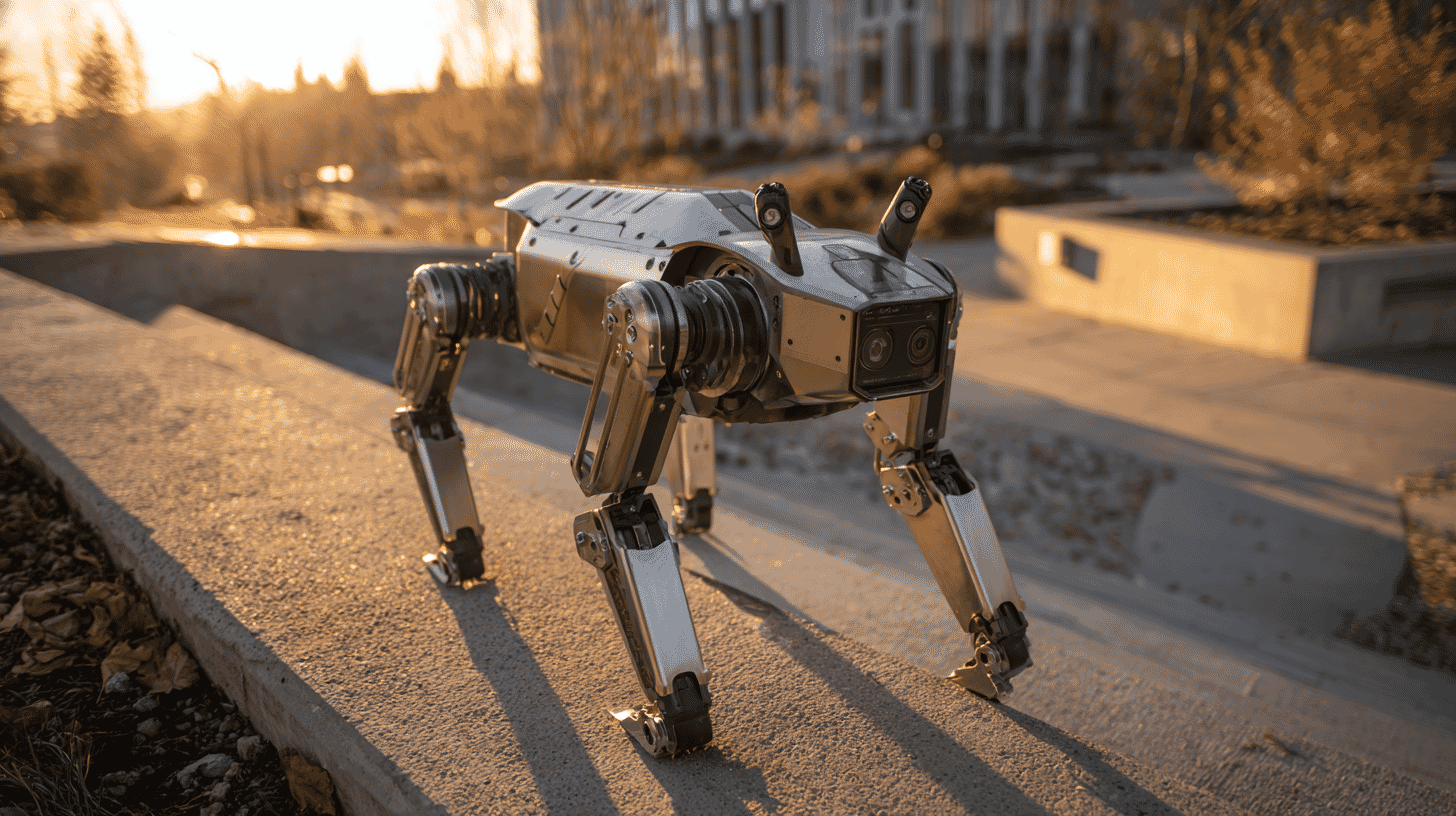
You know Boston Dynamics' Spot, the yellow robot dog that patrols factories and construction sites? It costs $74,500. Add sensors and autonomy software, and you're easily past $100,000. Now imagine a robot the same size, with LiDAR and cameras, that anyone can build from publicly available parts and open-source designs. A team at the University of Tokyo just made that real. Meet MEVIUS2.
A Spot-Sized Robot, Fully Open-Source
In April 2026, a research group led by Lecturer Kento Kawaharazuka at the University of Tokyo's Next-Generation Artificial Intelligence Research Center unveiled MEVIUS2, a quadruped robot roughly the same size as Boston Dynamics' Spot (about 73 cm long and 38 cm wide), with every piece of its design published freely on GitHub.
Open-source quadruped robots aren't entirely new. Projects like Solo and PAWDQ have let hobbyists and researchers build their own four-legged machines. But there's been a persistent problem: most are designed for 3D printing, which keeps them small and structurally fragile. Some metal-bodied alternatives exist, but they too have stayed small and lacked the sensors needed for real-world use.
MEVIUS2 breaks through both limitations at once.
Sheet Metal Welding Meets E-Commerce
The robot's body consists of just 16 unique metal parts. Eleven are machined from A7075 aluminum alloy, the same grade used in aerospace, while the remaining five are A5052 sheet metal components. Three of the largest pieces (the base link, hip link, and LiDAR cover) are fabricated through sheet metal welding, creating strong single-piece structures that dramatically reduce the total part count.
Here's the key: every single metal component can be ordered through MISUMI's "meviy" online machining platform. Upload a STEP file, get an automatic quote, and have your parts delivered. No need for a machine shop, no special connections to a factory. A solo researcher with a credit card and a soldering iron can get started.
Eyes and Ears: LiDAR and HDR Vision
MEVIUS2 carries two Livox Mid-360 LiDAR sensors and one Tier IV C1 HDR RGB camera. LiDAR, the same laser-based sensing technology used in self-driving cars, maps the surrounding geometry in 3D, while the HDR camera captures visual detail even in tricky lighting conditions.
In testing, this sensor suite enabled MEVIUS2 to navigate concrete surfaces, grass, dirt, stairs, steep slopes, rain-slicked steps, and indoor environments. The robot builds elevation maps of its terrain as it walks, a capability that puts it in the same league as commercial platforms costing many times more.
Learning to Walk with Reinforcement Learning
Twelve Robstride03 motors power the robot's legs, and its locomotion policy is trained through reinforcement learning in NVIDIA's IsaacGym simulator. After training, the policy is validated in MuJoCo before being deployed to the real hardware. The entire training pipeline, reward functions, and parameters are included in the open-source release.
This means you don't just get a robot body: you get the complete recipe for teaching it to walk. Researchers can experiment with different terrains, gaits, and behaviors on the same platform.
The Price Question: $74,500 vs. DIY
Spot's base Explorer Kit retails for around $74,500. Add a robotic arm, extra sensors, or autonomy software, and the total can exceed $100,000. For data center security applications, deployments reportedly run from $175,000 to $300,000.
MEVIUS2's exact build cost isn't stated in the paper, but every component is commercially available: sheet metal parts via online fabrication services, off-the-shelf motors, and consumer-grade LiDAR and camera units. Industry observers estimate the total could come in at a small fraction of Spot's price, potentially in the low thousands of dollars for the mechanical hardware alone.
To be fair, Spot is a polished commercial product backed by years of field testing, enterprise software, and a global support network. MEVIUS2 is a research platform. But for labs, universities, and the growing community of robotics hobbyists who want a serious quadruped without a six-figure budget, MEVIUS2 is the first realistic option.
Opening the Door to Robotics for Everyone
The research paper has been published in IEEE Robotics and Automation Practice, and all materials (CAD files, ROS-based software, IsaacGym training scripts, MuJoCo models, and URDF descriptions) are available at github.com/haraduka/mevius2.
In software, Linux and Git transformed how people build and share technology. MEVIUS2 aims to do something similar for physical robots. By choosing sheet metal welding over 3D printing, the Tokyo team moved beyond toy-sized prototypes into machines that can actually handle real-world environments.
Japan has long been a powerhouse in robotics research, but the path from university labs to commercial products has often been rocky. MEVIUS2 takes a different approach entirely: instead of trying to commercialize the robot, it gives the designs away. Improvements and applications won't be limited to a single company or country. Researchers and DIY builders worldwide can modify, extend, and build upon the platform, much like how open-source software projects evolve through global collaboration.
The HackerNews and Reddit robotics communities have already taken notice, and for good reason: a Spot-class quadruped that anyone can build from openly available parts is the kind of project that gets people excited about building things themselves.
How advanced is the open-source robotics scene in your country? Do you see the future in polished commercial robots like Spot, or in open platforms like MEVIUS2 that anyone can tinker with? We'd love to hear your thoughts.







Global Discussion
14 comments