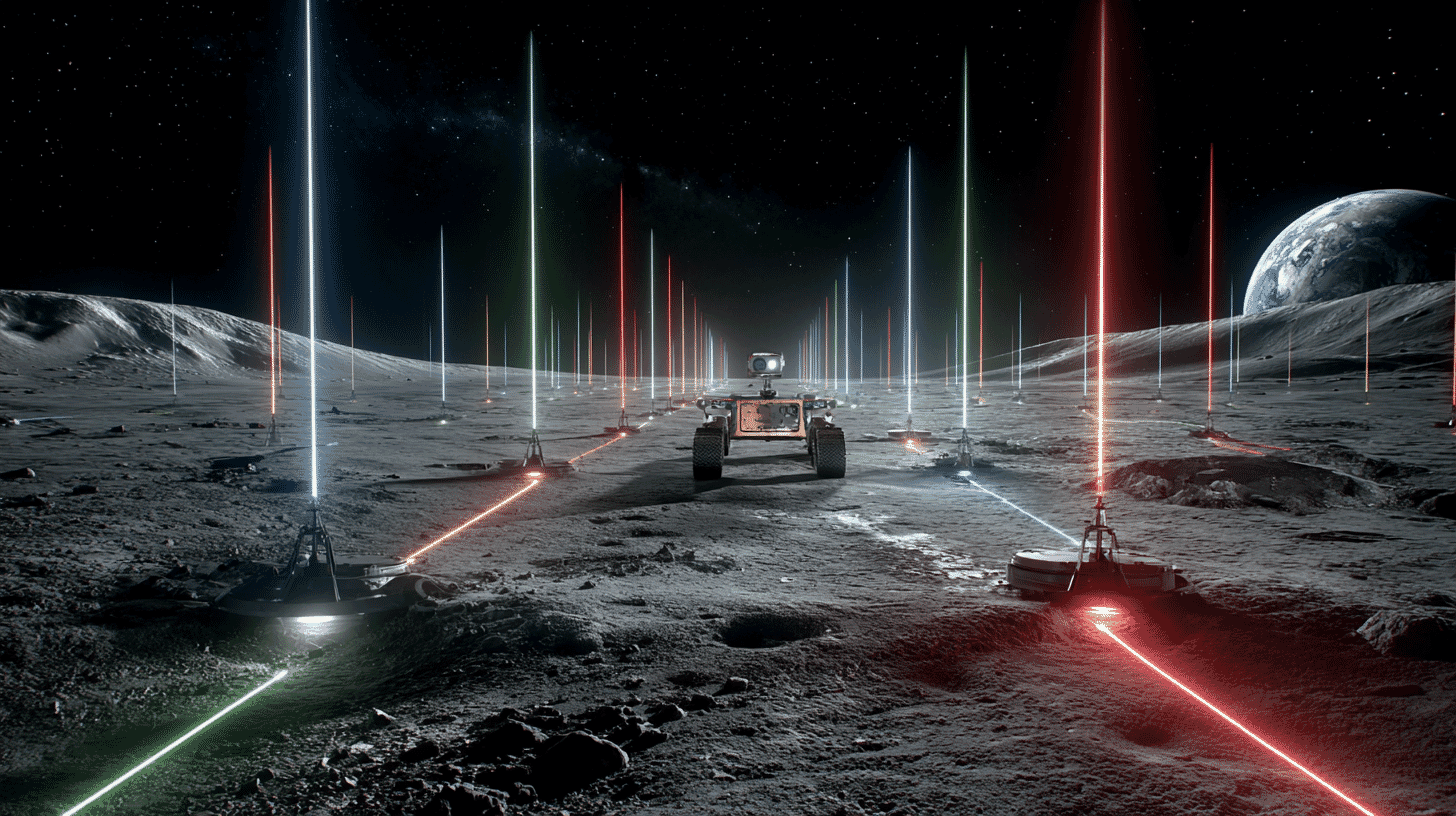
There is no GPS on the Moon, and that simple fact is becoming one of the biggest obstacles in lunar development. On Earth, checking your location on a phone is second nature. The Moon has no GPS satellites, so how do you navigate? Casio and JAXA found the answer in warehouse lighting. Their LED-based positioning system, picalico, has now demonstrated ±5cm accuracy in a simulated lunar environment.
The GPS Problem on the Moon
On Earth, everything from smartphone navigation to drone delivery depends on GPS (Global Positioning System). About 30 GPS satellites orbit the Earth, allowing anyone on the surface to pinpoint their location within a few meters by receiving signals from at least four satellites simultaneously.
The Moon, however, has no such infrastructure. A "lunar GPS" called LNSS (Lunar Navigation Satellite System) is under discussion, but it won't be ready until the late 2030s at the earliest. Until then, robots and crewed vehicles operating on the lunar surface need alternative methods to determine their position.
The Moon's environment makes this even harder. The surface is a monotonous landscape of sand dunes and craters, almost entirely lacking the landmarks, buildings, roads, distinctive terrain features, that image recognition systems rely on for navigation on Earth. And some of the most promising sites for future lunar bases, underground lava tubes and cave systems, are places where even satellite signals can't reach.
From Forklifts to the Final Frontier: What Is "Picalico"?
The solution came from an unexpected source. Casio, the Japanese electronics company better known for G-SHOCK watches and calculators, has sold a positioning system called picalico since 2019, originally designed to track forklifts in warehouses and factories. It became a JAXA joint research theme through the Space Exploration Innovation Hub's sixth call for research proposals.
The concept is elegantly simple. RGB (red, green, blue) LED transmitters are installed at known locations. Each transmitter blinks in a unique color-change pattern that serves as an ID, with about 1.06 million possible combinations. A camera mounted on a moving vehicle captures these blinking lights, and a computer uses triangulation to calculate the vehicle's position. A single camera can simultaneously recognize up to 100 LED transmitters.
Compared to QR code-based positioning systems, picalico has a huge advantage in range. Reading a QR code from 50 meters away would require a code roughly 11 feet (3.3 meters) on each side. Picalico's LED transmitters, on the other hand, only need to be about 4 inches (10 cm) tall, they work as long as at least one pixel of light registers on the camera sensor.
Using visible light instead of radio waves offers additional benefits. It eliminates the need for radio frequency certification, a significant advantage when multiple countries might eventually operate on the lunar surface, potentially creating radio interference issues. And in the Moon's vacuum, with no atmosphere to scatter light, LED signals can travel even farther than on Earth.
Three Experiments, Three Breakthroughs
Casio and JAXA's joint research began in 2021 after picalico was selected through JAXA's Space Exploration Innovation Hub research program. Three increasingly sophisticated experiments have been conducted since then.
Experiment 1 (November–December 2021): The first test took place at a baseball stadium in Sagamihara, Kanagawa Prefecture. The team reimagined the field as a lunar crater and used a tractor as a stand-in for a lunar rover, with 10 LED transmitters placed in the stadium seating. The primary goal was to confirm that picalico, originally designed for indoor use, could function outdoors.
Experiment 2 (January 2023): Moving to the Fukushima Robot Test Field in Minamisoma, Fukushima Prefecture, the team introduced a new 3D positioning algorithm that accounted for elevation changes. This proved that picalico could maintain accuracy even on uneven terrain, the kind of landscape rovers would encounter around lunar craters. The team did face an unexpected challenge: a blizzard that temporarily blocked the LED signals. On the actual Moon, of course, there's no weather to worry about.
Experiment 3 (February 4, 2026): The latest and most sophisticated test was conducted at JAXA's Sagamihara Campus in a dedicated "Space Exploration Field", an indoor facility with simulated lunar regolith (soil) and slopes. The key innovation was a "hybrid approach": instead of relying solely on expensive RGB LEDs, the team tested whether ordinary white LED work lights, the kind that would already be installed at a lunar base, could supplement the RGB transmitters for positioning.
Using 3 RGB LEDs and 9 white LEDs, a camera-equipped rover navigated the simulated terrain. The results were compared against a motion capture system as a precision benchmark.
The results: ±5cm accuracy when stationary, and approximately ±20cm while moving. For perspective, the planned LNSS lunar satellite navigation system initially targets 40-meter accuracy, making picalico roughly 800 times more precise.
Building a Moon That Works: The 1,000-Person Vision
JAXA envisions an ambitious lunar future. According to Kenichiro Maki, the JAXA assistant professor who leads this research theme, Japan's international space exploration roadmap envisions a lunar population of around 1,000 people by the 2050s.
Getting there requires starting small. The initial phase involves just one or two astronauts, gradually expanding the base over time. Picalico is particularly suited to this early stage, a base the size of a tennis court would only need about 20 LED transmitters positioned around its perimeter.
Even after larger radio-based positioning systems are eventually deployed, picalico remains valuable in environments where radio waves can't penetrate, underground lava tubes, deep crater interiors, and other locations where lunar water ice is most likely to be found.
Japan's Lunar Momentum: From SLIM to Artemis
Japan's lunar exploration program has been building impressive momentum. In January 2024, JAXA's SLIM (Smart Lander for Investigating Moon), nicknamed "Moon Sniper," successfully touched down on the lunar surface, making Japan the fifth country, after the Soviet Union, the United States, China, and India, to achieve a soft landing on the Moon. SLIM demonstrated pinpoint landing accuracy within 55 meters of its target, proving Japan's precision landing technology on the world stage.
The international lunar race is accelerating. NASA launched Artemis II on April 1, 2026, sending four astronauts around the Moon for the first crewed lunar mission since Apollo 17 in 1972. The crew flew past the far side and splashed down in the Pacific on April 11, setting a record for the farthest humans have travelled from Earth at roughly 406,771 km. They did not land.
Artemis III was originally to be the first crewed landing. In February 2026, NASA restructured the program, redesignating Artemis III as a lander test in low Earth orbit. That moves the first crewed lunar landing to Artemis IV, targeted for 2028. Japan is deeply embedded in this program: under an April 2024 agreement, Japan will provide a pressurized lunar rover (the "Lunar Cruiser," co-developed by JAXA and Toyota) in exchange for guaranteed lunar surface landing opportunities for two Japanese astronauts. If realized, they would become the first non-Americans ever to walk on the Moon.
Picalico could serve as essential infrastructure supporting these crewed missions. While astronauts in spacesuits have limited activity windows, the pressurized Lunar Cruiser allows crews to travel for up to 28 days without suits. Precise positioning during such long-range expeditions is critical for both safety and efficient exploration.
Why a "Watch Company" Is Building Lunar Infrastructure
Most people associate Casio with wristwatches, calculators, and electronic keyboards. But the company has been researching visible light communication for over two decades, exploring applications from entertainment to industrial use. That picalico, born in Japanese warehouses, is now finding its way to the Moon speaks volumes about the depth of Japan's manufacturing technology ecosystem.
Casio's development team emphasizes the system's practicality: the cameras, computers, and LED lights used in picalico are all compact, commercially available components. Since the cost of transporting equipment to the Moon scales dramatically with weight, this small footprint is a major advantage.
Importantly, this isn't just a space story. Picalico continues to serve Earth-based applications, tracking forklifts in warehouses, monitoring automated guided vehicles in factories, and operating in any environment where radio signals are unreliable. This "dual use" approach, space technology benefiting terrestrial industry and vice versa, exemplifies the philosophy of JAXA's Space Exploration Innovation Hub.
Placing "rulers made of light" across the lunar surface, Casio and JAXA's partnership demonstrates how Japan's engineering creativity can open new frontiers in space development. In a world without GPS, light might just become the ultimate guide.
In Japan, the idea of adapting warehouse tech for the Moon has captured the public imagination. What surprising technologies from your country could find a second life in space? We'd love to hear your thoughts!








Global Discussion
15 comments