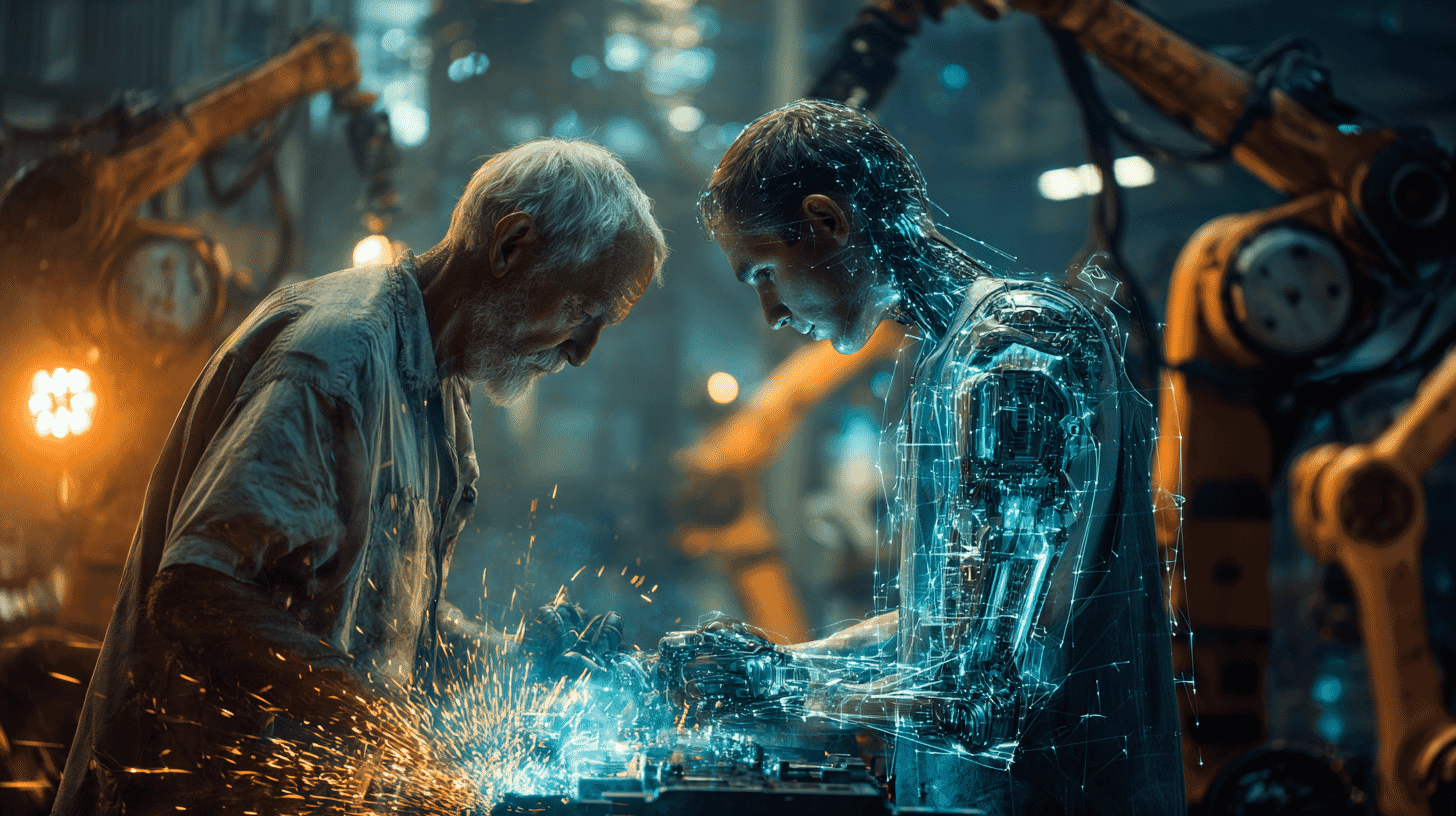
🏭 What if the irreplaceable skills of master craftsmen could live on forever through AI? Hitachi is betting big on "Physical AI"—a $140 billion market opportunity by 2030. As Japan faces a severe labor shortage and an aging workforce, this technology could be the key to preserving decades of manufacturing expertise. Here's how one company's unique combination of IT, OT, and products positions it to lead the next wave of AI innovation.

What Is Physical AI?

Physical AI refers to artificial intelligence systems that perceive and understand the real world through sensors and cameras, generating physical actions in response. Unlike traditional AI that focuses on text and image generation, Physical AI excels in real-world applications like robotics control, predictive maintenance, and complex system optimization.

According to Grand View Research, the Physical AI market is projected to explode from approximately $47.1 billion in 2023 to around $124.7 billion (about ¥20 trillion) by 2030. This represents roughly three times the size of the AI agent market.

Hitachi's Unique Vision for Physical AI

Hitachi's Executive Vice President Jun Abe has articulated a clear vision for the company's Physical AI strategy.

"Our goal is to view social infrastructure operations—railways, power, manufacturing—as entire systems, and use AI to optimize everything from skilled workers' tacit knowledge to equipment behavior," Abe explains.

While other companies focus on humanoid robots as "Physical AI technology," Hitachi takes a different approach: supporting people and ensuring the stable operation of social infrastructure. This distinction is crucial to understanding their strategy.

NVIDIA CEO Jensen Huang has recognized Hitachi as a "rare existence," noting that the company possesses all the capabilities needed to create value from data—IT, operational technology (OT), and physical products.

Japan's Manufacturing Crisis: The Tacit Knowledge Problem

Japanese manufacturing faces a structural crisis. According to the Ministry of Economy, Trade and Industry's "Monozukuri White Paper 2025," manufacturing employment has decreased by approximately 1.57 million over the past two decades, with particularly steep declines among workers under 34. Meanwhile, the proportion of workers aged 65 and older continues to rise.

At the heart of this problem lies the extreme difficulty of transferring "tacit knowledge"—the intuitive expertise that experienced workers possess. Consider the skills that master craftsmen develop over decades: sensing temperature changes in metal by color, distinguishing subtle sounds from machinery, finishing work with micron-level precision. These abilities, often described as "instinct, tricks, and experience," resist documentation or standardization.

Making matters worse, over 60% of manufacturing establishments report a shortage of personnel available to train and mentor younger workers.

HMAX: Hitachi's Answer to the Knowledge Crisis

HMAX (Hyper Mobility Asset Expert) serves as the cornerstone of Hitachi's Physical AI strategy. The solution comprises four key elements:

1. Data Collection from Digitized Assets Sensors and control systems gather vast amounts of data from power grids, railways, and manufacturing equipment.

2. Domain Knowledge Integration Over 110 years of operational and maintenance expertise is embedded into AI models.

3. Advanced AI Technology Fusion Multiple AI technologies—perception AI, generative AI, agentic AI, and physical AI—work in concert.

4. Global Partnership Ecosystem Strategic alliances with NVIDIA, Google Cloud, and OpenAI provide cutting-edge capabilities.

Early deployments in European railway systems have already delivered measurable results: 15% reduction in energy consumption, 20% decrease in train delays, and 15% lower maintenance costs.

How Hitachi Captures Tacit Knowledge

Hitachi's "AI Agent Development, Operation, and Environment Service" employs sophisticated methods to transfer expert knowledge to AI systems:

Ethnographic Research Anthropological observation techniques document skilled workers' behavior patterns and decision-making processes in detail.

AI-Assisted Interviews Structured conversations with experts extract knowledge and know-how that has never been articulated.

Linking to Explicit Knowledge The extracted tacit knowledge is combined with formal documentation—forms, design documents, manuals—to create training data for AI.

Within Hitachi Group companies like Hitachi Building Systems and Hitachi Power Solutions, hundreds of business processes already utilize AI. This internal track record enables the company to offer practical, proven solutions to customers.

Aiming to Become the World's Top "User" of Physical AI

Hitachi has declared its ambition to become the "world's top user of Physical AI." Notably, the company has consciously decided not to compete in developing its own large language models (LLMs).

"LLMs will eventually become commodities chosen primarily on price," explains Vice President Abe. "That layer doesn't hold much value for us." Instead, Hitachi positions its century-plus accumulation of social infrastructure domain knowledge as its "greatest asset and strength"—and its "strongest defensive moat."

Conclusion: A New Chapter for Japanese Manufacturing

Physical AI presents a compelling potential solution to Japanese manufacturing's structural challenges of labor shortages and skills transfer. Hitachi's approach stands out for its focus not on replacing humans, but on preserving the wisdom of skilled workers for future generations while ensuring the stable operation of critical social infrastructure.

In Japan, the declining working-age population due to demographic shifts is accepted as an unavoidable reality, and expectations for AI-enabled skills transfer are high. On manufacturing floors, the urgent question is how to digitally preserve the "artisan techniques" that will otherwise disappear as veteran engineers retire.

How is the manufacturing skills transfer challenge viewed in your country? What discussions exist around using AI to preserve and pass on skilled workers' expertise? Please share your thoughts in the comments.

References

Reactions in Japan

Our factory's master craftsman retires next year. If AI can preserve the polishing skills he developed over 50 years, I really hope they do it. We have no successor, and the technique will disappear otherwise.

I agree 0
I disagree 0

They talk about digitizing tacit knowledge, but can they really do it? Intuition and experience are tacit precisely because they can't be verbalized. Sounds a bit like Hitachi marketing speak to me.

I agree 0
I disagree 0

They're talking about a 20 trillion yen market, but won't NVIDIA just profit from it? Japanese companies aiming to be 'users' - isn't this the same pattern of losing the platform to overseas again?

I agree 0
I disagree 0

As someone working in manufacturing, I don't think AI can replace my seniors. But it's true they don't have time to teach. If AI can provide support, that might actually help.

I agree 0
I disagree 0

Hitachi's solution is for large companies. It's probably out of reach for a 30-person factory like ours. Unless they make it accessible to SMEs, Japan's manufacturing industry won't be saved.

I agree 0
I disagree 0

This reminds me of the 2007 problem when baby boomers retired. Skills transfer was a big issue then too, but nothing really changed. Hopefully AI can actually solve it this time.

I agree 0
I disagree 0

A 20% reduction in train delays in Europe is impressive, isn't it? If they use this on Japanese Shinkansen, would on-time performance improve even more? Or is it already good enough lol

I agree 0
I disagree 0

Not entering the LLM development race is a smart decision. Leveraging domain knowledge is where Japanese companies can compete. But there's a dilemma - that domain knowledge is retiring along with senior employees.

I agree 0
I disagree 0

Honestly, being able to ask AI is better than the 'learn by watching me' culture of older workers. When I ask questions, all they say is 'figure it out yourself.'

I agree 0
I disagree 0

Japanese manufacturing craftsmanship is truly amazing. But isn't the inability to teach it a problem with the education system? Before relying on AI, they should train workers to verbalize their knowledge.

I agree 0
I disagree 0

As someone with 40 years of factory experience, what's truly important is understanding 'why we do things this way.' Even if AI learns procedures, it won't handle abnormal situations. Can AI really teach that deep?

I agree 0
I disagree 0

Hitachi's stock is rising on Physical AI news, but actual revenue contribution is still far off. Talking about 2030 market size... buying now feels premature.

I agree 0
I disagree 0

Traditional crafts face the same issue. Lacquerware and sword-making techniques are disappearing due to lack of successors. I hope AI is used not just in manufacturing but in these fields too.

I agree 0
I disagree 0

Using ethnography to observe veteran workers sounds like a documentary. Before AI does it, I want NHK's 'Professional' show to feature this lol

I agree 0
I disagree 0

How will AI-enabled skill transfer affect labor markets? If skills become standardized, wage premiums for skilled workers may decrease. Efficient for society, but complex for individuals.

I agree 0
I disagree 0

Skills transfer is listed as a challenge in the Manufacturing White Paper every year, but government support is too weak. This shouldn't be left to private sector alone - it needs industrial policy.

I agree 0
I disagree 0

Voices from Around the World

Michael Chen

As a Silicon Valley engineer, Hitachi's approach is intriguing. In the US, humanoid robots get all the attention, but optimizing existing infrastructure might have more practical value.

Klaus Hoffmann

This feels similar to Germany's Industry 4.0 direction. The difference is Germany has developed solutions for SMEs (Mittelstand). Digital transformation support for small manufacturers will be key for Japan too.

Sophie Laurent

From French artisan culture, I understand the resistance to transferring skills to AI. In our country too, there's debate about 'optimizing' traditional methods. Balancing cultural preservation with innovation is challenging.

Wang Wei

Chinese manufacturing faces the same challenges. But we focus more on robotics and automation. Hitachi's 'tacit knowledge transfer' approach is interesting as a human-centered perspective.

Priya Sharma

Working at an Indian IT company, I see AI-digitizing Japanese manufacturing know-how as a huge business opportunity. Could become a new form of offshore development.

James Wilson

UK manufacturing has deindustrialized significantly, but there's much to learn from Japan's approach. We lost many industries by neglecting the skills transfer problem.

Maria Garcia

I work in quality control at a Spanish auto plant. We're trying to replace skilled inspectors' visual checks with AI, but replicating the ability to spot subtle defects is really difficult.

Erik Johansson

Sweden has addressed workforce issues through immigration, but skills transfer is different. With ABB acquired by SoftBank, Nordic countries are watching Japan's Physical AI developments closely.

Ahmed Hassan

In UAE, transferring oil industry expertise is a challenge. If Japan's manufacturing technology can be applied to other sectors, there's great opportunity in the Middle East market.

Park Min-jun

Korean semiconductor industry faces the same issue. As competition with TSMC and Japanese firms intensifies, how we retain skilled engineers' knowledge will determine winners.

Roberto Silva

Brazilian manufacturing has learned a lot from Japanese companies. If AI-enabled skill transfer works, that knowledge could be shared more widely. This is an opportunity for emerging markets.

Yuki Tanaka

I'm Japanese living in Australia. Manufacturing is declining here, so seeing Japan's efforts to preserve its monozukuri culture is moving. I hope they succeed.

Anna Kowalski

Poland is growing as Europe's manufacturing hub, but skilled worker development can't keep up. If we could adopt Japan's AI technology, it might help bridge the skills gap.

John Murphy

From a Canadian perspective, Japan's manufacturing challenges are common to developed nations. But choosing 'AI-based tacit knowledge preservation' as a solution is a uniquely Japanese approach.

Linda Nguyen

Vietnam has developed as a manufacturing base for Japanese companies. If their expert know-how remains through AI even after skilled workers retire, we'll benefit too.

Marcus Johnson

Skills disparity is a major issue in South African manufacturing. If AI can 'democratize' advanced country technologies, it could narrow the tech gap with developing nations. Watching closely.