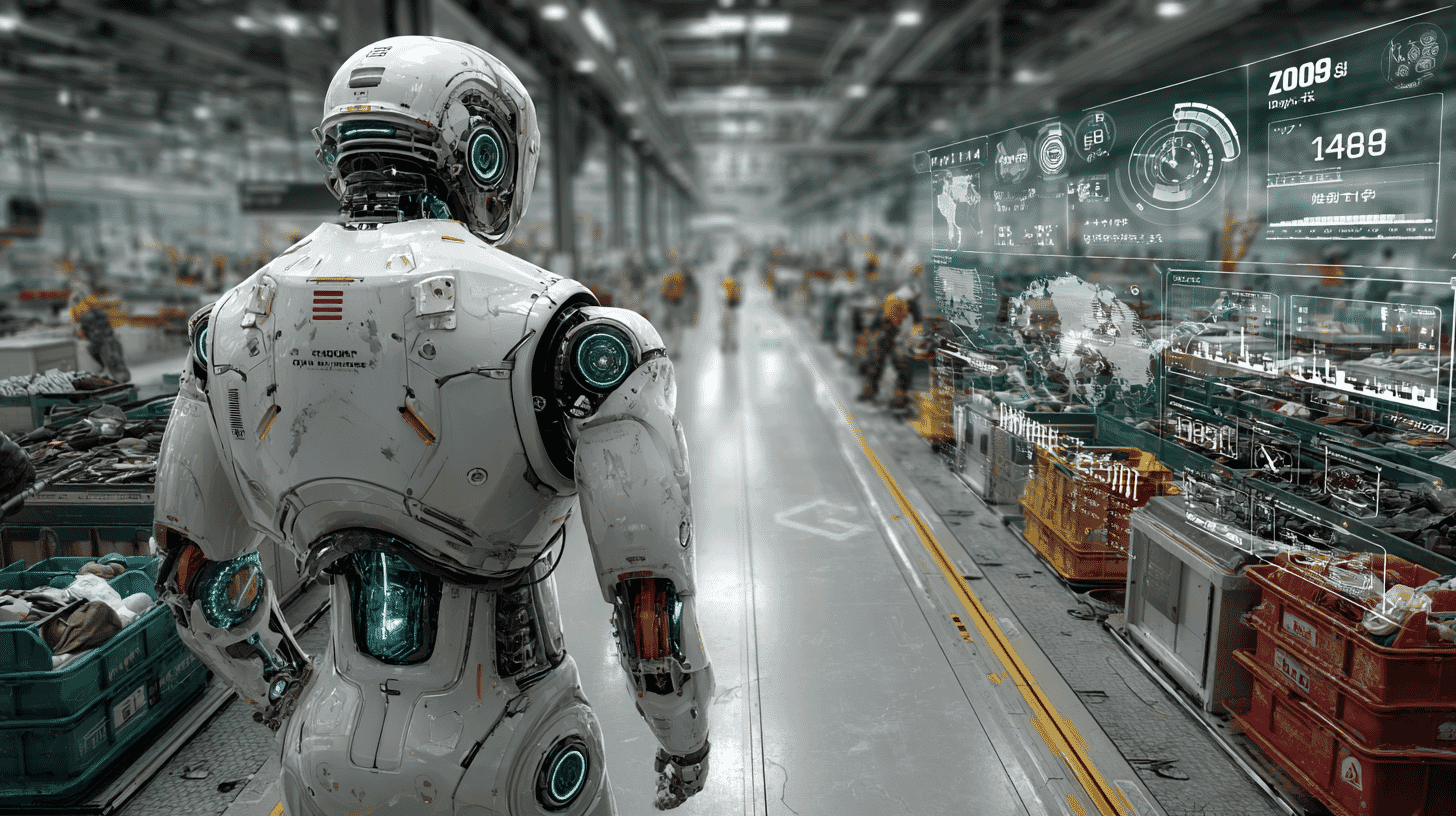
Japan's working-age population has shrunk about 15% from its 1995 peak of 87.26 million to 73.72 million in 2024, and is projected to fall roughly another 30% by 2060. Bankruptcies caused by labor shortages are running at record levels. The government's answer: deploy AI-powered autonomous robots into the jobs nobody wants to fill. Security guards, waste sorters, caregivers. These are the frontlines of Japan's labor crisis, and reinforcements are coming in steel and silicon.
What METI Just Announced
Japan's Ministry of Economy, Trade and Industry (METI) moved in March 2026 to release the roadmap for its "AI Robotics Strategy," a plan to deploy AI-equipped autonomous robots across labor-starved industries by 2030. The initial targets: security and waste management, two sectors where worker shortages have become critical. The strategy was formally adopted on March 26, 2026, by the interministerial liaison conference on AI robotics.
The strategy emerged from the AI Robotics Study Group, established in August 2025 and chaired by Professor Kensuke Harada of Osaka University's Graduate School of Engineering Science. Its members included DENSO, the Japan Robot Association, Waseda University, and other players from academia and industry, and it examined both the supply and demand sides of the problem.
On March 10, 2026, at the Japan Growth Strategy Council chaired by Prime Minister Sanae Takaichi, the government unveiled a draft roadmap for public-private investment in "Physical AI," the term for AI systems that act in real-world physical environments. The ambition: capture over 30% of the global AI robot market and secure roughly $130 billion (¥20 trillion) in market value by 2040, standing alongside the US and China as a third pole.
Why Security and Waste Management First?
The choice of initial deployment sectors reveals Japan's strategic priorities.
Security is plagued by chronic staff shortages and an aging workforce. Night patrols, long hours standing watch outdoors, and physically demanding duties deter younger workers, even as demand for building and public space security keeps growing. AI-equipped patrol robots fitted with cameras and sensors can detect anomalies and alert monitoring centers in real time, and they are already being tested in commercial facilities across Japan.
Waste management epitomizes what the Japanese call "3K" jobs: kitsui (tough), kitanai (dirty), and kiken (dangerous). Manual sorting of construction waste requires expert skills, but the harsh conditions make recruitment nearly impossible. Shitara Kosan, a waste processor in Fukaya, Saitama Prefecture, installed Finnish-made ZenRobotics Recycler units in November 2016, the first AI sorting robots at an industrial waste facility in Japan. Its Sunrise FUKAYA plant reports a 90% recycling rate, roughly six times the throughput of its previous manual line, and fewer workplace injuries.
METI's roadmap starts with sectors that combine high economic impact and high deployment feasibility, then expands in phases. Environmental stability, task complexity, and tolerance for failure were the criteria used to pick 16 domains, security and waste management among them.
The Blind Spot Behind a 70% Market Share
Japanese companies command roughly 70% of the global industrial robot market. FANUC, Yaskawa Electric, and Kawasaki Heavy Industries have long dominated the welding, painting, and assembly robots used in automotive and electronics plants. Harmonic Drive Systems and Nabtesco control most of the world market for precision gear reducers, the "joints" that give robot arms their finesse.
That dominance has a blind spot. China is pushing robot adoption as national strategy, and Japan's share has been drifting down. More seriously, Japan holds barely over 10% of the service robot market, the machines built for use outside factory floors, where the US, Europe, and China are pulling ahead. According to METI's study group materials, the global market for versatile robots including humanoids is expected to expand sharply from around 2030, reaching roughly $400 billion (¥60 trillion) by 2040.
Miss that wave, and even the industrial robotics lead Japan already holds could erode.
Physical AI Changes the Premise
Traditional industrial robots work in controlled environments, repeating pre-programmed movements. AI is dismantling that premise.
"Physical AI" fuses visual, audio, and sensor data so machines can decide for themselves in unpredictable real-world settings. Picture a robot that sees obstacles with cameras, understands spoken instructions, and adjusts on the fly, powered by foundation models known as VLAs (Vision-Language-Action Models).
METI's strategy leans on a shift toward Software Defined Robots, or SDRs, whose capabilities are defined and updated in software much like smartphone apps. Push an update, and a security robot handles a new patrol pattern. That modularity could cut the cost and time of deploying robots into new environments.
The Investment Gap Japan Must Close
The numbers tell a sobering story.
In the US, Tesla invested roughly $4.5 billion in R&D in 2024 alone. NVIDIA has signalled about $500 billion over four years for AI chip manufacturing and robotics development. China is running national-level industrial policy for humanoid robots, with investment in startups climbing fast.
Japan? Government AI investment over the five years through 2023 totalled about $1 billion, less than one-thirtieth of US levels. Private AI investment in 2024 was one-hundredth of America's. Japanese robotics startups typically raise tens to hundreds of millions of dollars at most.
To close the gap, the government has turned to "selection and concentration," naming 61 priority products and technologies across 17 strategic fields, AI robots and semiconductors among them.
How Other Countries Stack Up
Japan's strategy doesn't exist in a vacuum. Every major economy has its own robot play:
South Korea has one of the world's highest robot densities in manufacturing. Samsung and Hyundai have entered humanoid development, and the government pushes the robot industry as national policy.
China's "Robot+" action plan extends deployment far beyond factories, into agriculture, construction, and healthcare. Its manufacturers compete aggressively on price.
The United States leads through private-sector innovation: Boston Dynamics, Tesla's Optimus project, and Figure AI are racing to commercialize humanoid robots. Massive venture capital fuels rapid iteration.
Germany extends its Industry 4.0 framework to smart factories while supporting small and medium enterprises in adopting collaborative robots (cobots).
What sets Japan apart is how little choice it has. With projections pointing to a shortfall of about 11 million workers by 2040, Japan is hitting a demographic wall other nations will reach later. Robots here are not a convenience but a condition for keeping basic services running.
Will the Roadmap Work?
The targets are high. The obstacles are not low.
The funding gap. Can targeted investment compete with US and Chinese firepower on limited fiscal resources? Inflation and further yen weakness are flagged as risks.
Talent. METI's revised 2040 employment structure estimate puts the shortfall of workers who can put AI and robots to use at about 3.4 million, with demand of 7.82 million against a supply of 4.43 million. The scarcity is not in people who build robots but in people who use them.
Social acceptance. Will communities take to robot security guards and AI-operated waste facilities, and how are fears about jobs addressed? Building "robot-friendly environments," meaning redesigning buildings and workflows around autonomous machines, is a cultural change as much as a physical one.
Japan does hold cards. Decades of precision manufacturing expertise. A supplier ecosystem for motors, sensors, and reducers with few rivals. And a cultural affinity for robots that runs deep: from Astro Boy (Tetsuwan Atomu) to Doraemon, Japanese popular culture has cast robots as companions rather than threats.
2030 is four years out. Whether patrol robots working night shifts and AI sorters working waste lines become ordinary depends on how far the roadmap reaches into the actual worksite.
Japan is betting on AI robots to solve its labor crisis. How far along is your country in using robots to supplement the workforce? We'd love to hear your perspective.
References
- https://www.nikkei.com/article/DGXZQOUA1935K0Z10C26A3000000/
- https://www.meti.go.jp/shingikai/mono_info_service/ai_robotics/index.html
- https://www.meti.go.jp/shingikai/mono_info_service/ai_robotics_strategy/pdf/001_03_00.pdf
- https://www.cas.go.jp/jp/seisaku/nipponseichosenryaku/kaigi/dai3/shiryou2.pdf
- https://www.meti.go.jp/policy/mono_info_service/mono/robot/index.html








Global Discussion
12 comments