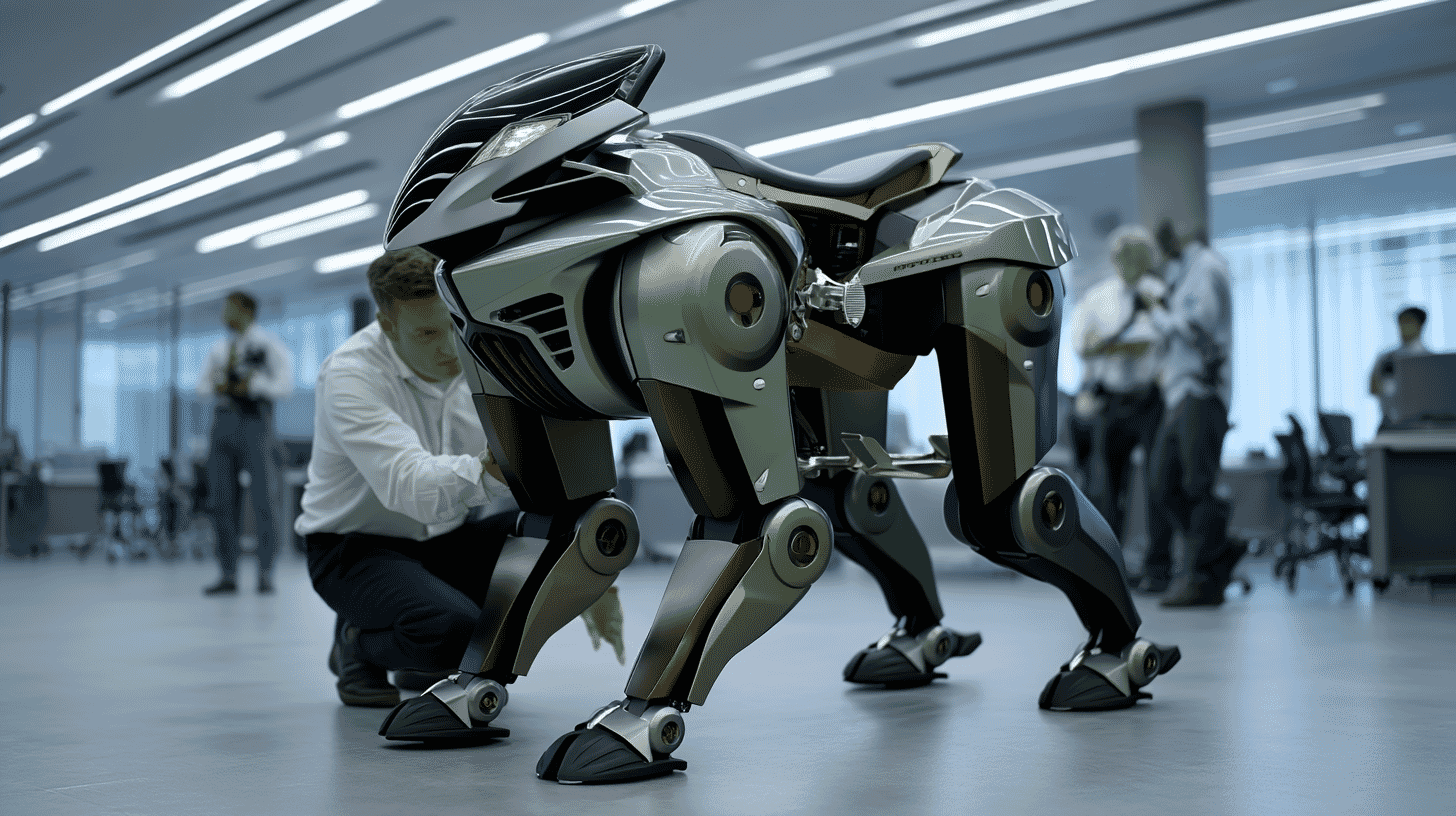
🐎 Kawasaki spent an afternoon in Tokyo letting reporters climb onto a robot horse. The strange part wasn't the four legs, or the hydrogen tank feeding them. It was the thing the company said it has no plans to install: a steering system, or a brake.
A mockup that people kept touching
On July 28, 2026, Kawasaki Heavy Industries held a press briefing for its SAFE ADVENTURE business at Haneda Innovation City, in Tokyo's Ota Ward. The subject was CORLEO, the four-legged personal mobility concept that first appeared at Osaka-Kansai Expo 2025 and then refused to go away.
Kawasaki says it ran no advertising campaign for it. The CGI concept film picked up 1.2 billion in social media reach anyway.
A full-scale mockup sat in the room and attendees were allowed to straddle it. Reporters who did noted that you have to grip the body with both legs to stay put, which is closer to horse than motorcycle. Development started the way a bike would, with design sketches and then a clay model, a step Kawasaki says its robotics teams normally skip entirely. Because a person sits on this one, the shape had to feel right before it had to work. Members of Kobe University's equestrian club were brought in to sit on early versions and say what felt wrong.
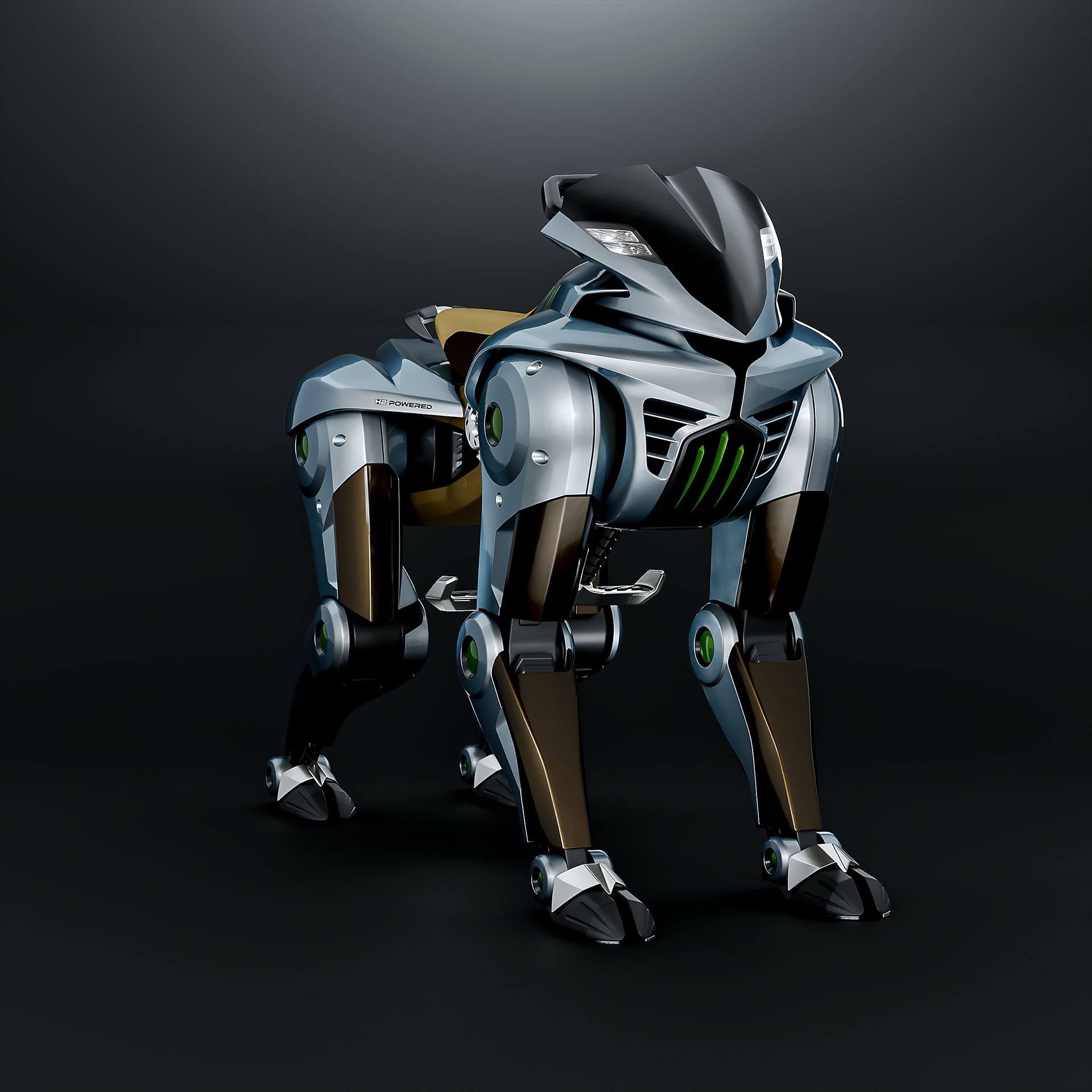
Source: Kawasaki Heavy Industries, Osaka-Kansai Expo site
The design decision nobody expected
Yusuke Amatatsu, who heads the SAFE ADVENTURE division, told the briefing there are no plans at this stage to fit either steering or a brake.
His explanation was disarmingly simple. On a bicycle or a motorcycle, when the rider wants to jump, the rider jumps and the machine goes with them. Kawasaki is building the hardware to read that intention directly, so that when your body loads up to leap, CORLEO leaps.
The controls, such as they are, live in the stirrups. Force sensors sit in them, they telescope, and the machine reads weight distribution through your feet. Amatatsu described the result as a vehicle whose performance depends on who is sitting on it, for better and worse, exactly like a horse. A novice and an experienced rider will get measurably different machines out of the same hardware, and that gap is a design goal rather than a defect to engineer away. There is still a bar to hold onto, but Kawasaki's own Expo material described it as a part that senses weight shift, not one that turns the machine.
Kawasaki frames two things here as industry firsts: a vehicle that watches its rider rather than ignoring them, and one that responds dynamically to ground that shifts underfoot. That's the company's characterization, not an independent finding.
Hydrogen legs, and why the terrain is the whole point
The pitch fits in one line: go where tires can't. Rock fields, forest floor, steep grades, ledges, dry riverbeds.
Power comes from a series hybrid. According to Traffic News, the current plan pairs a battery with a two-stroke 303cc hydrogen engine, up from the 150cc quoted when the concept debuted. That engine never drives anything directly. It generates electricity, and the electricity runs actuators in each leg. It's a generator with a very specific job.
The motorcycle DNA shows up in the rear legs, which use a swingarm mechanism and travel vertically independent of the front pair. That absorbs impact and, more usefully, keeps the rider's head pointed at the terrain ahead instead of at the sky when the machine climbs.
Building a "perfect ground" inside a computer
You cannot iterate a legged vehicle by breaking real prototypes on real mountainsides, because you would need thousands of mountainsides.
So Kawasaki is building them. Amatatsu described the requirement as simulating stones, rock and sand behaving under real physics, which means reproducing what he called a perfect ground. The company is doing it with NVIDIA's Cosmos platform and the Newton physics engine, constructing a virtual off-road course where loose footing genuinely wobbles when a hoof lands on it. Most of that work runs out of the Kawasaki Physical AI Center San Jose, which opened on May 21, 2026 with NVIDIA, Analog Devices, Microsoft and Fujitsu as partners.
Takahiro Ueno, a principal fellow in the division, argued that CORLEO isn't an extension of conventional robot development or of conventional vehicle development, and can only come from welding the two together. That thinking shows in the AI philosophy. Kawasaki isn't asking a neural network to figure out walking. The model is built in physics, and AI handles the residual, the stubborn gap between simulation and a real hillside. Ueno and Amatatsu summed it up as not chasing perfection and letting AI clean up afterwards. The sim-to-real gap, usually described as a problem, gets treated here as something you design around on purpose.
The team also inverted a normal engineering priority. Perceived speed matters more than actual speed, so the experience target comes first and the specs get derived from it. Fix the requirement at a 20-degree gravel slope and the necessary performance falls out of that.
Riyadh 2030, CORLEO X 2035, and a theme park that is really a data farm
As of July 2026, the roadmap runs like this. A dedicated development organization was formally established on April 1, 2026. Nikkei reports a prototype targeted for 2028. At Expo 2030 in Riyadh, Saudi Arabia, Kawasaki wants CORLEO adopted as on-site transport: running will still be out of reach, but walking should not be. A significant styling change is expected in 2027. Launch is set for 2035, under the name CORLEO X, alongside a riding park where the public can actually get on one.
The park has been pitched to Saudi Arabia. Nothing has been proposed in Japan yet. Business will start B2B before any consumer version, and pricing remains undecided, because Kawasaki says it is still working out what this experience is worth.
The park isn't only a revenue line. Staff at the briefing described its other purpose as manufacturing controlled rough terrain, a place to accumulate real-world running data across varied surfaces, which then feeds customized models for commercial operators. A test track that charges admission.
There's a games angle too. Kawasaki has started approaching the industry about the riding simulator and the motion data behind it, a pitch it calls mecha esports.
Boston Dynamics removes the human. Kawasaki insists on one.
Boston Dynamics, now under Hyundai, is pointed squarely at work. Its entire 2026 Atlas production run is committed to Hyundai's robotics application center and Google DeepMind, and Spot has spent years doing inspection rounds. The design target is a machine that operates without a person on it, ideally without a person nearby. Success means the human is somewhere else.
CORLEO fails by that standard on purpose. Strip out the rider and there is nothing left to control it. The person isn't cargo and isn't a supervisor; they're a component.
Japan doesn't own this idea outright, incidentally. China's XPeng showed a rideable robot pony aimed at children back in 2021. What's different is scale and intent: an adult-sized off-road machine that a heavy industry conglomerate has attached a launch year to.
Plenty of people remain unconvinced, and reasonably so. Futurism, writing after the Expo debut, questioned whether the thing would ever exist outside a render and noted that r/motorcycles compared it to a late April Fool's joke. As of July 2026 nobody outside Kawasaki has publicly ridden a CORLEO that walks. Everything so far is mockups, CGI and simulation.
The machine people wanted to pet
The detail that stuck with reporters had nothing to do with engineering. People who had just climbed off the mockup started stroking it.
Amatatsu has a theory about that. Give a machine legs, he suggested, and a lot of people get attached to it. Which is why Kawasaki is sketching out an ID system: log in from your phone, and your own CORLEO, tuned to how you ride, is waiting for you anywhere in the world.
That's a heavy industry manufacturer with a shipbuilding and aerospace business betting part of a product roadmap on affection. The bet isn't about torque or emissions; it's about how humans behave around things that walk.
If a machine in your country sprouted legs and let you sit on it, which reaction would come first, naming it or asking who's liable when it falls over?
References
- https://trafficnews.jp/post/692687
- https://www.khi.co.jp/expo2025/concept01/index.html
- https://www.watch.impress.co.jp/docs/news/2128633.html
- https://www.nikkei.com/article/DGXZQOUC272ZT0X20C26A7000000/
- https://www.khi.co.jp/pressrelease/detail/20251203_1.html
- https://global.kawasaki.com/en/corp/newsroom/news/detail/?f=20260522_8524
- https://bostondynamics.com/blog/boston-dynamics-unveils-new-atlas-robot-to-revolutionize-industry/
- https://futurism.com/the-byte/kawasaki-rideable-horse-robot





Global Discussion
3 comments