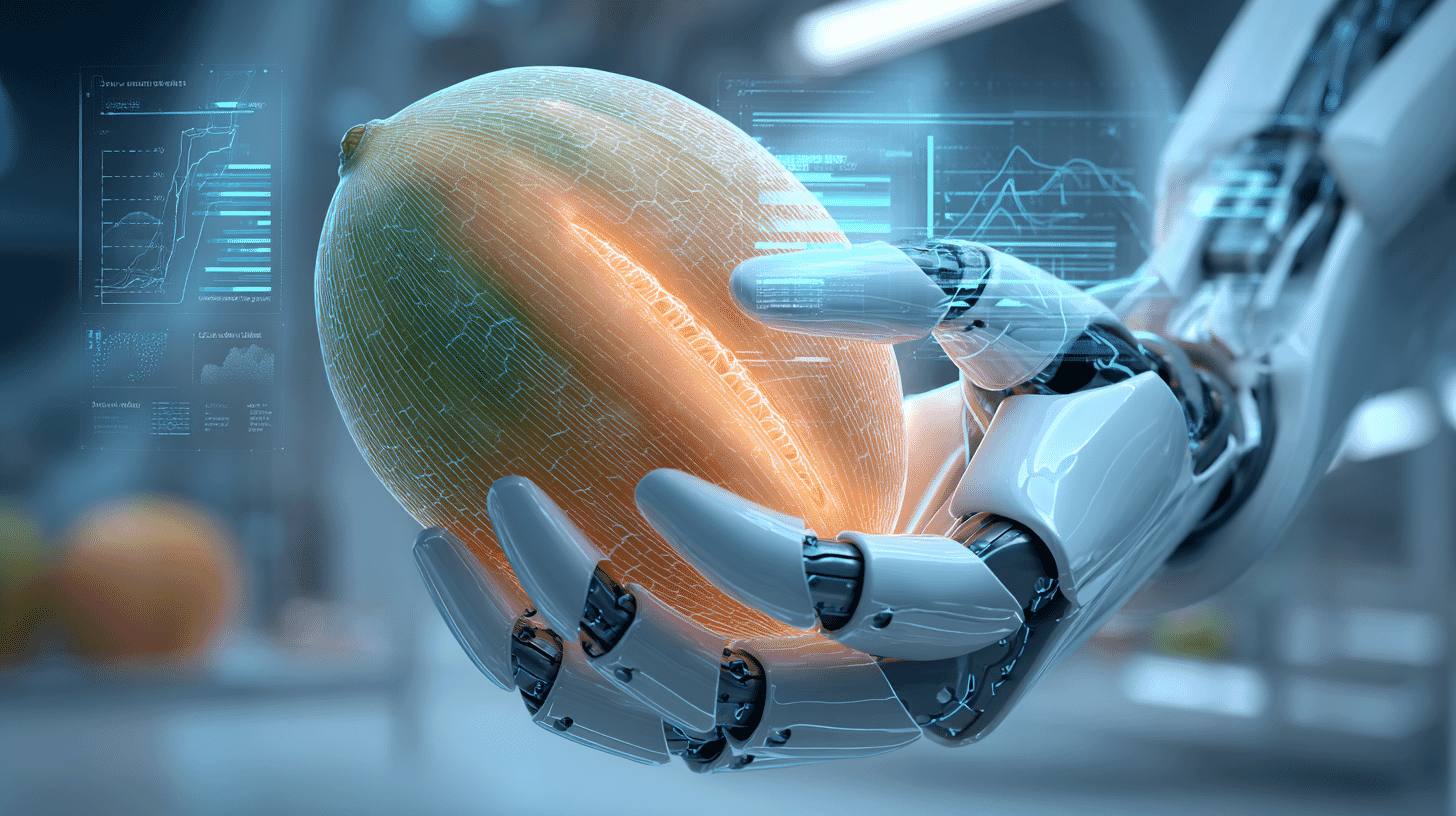
What if a robot could tell whether a melon is perfectly ripe inside, just by picking it up? No cutting, no X-rays, no expensive scanners. A Japanese university has built a robot hand that "feels" what's happening beneath the surface of objects the moment it grips them. Called "InSIGHT Grip," this technology could revolutionize how we sort fruit, inspect factory parts, and even diagnose medical conditions, all with a device that costs a fraction of current inspection systems.
The Problem: Inspection and Handling Are Two Separate Worlds
In agriculture, manufacturing, and food processing, quality inspection is essential. Is that peach ripe enough? Is this industrial component deteriorating inside? Currently, answering these questions typically requires specialized, and often expensive, equipment like laser scanners, ultrasonic devices, or X-ray machines.
The bigger issue is workflow. On a farm or factory floor, workers first handle an object (picking it up, moving it, sorting it), and then a completely separate system inspects it. These two steps, handling and inspection, run as distinct processes, adding time, cost, and complexity to production lines.
What if a single device could do both at once?
InSIGHT Grip: "Grab and Know" in One Motion
That's exactly what Associate Professor Hiroaki Kuwahara of Shibaura Institute of Technology's Real-World Informative Mechatronics Lab has achieved. His team developed "InSIGHT Grip" (the name cleverly combines "insight" with "grip"), a compact robot gripper that simultaneously holds an object and assesses its internal condition.
The system is surprisingly minimalist. It operates with as few as two motors, far fewer than conventional robotic inspection setups. But the real innovation is what it doesn't need: expensive force sensors. Traditional robot grippers that handle delicate objects like fruit rely on force-torque sensors that can cost hundreds or even thousands of dollars. InSIGHT Grip instead estimates gripping force using only motor rotation speed and electrical current, a proprietary technique currently under patent application in Japan (Patent Application No. 2025-135922).
How It Works: Vibrations Tell the Story
The principle behind InSIGHT Grip is elegant. While gently holding an object, the gripper sends tiny vibrations through it at specific frequencies. By analyzing how the object responds to these vibrations, the system extracts two distinct resonance peaks.
The first resonance peak reflects the behavior of the entire object, its overall mass and stiffness. The second peak captures the behavior of the surface layer specifically. By calculating the difference between these two readings, the system derives what engineers call "mechanical impedance", essentially a measure of internal hardness that differs from the surface hardness.
Think of it this way: when you tap a watermelon at the supermarket, you're doing a crude version of the same thing. The sound tells you something about what's inside. InSIGHT Grip does this with scientific precision and in real time.
This capability is particularly powerful for objects like melons, which have a firm exterior but soft, ripe flesh inside. Visual inspection or even surface touch cannot distinguish a perfectly ripe melon from an underripe one, but InSIGHT Grip can, the instant it picks one up.
From Fruit Farms to Factory Floors: Where This Technology Could Go
The immediate application is agriculture, particularly fruit sorting. Japan's premium fruit market, where a single Yubari melon can sell for over $70 at retail, demands extremely precise quality control. Currently, trained human inspectors or expensive optical equipment handle this task. InSIGHT Grip could allow robotic harvesters to simultaneously pick and grade fruit, dramatically streamlining the process.
But Professor Kuwahara's vision extends much further. The research roadmap includes:
- Agricultural integration: Combining InSIGHT Grip with robotic arms and automated guided vehicles (AGVs) to create systems that harvest and sort simultaneously
- Industrial inspection: Detecting internal deterioration in manufactured components without disassembly
- Construction and infrastructure: Assessing the structural integrity of building materials and infrastructure components
- Medical applications: Potential for low-invasive tissue assessment, where understanding internal tissue stiffness is diagnostically valuable
"Tactile Intelligence": A New Concept for Industry
Perhaps the most ambitious aspect of this research is its philosophical framework. Professor Kuwahara has coined the term "Shokakuchi" (触覚知), which translates roughly to "tactile intelligence" or "knowledge through touch." The concept envisions a future where the ability to understand an object's internal state through touch becomes a standard industrial capability, much like machine vision is today.
The goal is to establish tactile intelligence as a shared infrastructure across industries, contributing to solutions for some of Japan's most pressing challenges: labor shortages in agriculture and manufacturing, food waste reduction through more accurate quality sorting, and infrastructure safety maintenance in an aging society.
Award Recognition and What's Next
InSIGHT Grip has already earned recognition, receiving the Outstanding Award in the Applied Research Division of the 20th Wakashachi Encouragement Award in Aichi Prefecture. The team is now working on improving fruit ripeness estimation accuracy before moving to real-world integration testing with robotic systems and AGVs.
A Global Conversation About Robot Touch
Japan has long been at the forefront of robotics innovation, from industrial arms to humanoid companions. InSIGHT Grip represents a fascinating new direction: robots that don't just move and see, but genuinely "feel" and understand what they're touching.
As labor shortages affect agriculture worldwide and food waste remains a global challenge, this kind of technology could find applications far beyond Japan's borders. The concept of giving robots a sense of diagnostic touch opens up possibilities that researchers in agricultural robotics, food science, and manufacturing are only beginning to explore.
What do you think about robots that can assess quality through touch? Does your country face similar challenges in agricultural sorting or industrial inspection?






Global Discussion
15 comments