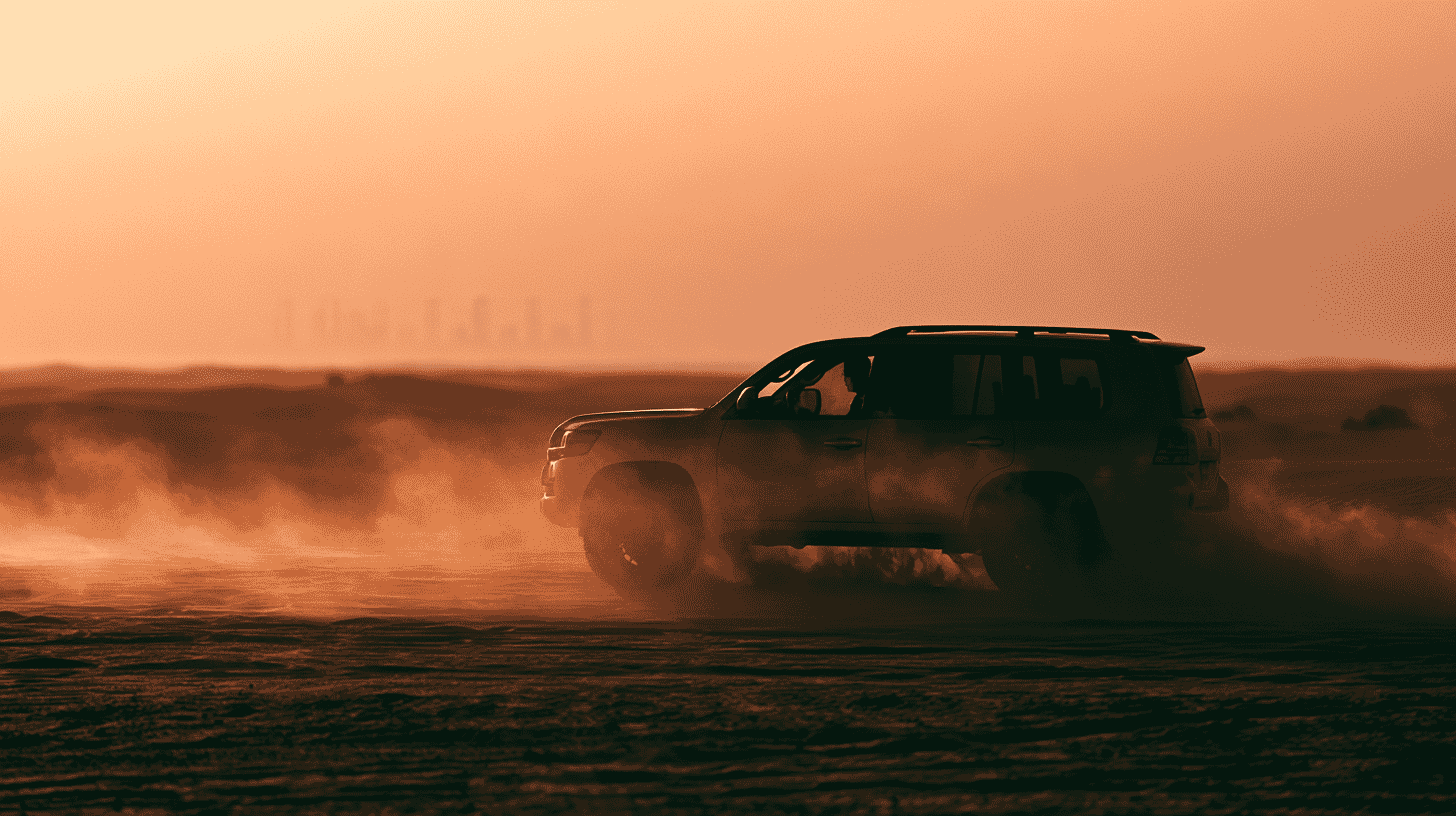
Mitsubishi Motors pulled the covers off a new Pajero on September 2, seven years after the nameplate left its home market. The next day the carmaker's shares rebounded, according to Response, and buyers also moved into the parts supplier that builds the vehicle's frame. Yet the plan for this SUV is modest: 10,000 units globally in fiscal 2026. Mitsubishi sold 797,000 vehicles worldwide in the year to March 2026, so the Pajero accounts for 1.3 percent of that base.
Volume does not explain the reaction. What the market put a price on was not the car but the name. So what has the Pajero actually been worth to Mitsubishi, why did the company walk away from it, and why does a badge like this get replaced so rarely?
The name survived, the factory did not
WEB CARTOP puts Pajero registrations in Japan at about 84,000 units in 1992, roughly 7,000 a month at the height of the country's recreational-vehicle boom. By 2018 the model was moving 50 to 60 units a month, under one percent of that peak, and domestic sales ended in August 2019.
Export production carried on at Pajero Manufacturing in Sakahogi, a town in Gifu Prefecture. Then, as part of the restructuring set out in the company's mid-term plan in July 2020, production was halted, and the plant closed in August 2021.
In March 2022, Mitsubishi announced it was selling the site of that former head-office plant to Daio Paper: about 152,000 square meters of land, handover scheduled for January 2023, price withheld under a confidentiality agreement. Gifu Prefecture records put the workforce at 1,123 people as of July 1, 2020, the month the closure was announced. The plant went, and so did the company that ran it. The name stayed.
Credit earned in the desert
The first Pajero arrived in May 1982, pairing serious four-wheel drive with independent suspension so the thing could be driven to work as well as up a riverbed. That generation alone sold about 630,000 units.
Rallying is what made the name travel. Mitsubishi entered the Paris-Dakar in 1983 and took the overall win in 1985, then strung together seven straight victories from 2001 to 2007 for 12 wins in total across 26 entries, retiring the works effort in 2009. From the 1980s into the 2000s, footage of a Pajero crossing desert made its way onto television worldwide.
Across four generations the Pajero was built in numbers exceeding 3.29 million units and sold across over 170 countries and regions, badged Montero in North America and Shogun in the United Kingdom. On dusty roads in the Middle East, Africa and Australia it functioned less as a model name than as a generic term for a class of tool. Brand recognition in that sense has little to do with advertising. It means workshops stock the parts, the used market holds a price, and a ministry or an aid agency can write the name straight into a procurement spec.
A plan for 10,000 units
At the world premiere on September 2, President and COO Keisuke Kishiura said the company is planning global sales of 10,000 units this fiscal year, as reported by Mynavi News. Under the plan as announced, Thailand goes first, Japan follows on December 17 and Australia in December. Pricing stays undisclosed until the formal announcement on October 29. The rollout to roughly 100 countries, including ASEAN, Latin America and the Middle East, starts in fiscal 2027.
Ten thousand vehicles will not move the earnings line. Mitsubishi's operating profit for the year to March 2026 was 75.5 billion yen, about $483 million, down 45.6 percent from the previous year, and this model does not change that order of magnitude.
What does explain the buying on September 3 is that the plan had already turned into hardware. Press Kogyo said its Thai subsidiary had won the frame order for the new Pajero, with volume supply apparently beginning in August, as Fisco reported. Its stock traded up 43 yen at 1,040 yen, about $7, shortly after 11 a.m. that day. The price reads as attached less to a name coming back than to a Thai supply chain already running under it.
Why the model does not get replaced every year
Full model changes for the Pajero landed in 1982, 1991, 1999, 2006 and now 2026. The fourth generation was sold for about 15 years on essentially unchanged bones, followed by a five-year gap with no car at all.
This is not peculiar to the Pajero. JBpress notes that the Delica D:5 minivan has gone more than 18 years without a full model change since its 2007 launch, and the same article describes Mitsubishi as a small-scale manufacturer producing under a million vehicles a year. For a company selling just under 800,000 units annually, refreshing a body-on-frame off-roader on a passenger-car cycle, with its own frame, its own durability programme and homologation in 100 markets, does not pay.
So the product plan works in bursts rather than in a steady stream. Going from a ladder frame to a built-in frame monocoque with the third generation, then back to a highly rigid ladder frame with the fifth, is a reversal you can only afford across a 20-year interval. A company changing the car slightly every year could not make that move twice.
A Japanese flagship built in Thailand
The new car pairs a 2.4-liter clean diesel with a new 8-speed automatic and 480 Nm of torque, carries S-AWC and Super Select 4WD-II across three rows and seven seats, and sits on a frame the engineers went back to. BestCar Web reports that production sits at the Laem Chabang plant in Thailand. The Gifu factory belongs to a paper company now, and Japan's flagship returns as a Thai-built vehicle. What Mitsubishi held on to was neither the tooling nor the workforce, but the name and the distribution network attached to it. The mid-term vision that frames the Pajero as a series was laid out back in May.
A nameplate does not sit on the balance sheet, but it can be priced. A name on its own still sells nothing. Whether that price was right depends on what multiple of 10,000 units the model reaches from fiscal 2027. Is there a product in your country whose factory closed, whose name outlived it, and that came back years later?
References
- https://www.mitsubishi-motors.com/jp/newsroom/newsrelease/2026/20260902_1.html
- https://www.mitsubishi-motors.com/en/newsroom/newsrelease/2026/20260902_1.html
- https://www.mitsubishi-motors.co.jp/lineup/pajero/teaser/history/
- https://www.mitsubishi-motors.com/jp/newsroom/notice/notice20220318/index.html
- https://response.jp/article/2026/09/03/416096.html
- https://response.jp/article/2026/05/09/411043.html
- https://response.jp/article/2019/05/04/321977.html
- https://response.jp/article/2019/04/24/321721.html
- https://www.webcartop.jp/2020/08/564269/
- https://www.pref.gifu.lg.jp/uploaded/attachment/201683.pdf
- https://diamond.jp/zai/articles/-/1072559
- https://news.mynavi.jp/premium/article/20260903-pajero-sales/
- https://www.netdenjd.com/archives/693764
- https://bestcarweb.jp/newcar/1622821
- https://jbpress.ismedia.jp/articles/-/89385
- https://ja.wikipedia.org/wiki/%E4%B8%89%E8%8F%B1%E3%83%BB%E3%83%91%E3%82%B8%E3%82%A7%E3%83%AD
- https://fx.minkabu.jp/news/378253








Global Discussion
4 comments