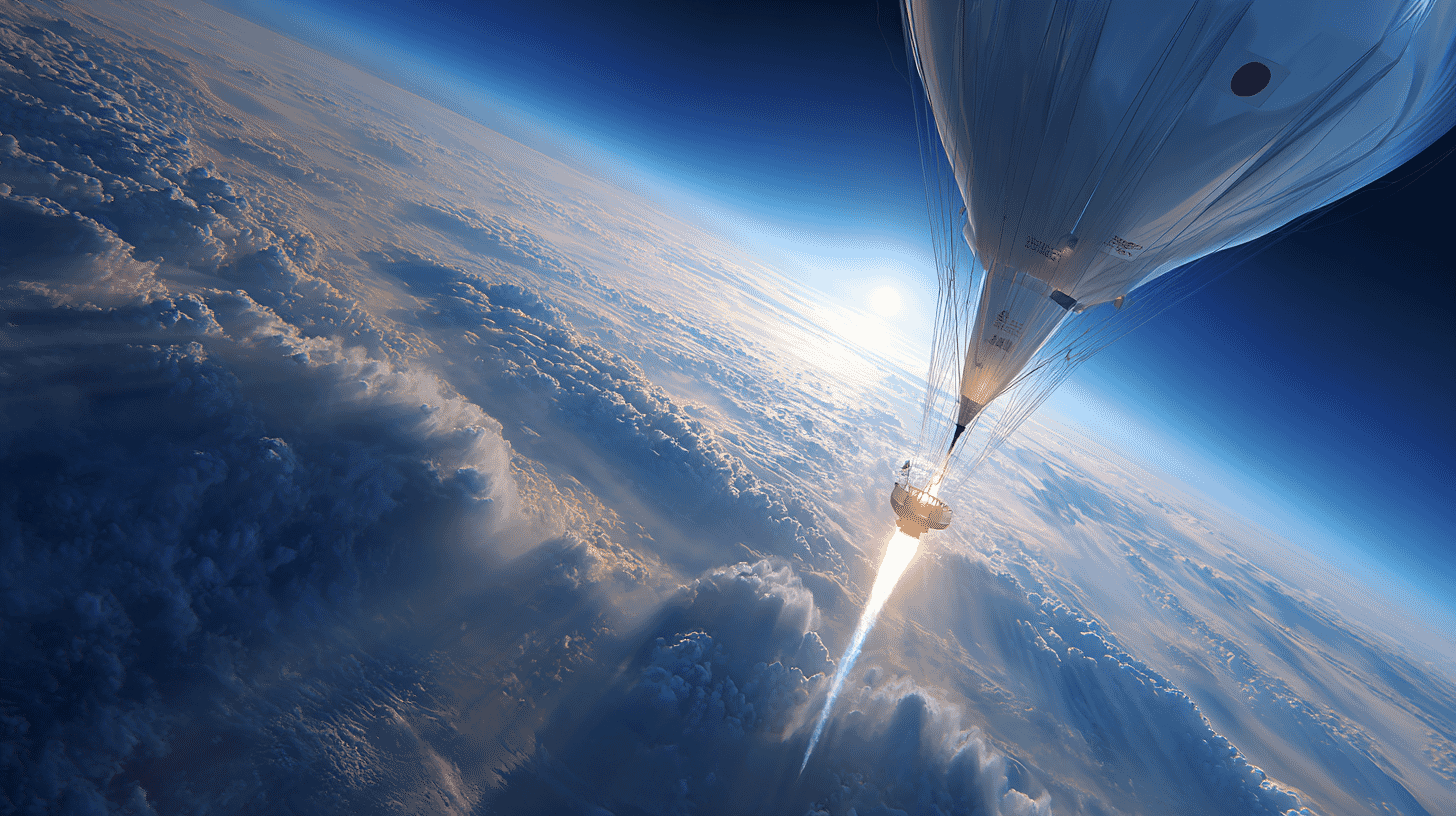
What if you could send a satellite to orbit without a massive launch pad? A Japanese startup called AstroX is doing exactly that, using giant balloons to carry rockets into the stratosphere, then firing them into space from 25 km above the Earth. The company just secured $15 million in Series A funding, and it plans to reach space by the end of 2026.
Here's how this unconventional approach could reshape the space launch industry and why it matters for the future of affordable space access.
What Is Rockoon Technology?
The term "Rockoon" is a combination of "Rocket" and "Balloon." The concept is surprisingly straightforward: a large high-altitude balloon lifts a rocket to the stratosphere, roughly 20 to 25 kilometers above the Earth, and then the rocket ignites mid-air and blasts off toward space.
This idea actually dates back to the 1950s, when American physicist James Van Allen used rockoons for upper-atmosphere research. But nobody has ever used this method to put a satellite into orbit. AstroX aims to be the first in the world to achieve that.
So why bother lifting a rocket by balloon instead of launching from the ground? There are four key advantages:
Dramatically reduced air resistance. At 25 km altitude, air pressure is only about one-tenth of what it is at sea level. A rocket fired from up there encounters far less drag, meaning it needs less fuel and can be smaller and cheaper.
No need for expensive launch pads. Traditional rockets require massive ground infrastructure, launch pads, fuel storage facilities, flame trenches, and more. A rockoon system can launch from a ship at sea, eliminating the need for costly fixed facilities.
Weather independence. The stratosphere has stable conditions regardless of what's happening on the ground. Rain, wind, or clouds below don't affect a launch happening above them.
Flexible launch location. Since the balloon can be launched from virtually anywhere, especially from ocean-going vessels, the rocket can be aimed at any orbital inclination. This means satellites can be placed exactly where they need to go, without the costly orbital maneuvering that rideshare missions often require.
AstroX: From Fukushima to the Stars
AstroX was founded in May 2022 in Minamisoma, a city in Fukushima Prefecture. For those unfamiliar with the area, Fukushima is the same region that experienced the devastating 2011 earthquake and nuclear disaster. The choice of location is intentional, AstroX operates within the Fukushima Innovation Coast Framework, a government-backed initiative to revitalize the region through cutting-edge technology.
The company's CEO, Shotake Oda, is a serial entrepreneur who previously founded and sold multiple IT companies before pivoting to his childhood dream of working in space. His vision is summed up in the company's bold motto: "Reclaim 'Japan as No.1' in space development."
This might sound ambitious, but the technical team backing the vision is formidable. The CTO is Professor Yutaka Wada from the Chiba Institute of Technology's Space Transportation Engineering Lab, who has successfully conducted university-based rocket launches including offshore firing. The executive team also includes Takashi Maemura, who was the first-ever launch director for Japan's H-IIA rocket, one of the country's most reliable launch vehicles.
The Funding Story: From Seed to $15 Million
AstroX's fundraising journey shows rapid acceleration:
In December 2022, the company raised an initial ¥50 million (about $330,000) in a seed round. By September 2024, they completed a pre-Series A round of ¥400 million ($2.6 million). Then in November 2025, the Series A first close brought in ¥1.8 billion ($12 million), combining equity investment from firms like Alpha, Daiwa Corporate Investment, and DeepCore with debt financing from Abukuma Shinkin Bank, Mizuho Bank, and Sumitomo Mitsui Banking Corporation.
In February 2026, the company announced its Series A second close, adding investment from One Capital and Inclusion Japan, bringing the total Series A funding to ¥2.32 billion (approximately $15 million).
This rapid fundraising trajectory, from seed to a significant Series A in under four years, reflects growing investor confidence in both the rockoon concept and AstroX's execution capability.
Technical Progress: Step by Step Toward Space
AstroX has been methodically building toward its goals:
December 2022: Successfully conducted a model rocket mid-air launch from a balloon in Yamaguchi Prefecture, demonstrating basic attitude control during aerial firing.
August 2024: Launched the small hybrid rocket "Kogitsune", developed in collaboration with Chiba Institute of Technology students, reaching an altitude of 300 meters and validating key offshore recovery techniques.
November 2024: Fired the much larger FOX-1 rocket (C1-2), a 6.3-meter-long hybrid rocket with capability to reach 10 km altitude, from the Minamisoma coastline. The rocket successfully reached 7 km, marking a major milestone.
December 2025: Completed the first launcher mechanism test, successfully deploying and separating a dummy rocket from the launch platform using a crane system.
The next major milestone is a Rockoon-mode suborbital launch, lifting a rocket by balloon to the stratosphere and firing it to reach 100 km (the Kármán line, the internationally recognized boundary of space), targeted for 2026.
Why Japan Needs This
Here's a fact that surprises many people: despite being a major space-faring nation, Japan currently launches nearly 99% of its small satellites on foreign rockets. Japanese satellite makers have to wait in line for rides on SpaceX Falcon 9s or other overseas vehicles, with limited control over timing, orbital placement, or mission parameters.
The global space economy is projected to exceed $1.8 trillion by 2035, and the small satellite market is one of its fastest-growing segments. Japan's own small satellite market was valued at $329 million in 2024 and is expected to double by 2033. Yet without domestic launch capability for these satellites, Japan risks becoming dependent on foreign infrastructure for a critical strategic sector, much as it did with semiconductor manufacturing.
But if a country cannot launch its own satellites on its own rockets, it remains dependent on others for strategically important space infrastructure. AstroX CEO Oda warns: "If things go on like this, our infrastructure will be taken, just as happened with IT."
AstroX's rockoon system directly addresses this gap. By offering a low-cost, flexible, high-frequency launch option, it could give Japanese satellite operators the independence they need. The company targets launch costs below ¥500 million ($3.3 million) per mission, competitive with the cheapest options currently available.
The Bigger Picture: AstroX Is Not Alone
AstroX operates in a competitive landscape. Several other companies around the world have explored or are exploring rockoon-style launches:
SpaceRyde (Canada) has been developing a balloon-launched rocket system for small satellite deployment. Zero 2 Infinity (Spain) has tested its Bloostar system, aiming to launch micro-satellites from balloon platforms. Leo Aerospace (USA), a Purdue University spinout, demonstrated a rockoon launch in 2019 in the Mojave Desert.
However, none of these companies have yet achieved orbital insertion using the rockoon method. AstroX's combination of hybrid rocket technology, JAXA collaboration on attitude control systems, and partnership with construction giant Obayashi Corporation (which contributed anti-rotation technology used in building the Tokyo Skytree) gives it a unique technical edge.
AstroX's Roadmap
The company has laid out an ambitious but structured timeline:
- 2026: Achieve suborbital flight (100 km altitude) using Rockoon method
- 2028: Reach satellite orbital altitude (500 km)
- 2029: Begin commercial satellite launch services and target IPO
If AstroX hits these milestones, it would become not just Japan's but the world's first company to commercially launch satellites using the rockoon method.
A New Chapter for Japanese Space Ambitions
Japan has a proud history in space, from the H-II series of rockets to the Hayabusa asteroid sample return missions. But the country has struggled to keep pace with the explosive growth of commercial space, particularly the SpaceX-driven revolution in low-cost launches.
AstroX represents something different: a startup approach to a problem that Japan's traditional aerospace establishment has been slow to address. Based in a region rebuilding from disaster, led by an entrepreneur from outside the aerospace old guard, and backed by technology that nobody in the world has fully cracked yet, the company embodies the kind of bold, unconventional thinking that Japan's space industry needs.
Whether AstroX succeeds or not, the fact that Japan is home to a serious contender in the rockoon race is a sign that the country's space ambitions are far from over.
In Japan, AstroX's balloon-launched rockets are raising both hopes and questions: some welcome them as a revival of Japanese innovation, while others ask whether the technology can really deliver. How does your country approach space launch?
References
- https://prtimes.jp/main/html/rd/p/000000025.000101722.html
- https://astrox.jp/
- https://www.jaxa.jp/press/2024/12/20241203-2_j.html
- https://thebridge.jp/2026/02/astrox-raises-series-a-2nd-close-for-rockoon-rocket
- https://newswitch.jp/p/46649
- https://kepple.co.jp/articles/tab7xlv5ll
- https://en.wikipedia.org/wiki/Rockoon
- https://airandspace.si.edu/stories/editorial/rockoons-rocket-and-balloon-experiments



Global Discussion
14 comments