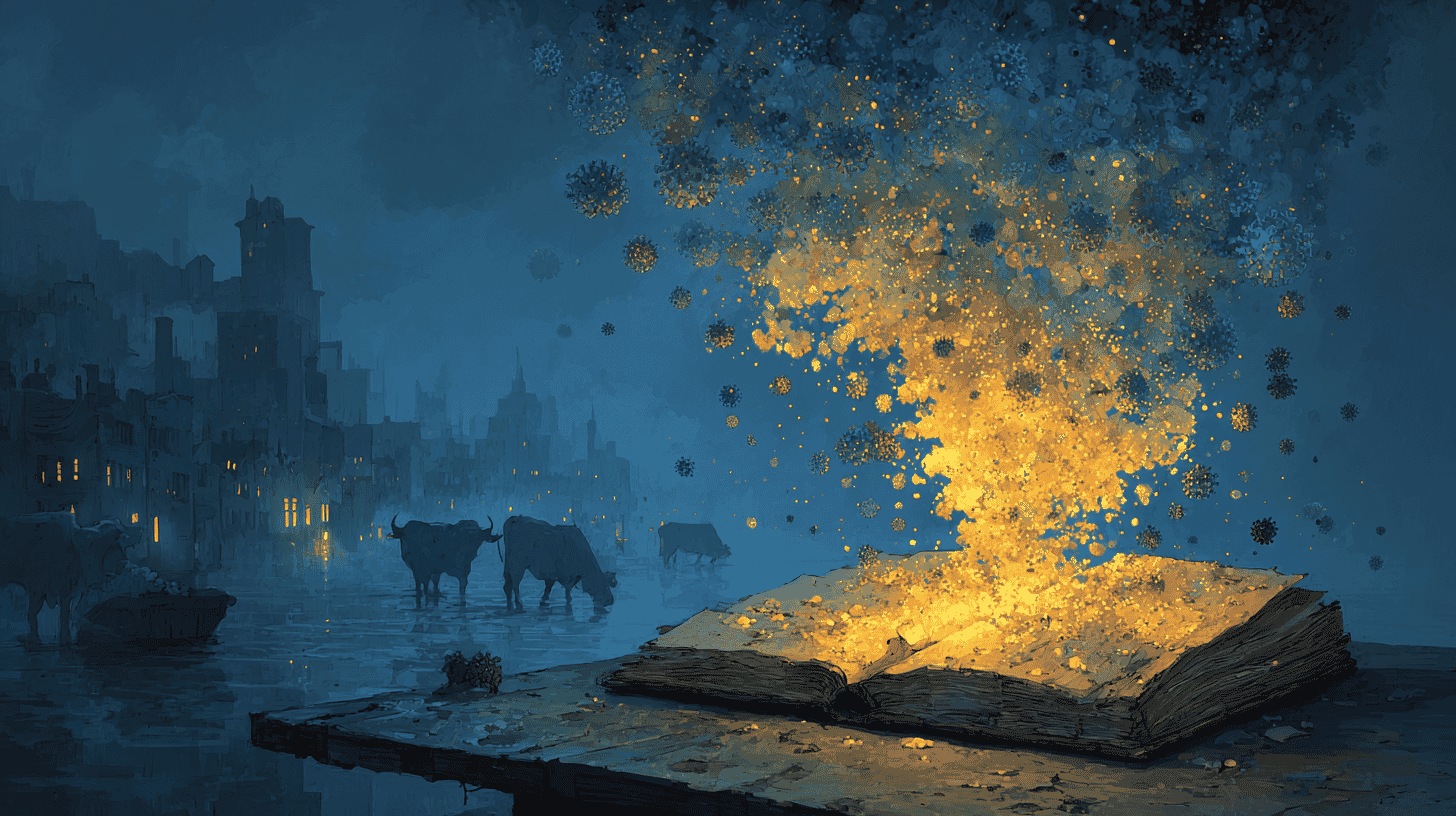
🦠 In 2004, a Japanese virologist let a magazine dialogue carry a blunt headline: "A Pandemic Will Definitely Come." Sixteen years later, COVID-19 proved the sentence right, though not in the way he meant it. And the flu pandemic he was actually warning about is now creeping closer, one sick dairy cow at a time.
That virologist is Yoshihiro Kawaoka. If you have never heard the name, you have almost certainly lived inside the world he spent his life trying to prepare us for. His chapter sits in What Researchers See at the Frontier of Science, a 2004 collection of dialogues by novelist Hideaki Sena, author of the horror bestseller Parasite Eve, who interviewed eighteen of Japan's leading scientists for the journal Nikkei Science across 2002 and 2004. Two decades on, some of those conversations read as charmingly dated. Kawaoka's reads like a memo nobody wanted to open.
The man who kept saying it would happen
Kawaoka trained as a veterinarian, not a doctor, a detail that turns out to matter, because most pandemics begin in animals. After earning a doctorate in veterinary medicine from Hokkaido University, he built a career across two countries at once, holding professorships at both the University of Tokyo's Institute of Medical Science and the University of Wisconsin–Madison, a dual appointment that is rare to the point of being almost unheard of.
What made him a world authority was a technique that sounds like science fiction: he was among the first to build influenza viruses artificially, gene by gene, in the lab, a method called reverse genetics that let researchers ask "what if" questions about a virus instead of just watching it. His team also helped reconstruct the 1918 Spanish flu virus, the pathogen that killed tens of millions. The awards followed: the Robert Koch Prize in 2006, Japan's Medal with Purple Ribbon in 2011, the Japan Academy Prize in 2016, and foreign membership in the U.S. National Academy of Sciences.
So when his 2004 chapter argued that a pandemic was not a question of if but when, it was not a writer reaching for drama. It was the considered position of someone who understood, better than almost anyone, how easily an influenza virus rearranges itself. He pressed the point again in his 2005 book Influenza Crisis, which warned specifically that bird flu was the most likely candidate to make the jump into a human pandemic.
To prove the danger, he made it more dangerous
Here the story takes the turn that still divides scientists.
Around 2011, Kawaoka in Wisconsin and Ron Fouchier in the Netherlands separately did something that horrified part of the research world: they engineered versions of the H5N1 bird flu virus that could spread through the air between ferrets, the standard stand-in for how flu moves between people. The logic was preventive: if you know exactly which mutations would let bird flu go airborne in mammals, you can watch for them in the wild and start building vaccines before, not after, the outbreak.
The reaction was fierce. A U.S. biosecurity advisory board initially urged the journals to withhold the experimental details, fearing the recipe could guide bioterrorists, or that the engineered virus could simply escape a lab. Tabloids ran apocalyptic headlines about a man-made strain that "could kill" enormous numbers of people; the novelist Dan Brown even folded the work into a thriller. After a WHO expert meeting in early 2012 and months of argument, the board reversed itself, and the papers appeared in Nature and Science that summer. The episode helped trigger a multi-year U.S. funding pause on this kind of "gain-of-function" research.
Kawaoka has never apologized for the work. His view, laid out in later interviews, is that almost every powerful tool (he likes the comparison to knives and dynamite) carries both benefit and risk, and that a scientist's job is to minimize the danger rather than refuse to look. Critics counter that some experiments create a risk that simply did not exist before. Twenty years later, that argument is not settled. It has only gotten louder.
When the pandemic finally came
It arrived at the end of 2019, and it was the wrong virus.
COVID-19 was a coronavirus, not an influenza, which means Kawaoka did not "predict COVID" in any literal sense; the specific flu catastrophe he studied was not the one that shut down the planet. But the larger claim, that a pandemic was coming and that modern life had built a perfect highway for one, was vindicated with brutal completeness. The disease officially killed more than seven million people, with credible estimates of the true toll running far higher.
Kawaoka did what specialists do: he pivoted. His labs worked on how the virus damages the body, why some cases turn severe, and on vaccines and antivirals, and he joined the advisory bodies steering Japan's response. He also co-wrote a book trying to explain the new virus to a frightened public. The man who had spent fifteen years being told he was overstating the threat suddenly had the grim authority of someone who had been right about the shape of the thing, if not its name.
The flu he feared is still out there
The influenza pandemic Kawaoka actually warned about has not happened. Not yet. And in the last two years it has moved unmistakably closer. Since March 2024, H5N1 bird flu has been spreading through dairy cattle in the United States, the first time the virus has established itself in cows, and it has jumped from animals to people. By the U.S. Centers for Disease Control and Prevention's count, 1,022 human H5N1 infections had been confirmed worldwide since 1997 as of June 10, 2026, and roughly 48 percent of those people died. The World Health Organization's tally, which starts in 2003, is likewise close to 1,000 cases with more than 450 deaths. Most of the recent American dairy and poultry worker infections, though, have been mild. Seventy people in the U.S. have been confirmed infected since 2024, one of whom died in January 2025.
Update: USDA figures put the number of U.S. dairy herds with confirmed H5N1 at more than 1,166 across 19 states as of July 22, 2026, with Idaho leading at 173. California, once the center of the outbreak, has recorded no new livestock detections since November 2025 and released its dairies from quarantine in February 2026.
What virologists are watching is the single thing Kawaoka built his ferret experiments to understand: whether the virus picks up the mutations that would let it pass easily from one human to the next. It has not crossed that line. The fear is that every new mammal it infects is another roll of the dice. The gain-of-function debate that nearly ended his publishing in 2012 is now back at the center of policy, sharpened by years of arguing over where COVID came from.
Read the title of that 2004 chapter again, A Pandemic Will Definitely Come, and the unsettling thing is not that it was dramatic. It is that it was simply a description of how the world works, written by someone who could see it before the rest of us could. The next time, it may be the virus he named all along.
In Japan, a generation that lived through COVID now reads warnings like Kawaoka's very differently than it did in 2004. How is it in your country: when a scientist says "this will happen," does anyone act before it does?
References
- https://nikkeibook.nikkeibp.co.jp/item-detail/16468
- https://www.u-tokyo.ac.jp/focus/ja/people/people001333.html
- https://ja.wikipedia.org/wiki/河岡義裕
- https://www.natureasia.com/ja-jp/nmicrobiol/interview/6
- https://www.amazon.co.jp/dp/4087203131
- https://www.mhlw.go.jp/stf/seisakunitsuite/bunya/0000144523.html
- https://natgeo.nikkeibp.co.jp/atcl/news/24/122000702/




Global Discussion
0 comments