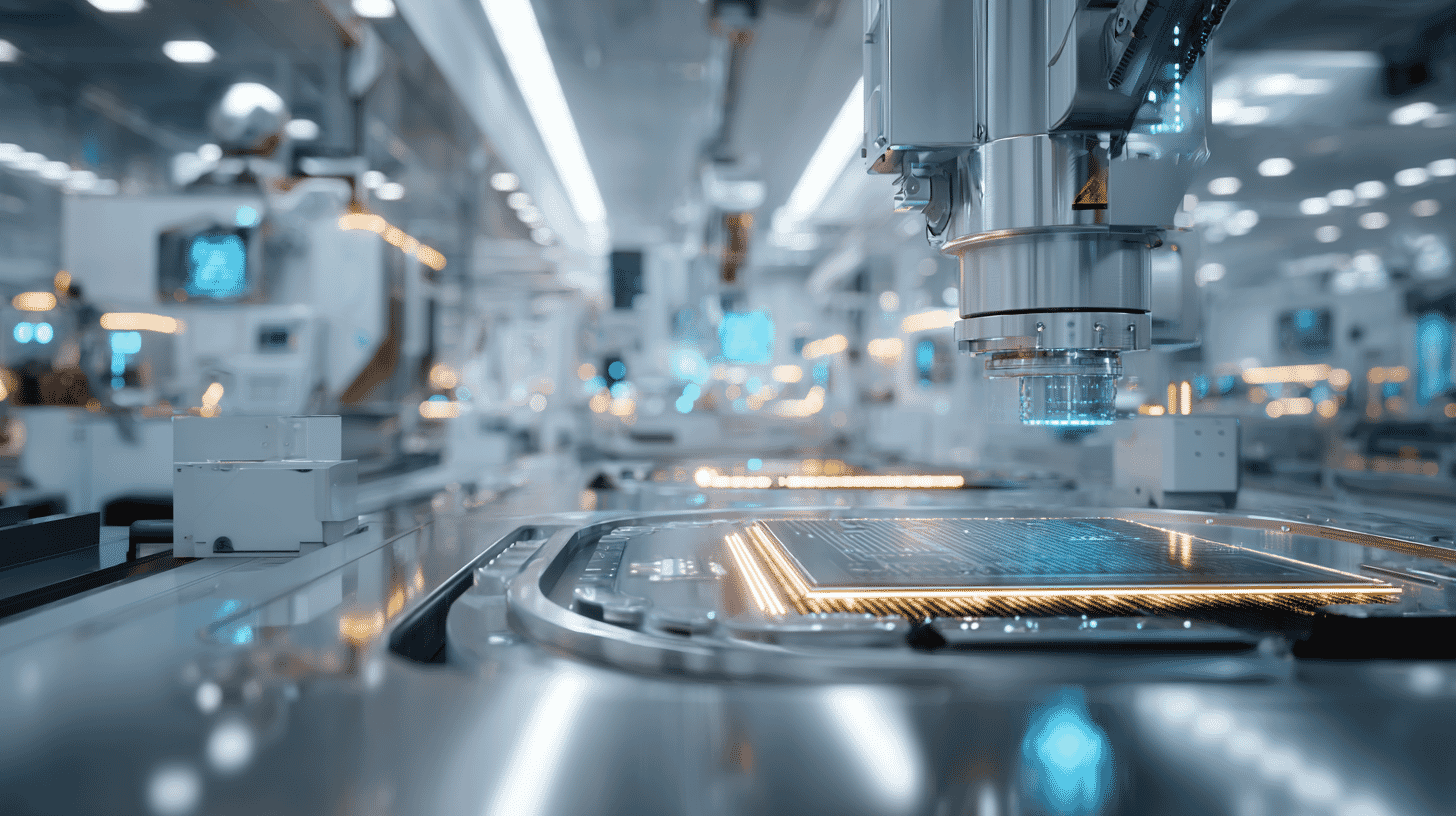
No semiconductor equipment, no smartphones, no AI, no autonomous driving. Japanese companies control roughly 31% of the global semiconductor manufacturing equipment market, dominating coater/developers at 90%+, batch wafer cleaning at over 80%, and semiconductor testing at 58%. As the AI chip boom reshapes the industry, Japan's "behind-the-scenes" champions are stepping into the spotlight.
What Is Semiconductor Manufacturing Equipment? A Multi-Trillion Dollar Industry
Manufacturing a semiconductor chip requires over 1,000 process steps, each demanding specialized ultra-precision equipment. Lithography tools that print circuit patterns, etching machines that carve away unwanted material, deposition systems that build ultra-thin films, cleaning equipment that removes nanoscale contaminants, and testing apparatus that verifies finished chips, all fall under the umbrella of "semiconductor manufacturing equipment."
According to SEMI's late-2025 forecast, the global semiconductor equipment market was projected to reach a record $156 billion by 2027. AI chip demand, the start of 2-nanometer mass production, and massive investment in High Bandwidth Memory (HBM) are fueling this growth.
Japan's Dominant Niches: A Category-by-Category Breakdown
In the overall equipment market, the United States leads at roughly 35%, followed by Japan at approximately 31%. But within specific equipment categories, Japanese companies exercise commanding, sometimes near-monopolistic, control.
Tokyo Electron (TEL): The Undisputed King of Coater/Developers
Coater/developers apply and develop photoresist, a light-sensitive material essential for forming circuit patterns. Tokyo Electron holds approximately 90–94% of the global market in this category, a virtual monopoly. The company also ranks among the world's top players in etching and deposition equipment, with a broad product portfolio that spans multiple manufacturing steps. Revenue for the fiscal year ended March 2026 was projected at approximately ¥2.35 trillion.
SCREEN Holdings: World Leader in Wafer Cleaning
Cleaning steps are estimated to account for 30–40% of the entire semiconductor manufacturing process. SCREEN holds the world's top position in single-wafer cleaning equipment with roughly 34.7% market share, and dominates batch-type cleaning with over 80% share. Its proprietary technology achieves nanoscale particle removal while minimizing wafer damage, a combination that has earned trust from chip manufacturers worldwide.
Advantest: The Quality Gatekeeper of the AI Era
Every semiconductor chip must pass testing before shipment. Advantest commands approximately 58% of the global semiconductor test equipment market, an overwhelming lead. Whether it's GPUs, NAND flash, or HBM, all chips need testing as a final step. As AI chips grow more complex, test times increase, driving ever-greater demand for Advantest's systems. The company revised its fiscal 2025 revenue forecast upward from ¥950 billion to ¥1.07 trillion, and its market capitalization surpassed Tokyo Electron's for the first time in roughly 20 years.
Disco Corporation: The Artisans of "Cut, Grind, and Polish"
Disco holds 70–80% of the global market for dicing saws (which cut wafers into individual chips) and 60–70% for wafer grinders. Originally founded as an abrasive manufacturer, the company's ultra-precision processing technology is seeing growing demand as advanced packaging evolves.
KOKUSAI ELECTRIC: Dominating Batch ALD
In batch-type Atomic Layer Deposition (ALD) equipment, essential for next-generation chip manufacturing, KOKUSAI ELECTRIC holds approximately 70% global share. Together with Tokyo Electron, it forms a duopoly that underpins manufacturing at the 2-nanometer node and beyond.
Why Japanese Companies Excel: Three Structural Advantages
First, a culture of "suri-awase" (collaborative fine-tuning) that produces unmatched precision. Cleaning equipment that requires microscopic control of ultra-pure water temperature and chemical concentrations, or coating technology demanding nanometer-level accuracy, these cannot be developed without decades of accumulated shop-floor know-how. This tacit knowledge base makes Japanese technology extremely difficult for competitors to replicate.
Second, deep, long-term customer relationships. Once a chip manufacturer integrates equipment into their production line, they optimize processes around that specific equipment's characteristics. This "lock-in effect" creates significant barriers to entry, sustaining Japanese companies' market positions. Meticulous after-sales support further differentiates them from Western competitors.
Third, a vertically integrated industrial ecosystem with world-class materials suppliers. Shin-Etsu Chemical and SUMCO in silicon wafers, Tokyo Ohka Kogyo and JSR in photoresists, JX Metals in sputtering targets, Japan hosts a cluster of globally dominant materials companies. The tight coordination between equipment and materials manufacturers strengthens the entire Japanese semiconductor supply chain.
The Inconvenient Truth: Japan's "Strong Niche" Dilemma
However, the picture is not entirely rosy. Most equipment categories where Japanese companies lead have market sizes capping at roughly $6 billion. In contrast, categories exceeding $10 billion, lithography, etching, and CVD deposition, are dominated by ASML, Applied Materials, and Lam Research.
In lithography, where Nikon and Canon once held combined share exceeding 70%, ASML's EUV (Extreme Ultraviolet) technology has shifted the landscape dramatically. ASML now controls over 90% of the lithography market, while Japanese companies hold less than 10%.
Furthermore, Japan's semiconductor device consumption market continues to decline. In 2025, Japan was the only major market globally to record year-on-year decline in semiconductor sales, with its share falling to just 5.7%. The paradox of strong equipment makers coexisting with a shrinking overall semiconductor presence is a reality Japan must confront.
Government Mega-Investments and the "Made in Japan" Chip Revival
The Japanese government invested approximately ¥4 trillion in the semiconductor industry over three fiscal years from 2021 to 2023, proportionally more than the United States or Western European nations relative to GDP. This includes support for TSMC's Kumamoto fab (JASM), funding for Rapidus Corporation's 2-nanometer chip development, and an additional ¥200 billion investment in Rapidus announced for fiscal 2025.
In Kumamoto, TSMC's arrival has triggered a structural economic transformation, attracting semiconductor-related businesses and creating significant employment. In Chitose, Hokkaido, Rapidus has activated its pilot line and successfully verified operation of 2-nanometer-class prototype transistors.
These developments create tailwinds for equipment makers. More domestic cutting-edge fabs mean faster development and verification cycles, and deeper collaboration with customers.
The AI Semiconductor Boom: A Historic Opportunity
The start of 2-nanometer mass production in late 2025, 1.6-nanometer production beginning in late 2026, and the emergence of HBM4, as semiconductor miniaturization and performance acceleration intensify, equipment manufacturers face unprecedented business opportunities.
As of 2025, the Semiconductor Equipment Association of Japan (SEAJ) forecast that Japanese semiconductor equipment sales would reach ¥5.35 trillion in fiscal 2026. How much additional market share Japanese equipment makers can capture as AI-related investment scales up is a key question for the industry.
That said, export restrictions stemming from US-China tensions cannot be ignored. China is one of Japan's largest equipment markets, and tighter restrictions could impact short-term revenues. Balancing geopolitical risk with business opportunity will shape corporate strategies going forward.
The AI era could represent a historic inflection point for Japanese equipment makers. Precision manufacturing is a quiet but formidable strength, and the world is watching how far Japanese companies can go in the global market.
Does your country have semiconductor equipment companies or national projects? What are the strengths and challenges of your nation's semiconductor industry?









Global Discussion
13 comments