
📱 For years, Japanese eye clinics and tabloids have traded the same buzzword: "smartphone esotropia." Teenagers and twenty-somethings showing up cross-eyed, doctors blaming hours spent inches from a glowing screen. The story made for great television. What it lacked was data, until now.
A team at Kyoto University has pulled nearly every health insurance claim filed in Japan between 2014 and 2019 and traced what actually happened to esotropia cases as smartphones swept the country. The numbers do show a rise. They also show, more interestingly, why "epidemic" is the wrong word for what is going on.
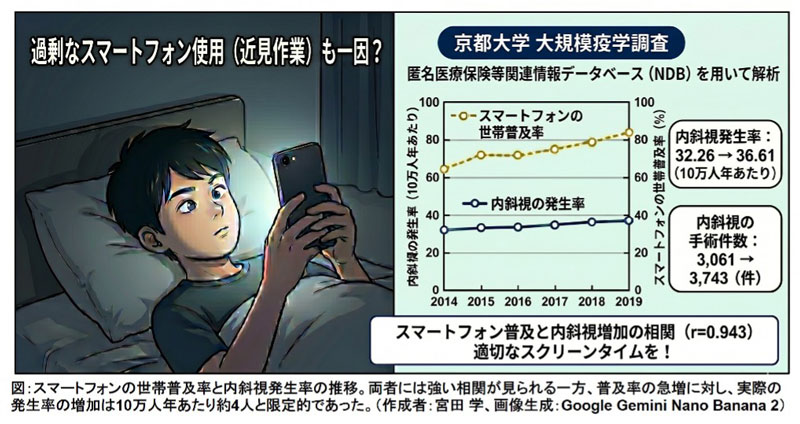
Source: Kyoto University press release
What is "esotropia," and why is everyone talking about it?
Esotropia is a type of strabismus, what English speakers casually call cross-eye, where one or both eyes turn inward instead of pointing at the same target. Most cases are present from infancy. But there is a less common variant, acute acquired comitant esotropia (AACE), that hits older children, teenagers, and young adults suddenly. People wake up seeing double. The world turns into a soft, slipping mess of overlapping images.
The condition is treatable, often with prism glasses or surgery on the small muscles that pull the eyes inward. It is not blindness. But it is disruptive enough that, when ophthalmologists in Japan, Korea, and elsewhere started noticing more young patients showing up with it around the mid-2010s, the obvious question was whether all those hours staring at phones, six inches from the face, were doing something to young eyes.
Case reports piled up. A 2016 Korean study at Chonnam National University Hospital described twelve adolescents with AACE, all of whom had been using smartphones more than four hours a day, often at a distance of under 30 centimeters. During the COVID lockdowns, similar reports came in from India, China, Hong Kong, Italy, and the UK as students were thrown into all-day online classes.
What none of those studies had was scale. A clinic seeing more cases is suggestive. A country-wide trend is evidence.
The Kyoto study, in one chart
That is where the new paper, published April 22, 2026 in PLOS Digital Health, comes in. Saori Wada, Manabu Miyata, Akitaka Tsujikawa, and their colleagues at Kyoto University's Graduate School of Medicine reached for Japan's NDB, the National Database of Health Insurance Claims and Specific Health Checkups, which captures essentially every insured medical encounter in the country. Japan has near-universal health coverage, so "essentially every" is closer to literal truth here than in most public-health datasets.
They counted new diagnoses of esotropia and esotropia-related surgeries for each year from 2014 to 2019, the precise window in which Japanese household smartphone penetration went from around 64% to over 83%, depending on the survey.
The headline numbers:
- Esotropia incidence rose from 32.26 per 100,000 person-years in 2014 to 36.61 in 2019. That is an average annual increase of about 2.49%.
- Esotropia-related strabismus surgeries climbed from 3,061 to 3,743 over the same six years.
- The annual incidence tracked smartphone household penetration with a correlation coefficient of r = 0.943 (p = 0.005), what statisticians politely call a strong association.
So yes, the curve goes up. And yes, it goes up in lockstep with the curve of smartphone adoption.
Now the part the tabloids leave out
Here is the framing the headlines rarely supply. Between 2014 and 2019, the number of smartphone users in Japan grew by more than 30 million. Over the same period, esotropia incidence rose by about 4 cases per 100,000 person-years. Tens of millions of new phone users; a few extra cases of cross-eye per hundred thousand.
If smartphones were creating esotropia, you would expect a much steeper response. What the Kyoto team see, instead, is consistent with a more modest story: heavy near-vision work, the kind a smartphone makes effortlessly available, may trigger the condition in people who already carry an underlying predisposition. Most users will never develop it. A few do.
Lead clinician Manabu Miyata, in a comment posted with the press release, was unusually blunt for a Japanese academic. He had been worried, he said, that sensational coverage of "soaring smartphone esotropia" was scaring people without basis. The increase in esotropia is extremely limited compared to the explosion in smartphone users, he wrote, the smartphone is a useful tool and there is no need to fear it excessively. What is needed, he added, is the discipline to use it well, and a calmer public conversation than the one Japan has been having.
That careful framing matters because the same dataset could easily be cut into a panic-button press release. "Esotropia incidence up 13.5% in six years!" is a true sentence. So is "Surgeries up 22%!" Both are also slightly misleading on their own, in a way the full numbers correct.
How smartphones could push the eye to cross
Even with the cautious framing, the mechanism is plausible enough that ophthalmologists worldwide take it seriously.
To look at something near your face, the eyes do three things at once, known as the near triad: they rotate inward (convergence), the lenses inside them change shape to focus (accommodation), and the pupils shrink. Smartphones, held closer than books and used for far longer at a stretch, push those systems hard. The medial rectus muscles, the small muscles that pull each eye toward the nose, stay tensed. In some people, that prolonged tension is hypothesized to spill into permanent inward drift even when the phone is gone.
This is still hypothesis. The Kyoto paper is an ecological study, population-level correlation, not a controlled experiment that proves any individual's cross-eye was caused by their phone. What it does is rule out the most reassuring counter-explanation, the one where "smartphone esotropia" is just better diagnosis or media-driven over-reporting. If the rise were diagnostic artifact, you would not expect it to track smartphone penetration this tightly.
What other countries are seeing
Japan is far from alone in watching this. South Korea has been the most active research base. A 15-year single-center study at Chonnam National University Hospital, published in Eye in 2024, tracked AACE cases from 2009 onward and reported a notable rise that aligned with both the smartphone era and the COVID-19 lockdown years. Smaller series from China, India, Italy, the UK, and Hong Kong followed similar patterns.
The American Academy of Ophthalmology, in contrast, has been careful not to overclaim. The AAO does not have specific recommendations on the amount of screen time for children, noting that parents should be aware of possible effects on children's eyes and the broader health concerns flagged by groups like the WHO. What it does emphasize, alongside the American Academy of Pediatrics, is the well-documented link between near-work and myopia, short-sightedness, a far more common consequence of life lived close to a screen than esotropia is.
The reading distance and posture matter as much as the device. So does time spent outdoors, which seems to protect young eyes regardless of how much screen time they also have.
What this means for parents, and for everyone else
Putting the Kyoto study next to the international picture, a few things land cleanly:
The data confirm that something real is happening to young eyes in the smartphone era, not just in Japan, but the Japanese numbers are the largest and cleanest evidence yet. The data also confirm that the absolute risk for any individual user is very small. Esotropia is not a smartphone disease in the way lung cancer is a tobacco disease.
What the data point to is something more like a vulnerability question. Some people's visual systems are more susceptible to the strain of sustained close work, and giving everyone in a society a hyper-portable near-work device for 16 hours a day is going to surface those vulnerabilities. The policy response, if there is one, is probably not "ban phones for teenagers." It is more along the lines of: screen breaks (the 20-20-20 rule popularized by US optometrists, every 20 minutes look 20 feet away for 20 seconds, is the standard nudge), longer reading distances, outdoor time, and a low threshold for getting evaluated if a child or young adult suddenly starts seeing double.
The Japanese ministry-level conversation about formal screen-time guidance, which the Kyoto team explicitly hopes their work will inform, has been stuck in the realm of "concerned editorials" for years. Hard numbers may finally move it.
For the rest of us, the practical advice is unchanged from what eye doctors have been saying for a decade. Hold the phone farther away. Take breaks. Get sunlight on your face. The Kyoto study did not blow up the smartphone. It just put a number on the price of using one badly.
So how does your country handle screen time for kids, formal rules, soft guidelines, or "figure it out yourself"? Let us know in the comments.
Sources
- Kyoto University: smartphone use and esotropia incidence (Japanese)
- University Journal Online: esotropia rising through the smartphone era (Japanese)
- PLOS Digital Health: the original paper
- BMC Ophthalmology (2016): AACE case series in Korean teenagers
- Eye (2024): 15-year single-center study at Chonnam National University Hospital
- American Academy of Ophthalmology: screen use and kids
- American Academy of Ophthalmology: digital devices and your eyes
- Kyoto University (2024): one in fifty Japanese has strabismus (Japanese)









Global Discussion
0 comments