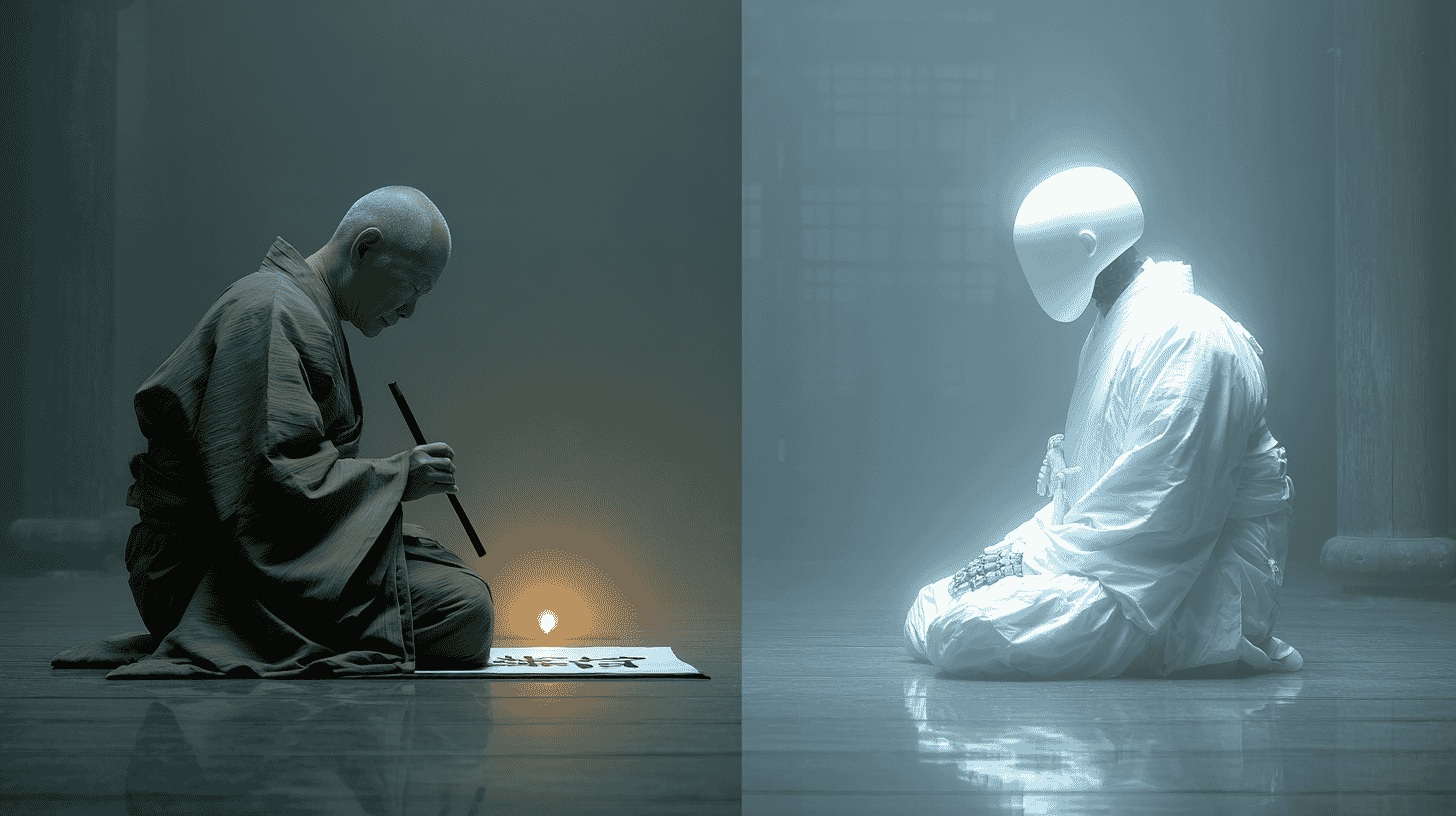
For 2,500 years, no one has been able to talk to the Buddha. His teachings survived only as scripture, memorized, copied, and interpreted across generations, but the dialogue itself was lost. Now, in a Kyoto temple, a robot monk presses its palms together in prayer and answers your deepest worries using AI trained on those very same ancient texts. With 30% of Japan's 77,000 Buddhist temples projected to vanish by 2040, is artificial intelligence the unlikely savior of one of the world's oldest spiritual traditions?
The Crisis: Japan's Temples Are Disappearing
Japan has roughly 77,000 Buddhist temples, more than the number of convenience stores in the country. But behind this staggering number lies an existential emergency.
Experts estimate that by 2040, around 30% of these temples will be forced to close. The causes are deeply intertwined: rural depopulation is draining the danka system (parishioner households that financially support local temples), priests are aging without successors, and younger generations are drifting away from organized religion.
Within the Soto Zen school alone, one of Japan's largest Buddhist denominations with 14,000 temples, the number of temples without a resident priest grew by roughly 30% in just 20 years, reaching 2,743 by 2005. In the most extreme cases, rural temples survive on support from as few as four households.
Adding to the pressure is a shift in funeral culture. Japanese funerals are among the world's most expensive, often costing several million yen (tens of thousands of dollars) when Buddhist rites and a posthumous name (kaimyo) are included. Dissatisfaction with these costs has driven many families toward non-religious "direct cremation" services or scattering ashes in forests and oceans. In Tokyo, more than a quarter of funerals are now conducted without any religious ceremony.
Buddhism in Japan has long been criticized as sōshiki bukkyō, "funeral Buddhism", a religion that became overly dependent on death rituals while losing its ability to serve the living. Now, with irreversible demographic decline compounding that structural weakness, temples face a stark choice: adapt or vanish.
Mindar: The $1 Million Android Goddess of Mercy
The first major attempt to fuse temple Buddhism with cutting-edge technology came in 2019, when Kyoto's historic Kodai-ji Temple unveiled Mindar, a 195cm, 60kg android modeled after Kannon Bodhisattva, the Buddhist deity of compassion and mercy.
Developed through a collaboration between the 400-year-old temple and robotics professor Hiroshi Ishiguro of Osaka University, Mindar cost approximately 100 million yen (about $1 million) to build. With a silicone face and hands, a camera embedded in its left eye for making eye contact, and the ability to gesture and bow, Mindar delivers a 25-minute sermon on the Heart Sutra, one of Buddhism's most widely known scriptures, with English and Chinese subtitles projected on the wall behind it.
The temple's chief steward at the time, Tensho Goto, framed the project through Buddhist philosophy: Kannon is a deity who can transform into anything to help those in distress. This time, Kannon had simply chosen the form of a robot.
The public response was mixed. Some visitors were moved to tears by Mindar's sermons. Others, particularly from Western countries, compared it to Frankenstein's monster. Research by Osaka University found that people rated Mindar as less credible than human monks, and those who watched the robot's sermon were 12% less likely to donate to the temple than visitors who hadn't seen it.
But Mindar had a fundamental limitation: it could only deliver pre-programmed sermons. It couldn't listen, respond, or engage in the kind of back-and-forth dialogue that spiritual guidance often requires. The next evolution would need artificial intelligence.
BuddhaBot: Training AI on the Buddha's Words
That evolution came from Seiji Kumagai, a professor at Kyoto University's Institute for the Future of Human Society, and himself a Buddhist priest. Kumagai started from a deceptively simple observation: for 2,500 years, humans haven't been able to have a conversation with the Buddha. What if technology could restore something close to that experience?
In 2021, Kumagai and Teraverse CEO Toshikazu Furuya released the first version of BuddhaBot, an AI chatbot trained on the Sutta Nipata, one of the oldest surviving collections of the Buddha's dialogues with his disciples. Using Google's BERT machine-learning algorithm, the system matched users' questions with relevant scriptural responses.
By 2023, the project evolved into BuddhaBot Plus, built on OpenAI's ChatGPT. This version could generate more natural, contextual responses and provide interpretations of Buddhist teachings rather than just retrieving passages. The team also developed specialized variants: VasubandhuBot (based on the consciousness-only school of Buddhist philosophy) and ShinranBot (trained on the teachings of Shinran, founder of the Jodo Shinshu sect).
An augmented reality version, "Tera Platform AR," lets users point their smartphone camera at a space and interact with a virtual Buddha figure overlaid on the real world. And the broader "Teraverse" project, a portmanteau of tera (Japanese for temple) and metaverse, envisions a virtual Buddhist world where anyone on Earth can visit Japanese temples digitally.
Buddharoid: The Robot That Walks, Prays, and Listens
In February 2026, the project took its most dramatic leap yet. At Kyoto's Shoren-in Temple, Kumagai's team unveiled Buddharoid, a humanoid robot monk equipped with the BuddhaBot Plus AI system.
Built on a Unitree Robotics G1 humanoid from China, Buddharoid has been programmed to move like a monk: slow, deliberate walking; respectful bowing; and gassho, the traditional Buddhist gesture of pressing both palms together in prayer. These movements are intentionally unhurried, designed to put visitors at ease rather than overwhelm them with technology.
During its public debut, a young NHK journalist told Buddharoid that she worried too much and overthought things. The robot responded in a calm, deep voice: "Buddhism teaches that it is important not to blindly follow one's thoughts or rush headlong into things. One approach is to calm your mind and let go of the thought itself."
Unlike Mindar's scripted sermons, Buddharoid holds real-time conversations. It can address anxiety, family problems, and life concerns by drawing on Buddhist scripture, and it can project translations in English and Chinese simultaneously.
The robot is currently in a testing phase at the temple, with engineers monitoring its responses and working to improve how it handles complex emotional situations. If trials succeed, similar AI monks could eventually be deployed at temples across Japan, offering 24/7 spiritual guidance even where no human priest is available.
From the Ground: How One Temple Is Already Using AI
Not all AI adoption in temples involves humanoid robots. At Ganshuji Temple in the coastal city of Odawara, Kanagawa Prefecture, resident monk Souou Iwayama has been integrating AI into daily operations in more practical ways.
When Iwayama took over the temple, it had just four danka households. He introduced online zazen (seated meditation) sessions during the pandemic, and converted the traditional cemetery to jumokusō, "tree burial," where cremated remains are interred beneath trees and flowers rather than expensive stone monuments. Today, over 550 families use the temple's burial plots.
Now, Iwayama uses AI to manage memorial service schedules and refine written communications for parishioners. His approach is pragmatic rather than philosophical: technology is a tool for a monk's mission, not a replacement for it.
"Rather than seeing AI as a threat, we as monks must consider how it can be incorporated into our own efforts at propagation," he says. But he draws a clear line at the most human moments of his work. Taking a reporter's hand during an interview, he said: "When someone dies, and you hold their hand like this, telling them it will be all right, that moment matters. There's something essential in a human presence, where body and mind come together in an instant. I don't imagine that being replaced."
Beyond Japan: BuddhaBot Goes to Bhutan
While no religious institution in Japan has formally adopted BuddhaBot, interest is growing internationally.
In Bhutan, where Buddhism remains deeply embedded in public life, the Central Monastic Body has partnered with Kyoto University to explore the chatbot's use in educational and religious settings. Up to 200 monks are already testing the system in pilot programs, with discussions underway about broader deployment in monastic institutions and schools under clerical supervision.
The collaboration is significant: it marks the first instance of a Buddhist AI system being tested within an actual religious governance structure, rather than as an academic experiment or tourist attraction.
Kumagai's team has also developed a Protestant catechism bot that draws on Bible passages, signaling that the "traditional wisdom tech" concept could extend well beyond Buddhism.
The Debate: Where Does Faith End and Code Begin?
The fusion of AI and religion inevitably raises uncomfortable questions.
Kumagai himself is candid about the risks. As AI systems become more sophisticated, he worries users may lose the ability to distinguish between a simulation and a genuine spiritual source. "With increasing precision, AI could plausibly be worshipped by some as a god," he says. "In fact, it may already be taking on that role."
There are also concerns about dependency. Reports have linked intense chatbot interactions to self-harm, and the phenomenon of people seeking emotional or even romantic relationships with AI is well documented. In the religious context, an AI that gives spiritual guidance could acquire undue authority, especially if unscrupulous actors use such tools to steer people toward particular beliefs for profit or influence.
In Japan, these worries carry historical weight. The Aum Shinrikyo doomsday cult, which carried out the 1995 Tokyo subway sarin attack, remains a cautionary tale about the dangers of unchecked religious authority. Even without malicious intent, errors in AI-generated responses about faith could mislead vulnerable people.
Yet some scholars point to Japan's unique cultural framework as a reason for cautious optimism. The concept of yaoyorozu no kami, eight million gods, reflects a worldview in which divinity exists in all things: mountains, rivers, trees, even everyday objects. In such a tradition, the addition of one more "entity" may feel less transgressive than it would in monotheistic cultures. As one researcher observed: "In Japan, there's a kind of openness about gods since they're everywhere anyway. Having one more wouldn't seem so strange."
Where Travelers Can Experience AI-Powered Temples
For visitors interested in seeing this techno-spiritual fusion firsthand:
Kodai-ji Temple, Kyoto, Mindar continues to deliver sermons on the Heart Sutra, typically on Saturdays and Sundays (advance reservation required, free of charge). English and Chinese subtitles are projected during the 25-minute sermon.
Shoren-in Temple, Kyoto, Buddharoid was unveiled here in February 2026 and continues to attract attention. While still in a testing phase, public demonstration opportunities may expand as the project develops.
Tsukiji Hongwanji, Tokyo, This temple operates a high-tech indoor ossuary with smartcard-operated memorial altars storing over 2,000 sets of remains. It represents a different but equally striking example of how Japanese Buddhism is adapting to modern life.
Final Thought: Can Technology "Preserve" Faith?
"As long as I, the creator, keep saying 'It's not the Buddha,' I don't think there's a problem," Kumagai says. This single sentence may be the most important guardrail in the entire AI-religion conversation.
AI can memorize scriptures, generate spiritual advice, press its palms together in prayer, and walk through a temple hall. But when someone is dying, it's still a human hand that holds theirs. In a rapidly evolving technological landscape, Japan's temples are navigating the boundary between what machines can do and what only humans should.
If your local church, mosque, or temple introduced an AI priest, how would you feel? Would you see it as innovation, or sacrilege? We'd love to hear how people in your country think about the intersection of religion and technology.
References
- https://www.japantimes.co.jp/life/2026/04/13/lifestyle/buddhism-shinto-ai-religioin/
- https://www.tokyoweekender.com/entertainment/tech-trends/ai-powered-robot-monk-buddharoid/
- https://colombiaone.com/2026/02/26/japan-introduces-first-ai-buddhist-monk-robot-support-shrinking-temples/
- https://www.euronews.com/next/2026/02/25/meet-buddharoid-japans-ai-powered-robot-monk-trained-in-centuries-of-buddhist-scripture
- https://en.wikipedia.org/wiki/Mindar
- https://www.buddhistdoor.net/news/buddhabot-further-progress-made-on-ai-enlightenment-software-at-kyoto-university/





Global Discussion
15 comments