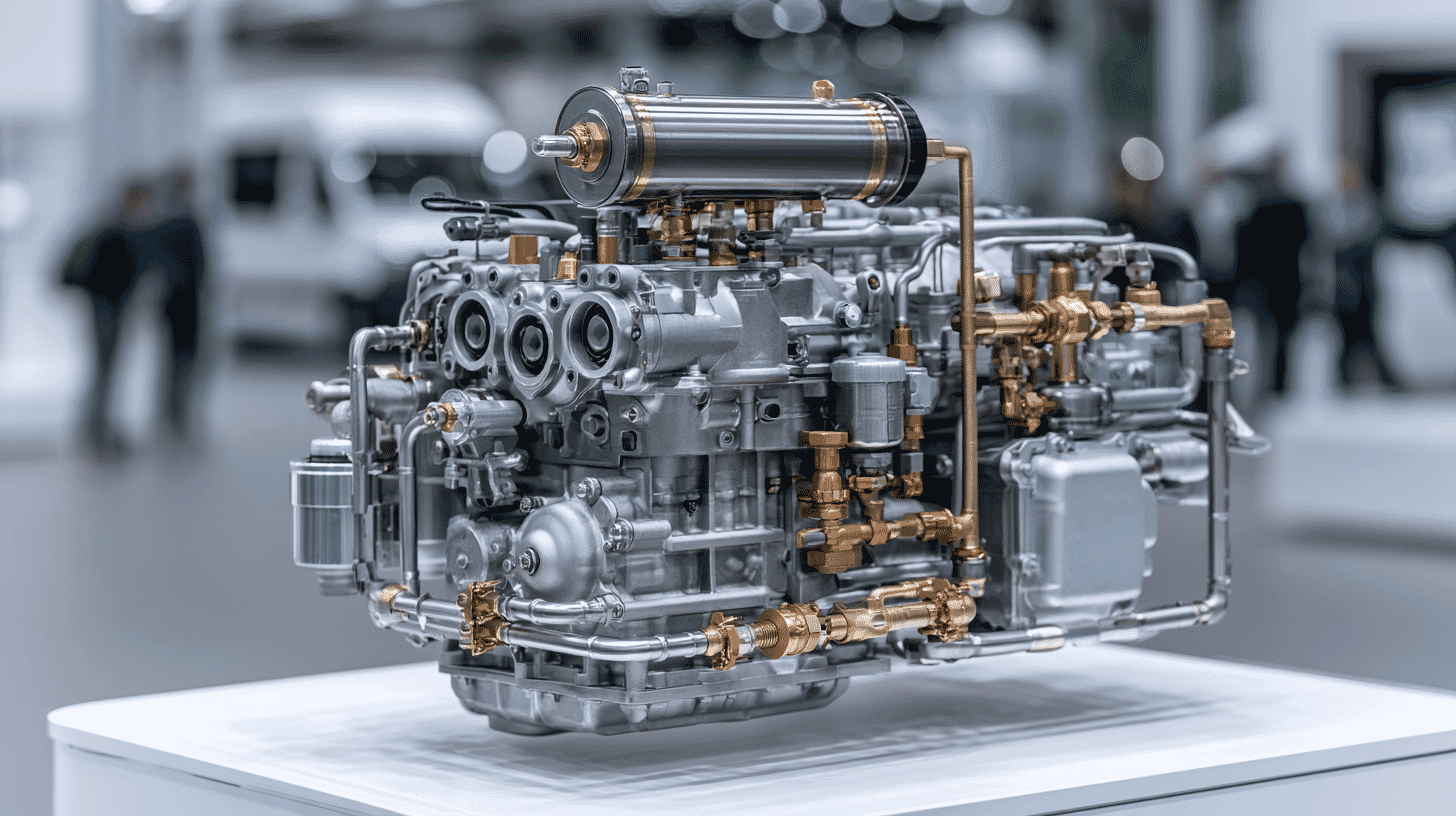
🔥 Ammonia is a lousy fuel to burn. Its flame crawls at one-sixth to one-ninth the speed of gasoline's, and it is far harder to ignite. To make it work in a kei car engine, Daihatsu decided to turn part of it into hydrogen on the car itself.
The engine was shown in the metal for the first time at Japan Mobility Show Bizweek 2026 (October 13–16, 2026, Makuhari Messe, Chiba). Response, a Japanese car news site, headlined it as an "ammonia engine" that Daihatsu aims to put to practical use in the 2030s. Daihatsu's own release, dated October 6, 2026, says neither. It calls the unit an ammonia/hydrogen co-combustion engine, gives no launch timing, displacement or output, and lists problems the company wants outside partners to help solve.
How badly does ammonia burn?
The Advanced Motor Fuels program run under the International Energy Agency (IEA AMF) publishes a property table that puts numbers on it.
| Ammonia | Gasoline | |
|---|---|---|
| Laminar flame speed | 0.067 m/s | 0.41–0.58 m/s |
| Minimum ignition energy | 680 mJ | 1.35 mJ (iso-octane) |
| Energy per liter | 12.69 MJ/L | 30.93 MJ/L (n-octane) |
Flame speed is how fast the burning front moves through the fuel-air mix. Inside an engine turning thousands of times a minute, a slow flame means fuel that hasn't finished burning when the exhaust valve opens.
Minimum ignition energy is the size of the spark it takes to light the mixture. Against iso-octane, the reference compound used to rate gasoline, ammonia needs about 500 times more. And a liter of liquid ammonia holds about 41% of the energy in a liter of gasoline. AMF notes that its table is for comparison and that not every value comes from experiments.
The fix: make hydrogen on the car
Daihatsu's answer is to carry only ammonia. Mounted on top of the engine are a plasma reactor and a catalytic reformer. Together they split part of the ammonia into hydrogen, which lights easily and burns fast, and the two fuels go into the cylinders together. In the release's words, the goal is to secure driving range and stable combustion at the same time.
On how much is reformed, MotorFan put the current hydrogen share at about 30%, with raising it listed as future work. Best Car gave a looser range, from a few percent to a few tens of percent.
The plasma reactor is mainly a cold-start device. MONOist reported that once combustion stabilizes, the catalyst, activated by engine heat, takes over the reforming, so the plasma unit no longer needs to run. A Daihatsu staff member told MONOist the company had already been developing plasma and catalyst technology for exhaust treatment and applied it here.
Carrying ammonia instead of hydrogen solves a storage problem. Ammonia stays liquid at 20°C under about 8.6 bar of pressure, according to NIST data. Hydrogen has to be cooled below −253°C to become liquid, according to the US Department of Energy. Daihatsu's release calls ammonia relatively energy-dense, and against hydrogen that holds: IEA AMF says liquid ammonia carries significantly more energy per liter than compressed or liquefied hydrogen.
Source: Daihatsu Motor
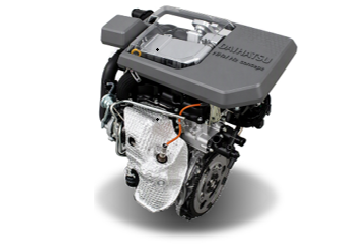
MONOist gives the unit as 800 mm wide, 700 mm long and 1,350 mm tall, weighing about 60 kg. It is a three-cylinder unit; reports split on displacement between 658cc (MONOist, Best Car) and 660cc (Response, MotorFan). Output and torque have not been disclosed. MotorFan reported range at about half that of a gasoline car and about double that of a hydrogen-engine car, but Best Car and Norimono News were both told that fuel economy and range can't be disclosed yet.
Why start with a kei car?
"Ammonia suits kei cars, which face tighter size and weight limits than regular cars," a Daihatsu staff member told MONOist, adding that its reluctance to ignite is the challenge.
Kei cars are a Japan-specific class of small car, capped at 3.40 m long, 1.48 m wide, 2.00 m tall and 660cc. The current length and width limits date from October 1998; the 660cc cap from 1990.
At the end of July 2026, Japan had 32.3 million kei vehicles on the road, 40.9% of its motor vehicle fleet, according to the national kei vehicle association (Zenkeijikyo), citing transport ministry data.
Source: Daihatsu Motor
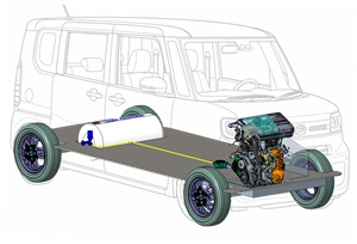
That puts four in ten vehicles in a class with little space or weight to spare for a large battery. Response reported that the company is considering pairing the engine with a series hybrid, where the engine only generates electricity, and MONOist linked it to the e-SMART HYBRID system Daihatsu showed at the 2025 Japan Mobility Show. MotorFan added that the tank, corrosion protection and hydrogen-generating system will inevitably push up the price of the car.
The unsolved problems, published as a call for partners
For this engine, the release says Daihatsu is looking for partners to work with it on downsizing, safety technology, ammonia reforming, exhaust cleanup and fuel supply infrastructure. The release describes a fix only for ignition, through hydrogen co-combustion.
Nitrogen oxides. Ammonia contains nitrogen, so burning it produces NOx. MotorFan wrote that NOx can be handled by catalytic aftertreatment. Best Car reported that the team is struggling to develop a good enough catalyst. No emission figures have been released.
Leftover ammonia and smell. A Daihatsu staff member told Norimono News that the exhaust should contain only nitrogen and water, but some ammonia currently remains. The car can't drive around "spreading a pungent smell," the staffer said, so treatment while the catalyst is still cold is the current challenge. In the US, OSHA's chemical database lists 300 ppm as the level immediately dangerous to life or health and 25 ppm as NIOSH's recommended workplace limit. Norimono News added that because ammonia is a regulated poisonous and deleterious substance in Japan, wider use would need both infrastructure and changes to the law.
Nitrous oxide. N2O has a global warming potential of 273 over both 20 and 100 years, according to the IPCC. IEA AMF expects ammonia engines to emit under 50 ppm on average, but notes that low-load combustion promotes N2O formation. There is also a trade-off: rich mixtures cut NOx but raise unburned ammonia and hydrogen. A small car that spends much of its time at light load in city traffic is likely to meet those conditions often. AMF also notes that SCR catalysts, which use ammonia itself as the reducing agent, can bring NOx down to very low levels.
The launch date that isn't in the release
Response wrote that Daihatsu is reportedly aiming for practical use in the 2030s. MotorFan also mentioned the 2030s. Best Car asked when the engine would come out and got no clear answer; it was told the engine on its own could be ready fairly soon. MONOist didn't mention timing.
These outlets covered the same booth, so the "2030s" figure most likely came from verbal explanations there, written up differently by each. It is a reported target, not a company commitment.
No CO2 at the tailpipe, plenty at the plant
Ammonia (NH3) contains no carbon, so burning it puts no CO2 out of the tailpipe. Making it is another matter. According to the IEA's 2021 Ammonia Technology Roadmap, 72% of ammonia in 2020 came from natural gas and 26% from coal. Direct emissions run to about 2.4 tonnes of CO2 per tonne of ammonia, or 450 million tonnes across the industry. IEA AMF cites a figure of more than 3 tonnes per tonne once production, transport and storage are counted, comparable to burning fossil fuels directly.
Cleaner routes exist but cost 10–100% more per tonne, and projects due online by 2030 total nearly 8 million tonnes, 3% of 2020 capacity. Daihatsu's release says nothing about where the fuel would come from. Japan's power sector has already been through this argument over ammonia co-firing at the Hekinan power plant.
At sea, it's already running
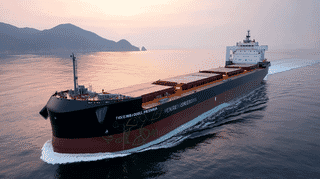
NEDO, citing IHI Power Systems, calls the company's engine the world's first marine four-stroke ammonia-fueled engine. IHI installed it on the tugboat Sakigake, and demonstration voyages in fiscal 2024 succeeded with a co-firing rate over 90%, up to about 95%, and a GHG cut of over 90%. Aftertreatment brought ammonia and N2O in the exhaust to near zero. Daihatsu has to do the same in a 60 kg unit that fits a kei car.
Sakigake was not the first ship to burn ammonia. In March 2024, Australia's Fortescue ran a trial in Singapore in which two four-stroke engines on its Green Pioneer burned ammonia together with diesel, Argus reported. Fortescue's engines were converted existing units; IHI developed its engine for ammonia.
Daihatsu also isn't the first carmaker with an ammonia engine. China's GAC presented a 2.0-liter, 120 kW ammonia engine in 2023, New Atlas reported. Daihatsu's own claim is narrower: the first public showing of its actual unit.
China, Europe and Japan's carmakers
China's market has gone heavily electric. New energy vehicles took 61.6% of China's new vehicle sales in September 2026 and 53.6% from January to September, according to CAAM data reported by CnEVPost.
Europe is wavering. On December 16, 2025, the European Commission proposed changing the 2035 target for new cars from a 100% to a 90% cut in tailpipe CO2, leaving a role for plug-in hybrids and combustion engines beyond 2035. As of October 2026, Parliament and Council had not adopted it. The ICCT warned that if the offsets are weak, the battery-electric share in 2030 could fall from 61% to 44%.
Japanese carmakers are keeping more than one door open. Toyota raced its liquid-hydrogen GR Corolla H2 concept at the Fuji 24 Hours in June 2026, though no production plan has been announced. Daihatsu's ammonia engine, still under development, is at an earlier stage.
If your country's roads are full of small cars, would you rather put a small chemical plant under the hood, or wait for batteries to get lighter?
References
- https://www.daihatsu.com/jp/news/2026/20261006-1.html
- https://response.jp/article/2026/10/14/417762.html
- https://motor-fan.jp/article/1649525/
- https://bestcarweb.jp/japan-mobility-show/1654812
- https://monoist.itmedia.co.jp/mn/articles/2610/14/news036.html
- https://trafficnews.jp/post/717690
- https://www.iea-amf.org/content/fuel_information/ammonia/fuel_properties
- https://www.iea-amf.org/content/fuel_information/ammonia/emissions
- https://webbook.nist.gov/cgi/fluid.cgi?Action=Data&Wide=on&ID=C7664417&Type=SatP&Digits=5&THigh=20&TLow=20&TInc=1&RefState=DEF&TUnit=C&PUnit=bar
- https://www.energy.gov/eere/fuelcells/liquid-hydrogen-delivery
- https://www.zenkeijikyo.or.jp/kei/standards
- https://www.zenkeijikyo.or.jp/statistics/4own
- https://www.osha.gov/chemicaldata/623
- https://www.ipcc.ch/report/ar6/wg1/downloads/report/IPCC_AR6_WGI_Chapter07.pdf
- https://iea.blob.core.windows.net/assets/6ee41bb9-8e81-4b64-8701-2acc064ff6e4/AmmoniaTechnologyRoadmap.pdf
- https://www.nedo.go.jp/news/press/AA5_101915.html
- https://www.argusmedia.com/en/news-and-insights/latest-market-news/2548235-ammonia-fuelled-vessel-trialled-in-singapore
- https://newatlas.com/automotive/gac-china-ammonia-engine/
- https://cnevpost.com/2026/10/12/china-sept-2026-nev-sales-caam/
- https://ec.europa.eu/commission/presscorner/detail/en/ip_25_3051
- https://oeil.europarl.europa.eu/oeil/en/procedure-file?reference=2025%2F0420%28COD%29
- https://theicct.org/publication/european-commissions-risks-and-opportunities-of-the-proposed-co%E2%82%82-standards-dec25
- https://global.toyota/en/newsroom/corporate/44458612.html
- https://toyotatimes.jp/en/toyota_news/hpe_challenge_2026/005.html







Global Discussion
4 comments