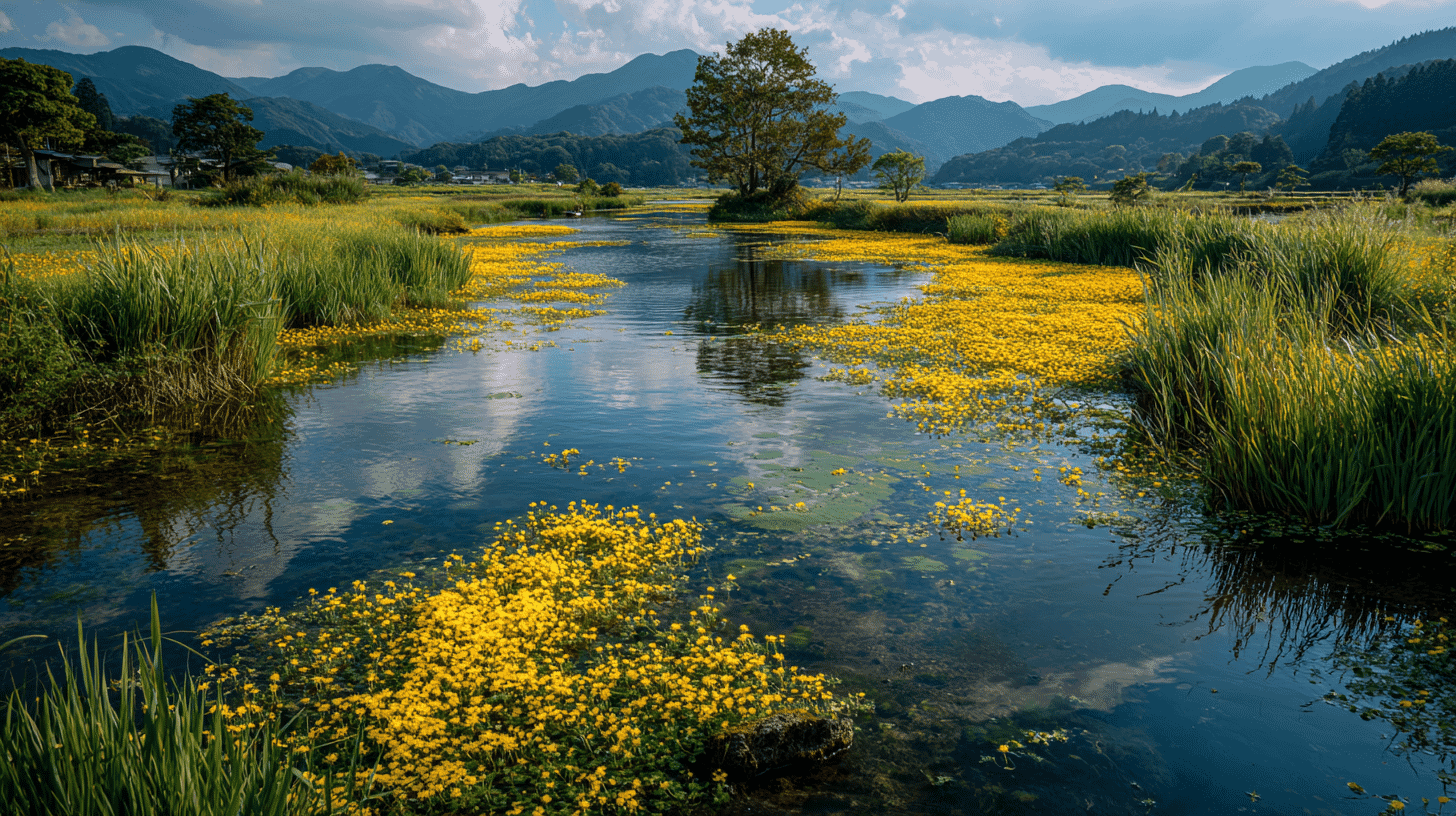
🌼 From a distance it looks like a postcard: a paddy field blanketed edge to edge in bright yellow flowers. But for rice farmers in central Japan, that golden carpet is a slow-motion disaster. The plant is water primrose, a South American invader so stubborn that a single shred of stem can rebuild an entire colony. Farmers spent all winter tearing it out by hand. By the time the rice seedlings went in this spring, it was already coming back.
A Yellow Carpet Where Rice Should Be
In Kuwana, a city in Mie Prefecture, a stretch of farmland that should be flooded paddies for the new rice season looked, last summer, like a flower garden. One side of a farm road was an ordinary green paddy. The other side was nearly half-covered in vivid yellow blooms, and dotted here and there with the rice plants that were supposed to be growing there.
Local growers say they first noticed the plant about three or four years ago. At first nobody paid it much attention; it looked like just another weed. Then, almost overnight, it spread from the irrigation channels into the paddies themselves. According to reporting by Japanese broadcaster CBC, farmers described their first reaction as bafflement, a plant nobody recognized had simply moved in, and once it took hold, it began eating into their harvest. One rice farmer summed up the economics bluntly: the crop suffers, yields fall, and there is no scenario where this turns a profit.
What alarms specialists is not just the spread, but where it is spreading. Shinya Hieda, a curator at the Toyohashi Museum of Natural History and one of Japan's leading researchers on the plant, told CBC that water primrose had long been seen invading canals, ponds and lakes, but cases of it growing thick inside actual rice paddies were uncommon. In his words, the "stage of invasion" appears to be advancing.
Why It Refuses to Die
The plant's full name is Ludwigia grandiflora, native to South America and the southern United States. Japan designated it an "Invasive Alien Species" in June 2014, which makes it illegal to cultivate, keep or transport. It was first found growing wild in Japan back in 2007, in Kasai, Hyogo Prefecture.
Its real weapon is regeneration. Water primrose reproduces in two ways: by seed, and, from roughly March to November, by simply breaking apart. A stem snaps, a fragment drifts downstream, it lands somewhere new, puts down roots, and starts a fresh colony. There is no need for flowers or pollination. Cold winters kill most of the visible growth, but surviving fragments resprout, and the seeds can lie dormant in mud and germinate later. In a Japanese government weed-risk assessment based on a United Nations FAO method, water primrose scored as the single highest-risk species out of nine invasive plants compared.
The numbers from Lake Biwa, Japan's largest lake, show what that means in practice. Water primrose was first found there in 2009, in Akanoi Bay on the lake's southern basin, covering just 142 square meters. Despite crews clearing some 18,000 square meters by hand, by the end of fiscal 2013 it covered 64,880 square meters, roughly 450 times the original patch. At its widest it sprawled across about 270,000 square meters, the area of some seven baseball stadiums, smothering native reeds that help keep the water clean and tangling in fishing nets and boat propellers.
There is a quieter danger too. Water primrose can cross-breed with native relatives, Ludwigia peploides subsp. stipulacea and Ludwigia ovalis, both listed as endangered in Japan. So the invader does not only crowd natives out physically, it can scramble their genes.
Eradication That Never Ends
Back in Kuwana, one farmer, Mr. Mori, threw everything he had at the problem over the winter. He applied herbicide and then tilled the soil as finely as possible, working the plant fragments deep underground on the theory that, buried and starved of oxygen, they would die. It worked well enough that he managed to plant his rice on schedule in April.
But the wider battle is far harder. In September 2025, around 60 people, prefectural and city staff, local farmers, gathered for a full-scale removal operation, preceded by a training session led by experts from Shiga Prefecture, who have spent years fighting the plant around Lake Biwa. The care they take is telling. Heavy machinery can clear large areas fast, but it also flings fragments everywhere, and each fragment is a future colony. So crews follow up by hand, pulling roots, and skimming even the small floating pieces off the water surface with fine-mesh nets. Everything removed has to be incinerated, composting is too risky, because the plant can simply re-root from the pile. Because the stems stay green even in winter, there is never really an off-season.
None of this is cheap. By 2018, Shiga Prefecture's removal and incineration costs had reached around 330 million yen, roughly 2 million US dollars, and the work has not stopped since. And the obvious hope, biological control, has not delivered an easy answer. Researchers in the US, working with insects collected from the plant's native range in Argentina and Uruguay, have tested flea beetles and thrips as potential natural enemies. The recurring problem: the insects are not picky enough. In lab trials they happily fed on native plants too, which makes them too dangerous to release. For now, control still comes down to muscle, machinery and herbicide.
The Same Plant Is Wreaking Havoc Worldwide
This is not a Japanese problem with a Japanese solution. Water primrose has gone global, and almost always the same way: it escapes from garden ponds and aquariums.
France has it worst. The plant was brought there in the 19th century as an ornamental and has since spread into at least nine European countries, including Belgium, Germany, Italy, the Netherlands, Spain and the UK. Controlling it has cost the French economy millions of euros. In the Marais Poitevin wetlands, authorities have spent on the order of 200,000 euros, about 230,000 dollars, every year since 2000 just to keep it in check.
Britain caught it earlier. Water primrose was first recorded in the wild there in 1998; a coordinated national eradication program began in 2009, and in 2014 the plant was banned from sale in England and Wales. UK officials framed it less as an ecological nuisance than as a flood risk, dense mats of the stuff clog rivers and ditches and back up the water. In the United States, it has naturalized in the wetlands of California, where land managers are still searching for a workable long-term fix.
The common thread is uncomfortable. A pretty pond plant, sold cheaply at garden centers, turns into an ecological wrecking ball the moment it gets loose.
Holding the Line
Experts who have fought water primrose the longest tend to agree on one hard truth: once it is fully established across a watershed, you probably cannot eradicate it, you can only contain it. That shifts the whole strategy toward catching invasions early. Japan's responders now map out "priority monitoring zones," lay light-blocking sheets to smother regrowth, and lean heavily on a simple public message borrowed from the country's broader invasive-species playbook: don't introduce it, don't dump it, don't let it spread.
The Kuwana paddies are a small front in a long war. A farmer can win one winter, plant his rice, and still watch the yellow flowers creep back by summer. The plant does not get tired, and it does not need much, just one stray fragment and a little water.
Plenty of countries are fighting their own version of this. In your part of the world, is there a plant, beautiful, often sold in shops, that turned out to be impossible to get rid of? And did anyone manage to stop it in time?
References
- https://news.yahoo.co.jp/articles/83222a8cd9a7abeffe98f75e87d22422fe3464e2
- https://news.yahoo.co.jp/articles/37d1119268b2033c02a989aa8ff2f5829792e0da
- https://www.env.go.jp/nature/intro/3control/files/oobana_nagae.pdf
- https://www.pref.shiga.lg.jp/ippan/kankyoshizen/shizen/14022.html
- https://www.town.fuso.lg.jp/kurashi/1001731/1004503.html
- https://research-er.jp/projects/view/1010041
- https://invasivespeciesni.co.uk/species-accounts/potential/freshwater/water-primrose
- https://pmc.ncbi.nlm.nih.gov/articles/PMC8159108/
- https://ucanr.edu/blog/uc-weed-science/article/biological-control-invasive-water-primroses








Global Discussion
4 comments