
🌱 "I can hear plants talking."
Say that out loud and people start edging toward the door. Occult nonsense? A crystal-healing crank? Someone who never grew out of their secret-superpowers phase? What kind of psychic are you, exactly?
But what if it were true? Hold on, don't close the tab just yet. Relax: this is actual, peer-reviewed science.
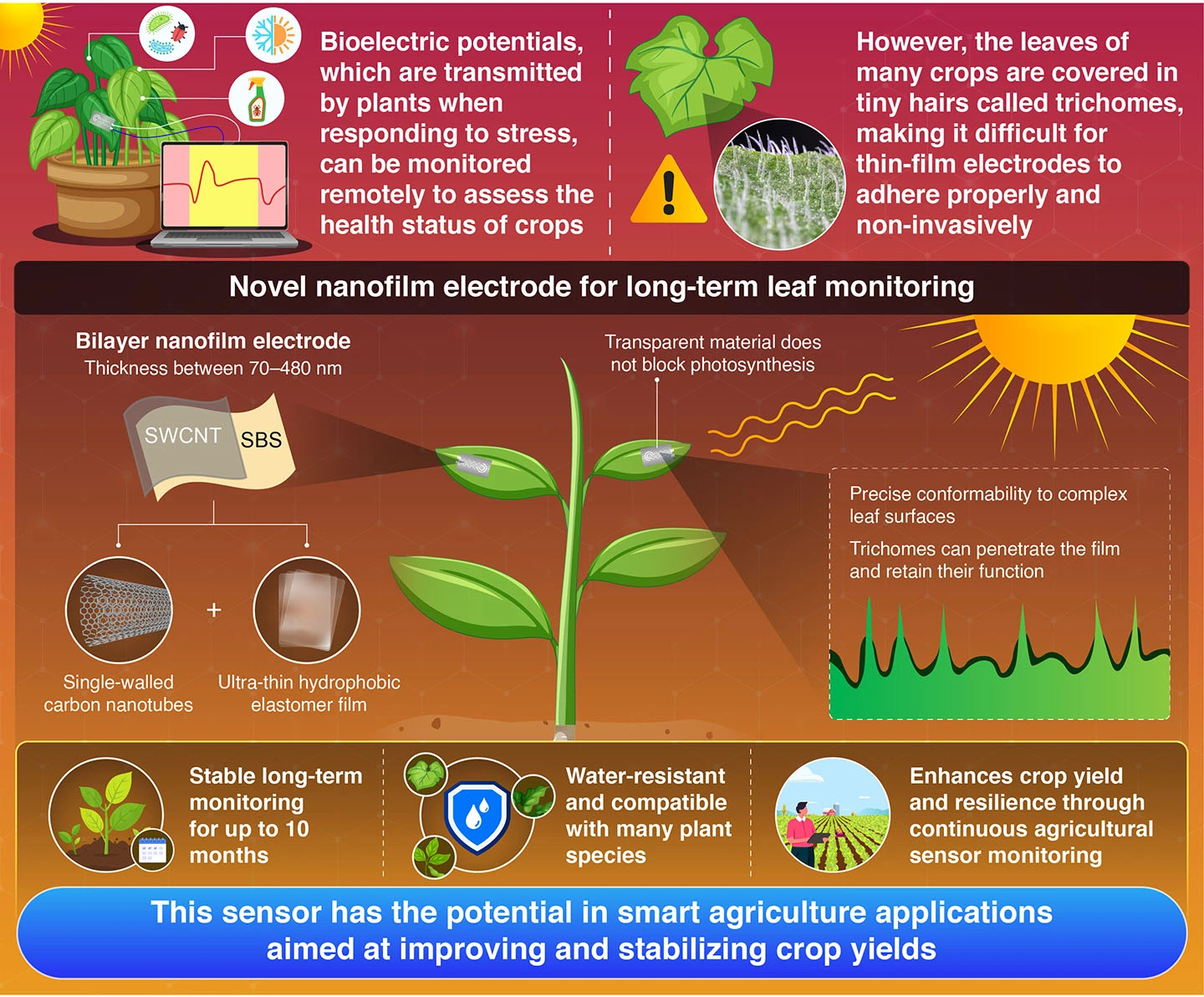
A team at Japan's Institute of Science Tokyo has built a film thin enough to eavesdrop on a living leaf for up to ten months, picking up the faint electrical signals a plant gives off when something's wrong. And the breakthrough wasn't a smarter sensor. It was a thinner one.
Source: Institute of Science Tokyo
Plants are already talking
It turns out plants have an electrical life. When a leaf gets too hot, too dry, or comes under attack from disease, the plant's cells shift their voltage, sending a faint bioelectric signal rippling through the tissue. Researchers have known about this for decades. The dream has always been to eavesdrop on it: if you could read a crop's distress signal the moment it appeared, you could water it, shade it, or treat it before any damage showed up on the leaf.
The catch is that these signals are tiny, and getting a clean reading off a living leaf for weeks at a time has been stubbornly hard. Needle electrodes pierce the plant and are sensitive, but they wound the tissue. Gel electrodes sit gently on the surface but dissolve in the rain, which rules out an actual field. Thin-film electrodes looked like the answer, until they ran into a very ordinary obstacle: leaf fuzz.
The problem was fuzzy leaves
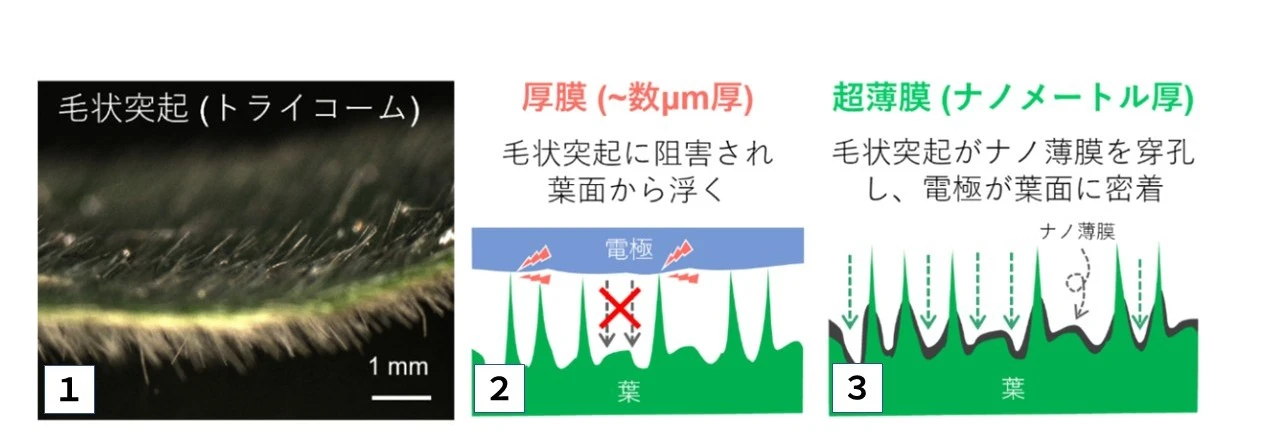
Look closely at a tomato, eggplant, or soybean leaf and you'll see it's covered in trichomes: microscopic hairs. They're not a defect; they help the plant manage gas exchange and fend off pests. But for anyone trying to stick a flat electrode onto the leaf, they're a nightmare. A conventional thin film just rests on top of the hairs, hovering a hair's breadth above the surface it's supposed to touch. The contact is poor, the signal is noisy, and over time wind and movement tear the film loose.
So the leaves you'd most want to monitor, the ones on the world's staple crops, were exactly the ones the technology couldn't handle.
The fix was to go thinner
The team led by Professor Toshinori Fujie took the counterintuitive route. Instead of pressing harder or adding adhesive, they made the electrode so thin it stopped fighting the hairs and let them through.
Their film is a two-layer sandwich: a conductive sheet of single-walled carbon nanotubes laid over a rubbery elastomer support, produced by a coating method that let them dial the thickness from 480 nanometers down to 70. (For scale, a human hair is around 70,000 nanometers across.) At the conventional ~500 nm, the film floated uselessly on the trichomes. But once they got into the 70 to 320 nm range, something elegant happened: the hairs simply punctured the film and poked through, and the electrode settled onto the leaf's actual surface. The thinnest 70 nm film held fast regardless of how dense or oddly shaped the hairs were. The reason is physics: bending stiffness collapses as a sheet thins, and a 70 nm film is floppy enough to drape into the gaps between hairs. The piercing worked the same way on leaves as different as soybean and eggplant.
Source: Institute of Science Tokyo
Thinness paid off twice over. The film is transparent, letting through more than 80% of the light a leaf needs for photosynthesis (a typical gel electrode passes only about 40%), so the plant goes on living normally underneath it. And the tighter contact slashed the electrical noise: the contact's electrical impedance dropped to between one-eighth and one-fiftieth of the thicker film's.
Ten months, through the rain
Contact is one thing; surviving outdoors is another. Here the carbon nanotubes turned out to have a hidden advantage: they're water-repellent. In a test simulating heavy rain, electrodes made from a common conductive polymer soaked up water and peeled off the leaf. The nanotube film shrugged off the stream and kept recording. The thick 480 nm film lost its signal within two weeks as it flapped loose; the 70 nm version was still stable past two weeks in the same comparison, and in separate long-run tests kept recording high-quality signals for more than two months, in some cases ten, with no visible harm to the plant.
Then came the real test: could it actually hear a plant in trouble? The researchers dosed leaves with DCMU, a herbicide that blocks photosynthesis, and watched the signal. When the plant was lit, the electrical response from a poisoned leaf dropped to about a third of a healthy one's: a clear electrical fingerprint of stalled photosynthesis, picked up before any browning or wilting. That early-warning quality is the whole point. Fujie's argument is that the method catches a plant's physiological stress without harming it, well before things get bad enough to cut into the harvest, and that he sees it heading for use in real farm fields.
From the lab to the dinner table
It's a long way from a soybean leaf in a Tokyo lab to a working farm, and the team is upfront about that. Wind, vibration, and the chaos of an open field still need solving, and the next steps include noise-resistant wiring and AI that can read the squiggly voltage traces alongside temperature and humidity data to flag drought, malnutrition, or pests early.
But the appeal is easy to see. As climate swings and pesticide resistance squeeze harvests, the idea of crops that can tell you they're struggling, quietly and electrically, months before they wilt, stops sounding like science fiction. The paper appeared in the journal Advanced Science on March 23, 2026, and Science Tokyo's plain-language writeup, the one that calls it listening to a plant's "voice," went out in June.
In Japan, where an aging farming population and a tight food self-sufficiency rate make every harvest count, the promise of fewer wasted resources lands hard. How is precision agriculture taking root where you live, and would you trust a leaf to tell you what it needs?








Global Discussion
3 comments