🌊 A flood that never happens leaves no receipt. No damage report, no insurance claim, no line item anywhere. That absence is a large part of why the world underspends on flood defense, and why a Japanese electronics company spent an academic year in Queens trying to price the void. The number NEC and New York University landed on: roughly $800 million.
The number, and where it came from
On May 27, NEC announced that it had worked with NYU to estimate the wider economic effects of flood protection work in New York City. The two built analysis models across five themes, among them transportation infrastructure, housing and mental health, and concluded that up to about $800 million in losses could be avoided.
The press release says Manhattan. The actual study site is the Rockaway Peninsula, a thin strip of Queens facing the Atlantic, well outside the borough most people picture when they hear New York. Since 2020, the Greater Rockaway Resilience Plan has been building dunes, reinforcing shoreline and raising seawalls there, work that traces directly back to Hurricane Sandy in 2012 and the cascading losses it triggered across the city.
The research itself started as coursework. NEC joined the Capstone Program at NYU Tandon's Center for Urban Science and Progress in September 2025 under the theme "Digital Adaptation Finance for Urban Resilience." A team of graduate students did the modeling, with Yuki Miura of the school as faculty mentor and NEC staff as project sponsors. The findings were presented at a student showcase on the Brooklyn campus on May 1. A memorandum of understanding between NEC and NYU followed.
Follow the flood far enough and it turns into money
The method is less exotic than it sounds. Build a value chain diagram: a road floods, so a business closes, so wages go unpaid, so tax revenue drops, so a shop that was waiting on a delivery loses the sale. Let the dunes wash away and the beach tourists stop coming with them. Homes take on water, residents are displaced, and the psychological cost of that displacement runs for years. Even the noise of long reconstruction counts.
Layering flood hazard scenarios over spatial and economic data (land use, tax records, demographics, maps) in a geographic information system, the team compared each pathway against a world with no defenses at all. The models were built in ArcGIS and Excel, which is to say with tools any city planner already owns.
Some of the individual figures are more arresting than the headline. Avoided traffic disruption from roadway flooding works out to an estimated $105 million over ten years. Mental health costs tied to flood trauma reach $501 million per major flood event, an estimate that leans on post-Sandy research finding PTSD rates among Rockaway residents at roughly three times the national average. And without flood countermeasures, 88% of the peninsula's public housing units sit inside the flood zone, in a city where the waitlist for a replacement unit stretches past five years. Displaced residents, in other words, have almost nowhere to go. NEC's own corporate story, published in July 2026, puts the total at roughly $820 million; the gap from the press release's "up to about $800 million" comes down to which scenario is used.
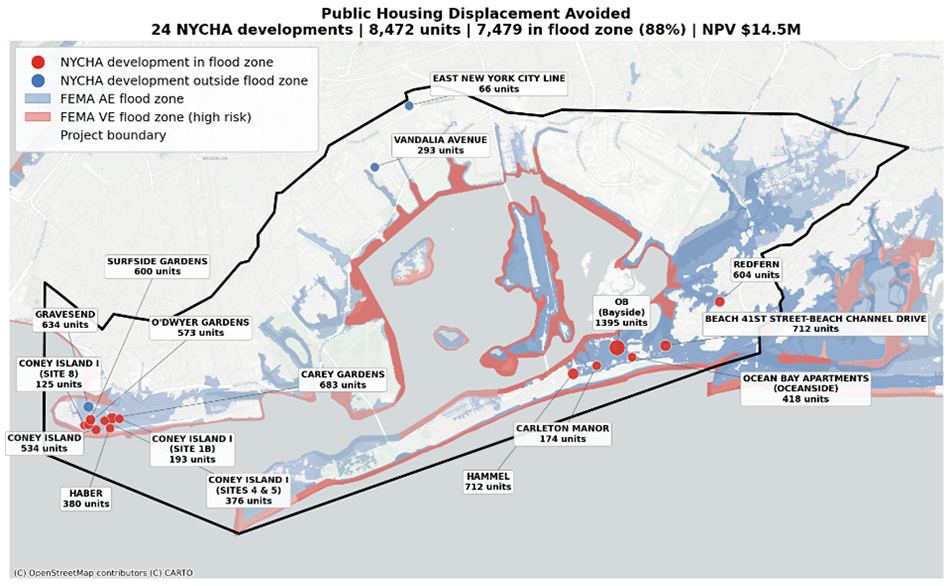
Source: NEC press release
The team checked its estimates against past storms and existing academic work, interviewed Rockaway residents and community organizations about life before and after the project, and ran the logic past financial institutions that price this kind of risk for a living.
The problem with an absence
Here is the gap NEC is aiming at. Cutting emissions attracts money because a solar farm produces something you can sell. Adaptation produces a non-event. There is no revenue line for the flood that didn't arrive, ROI is close to impossible to state, and capital does not chase returns that can't be shown. So flood defense has stayed a government job, and the Rockaway barriers were paid for federally.
Miura's argument is that the value already exists, it is just landing on parties nobody thinks to invoice. Subway operators, insurers, hospitals, the businesses that live off summer beach crowds. None of them are merely exposed to flood risk; each of them collects something real when the flood is held back. Work out the size of what each one collects, she suggests, and the question of who ought to pay for a seawall stops having an obvious answer.
Ryutaro Adachi of NEC's GX Business Development Division puts the same idea in the language of finance: translate the benefit into a return, and money that previously would not flow toward adaptation and resilience can start moving. That, he says, is how you connect an unglamorous project to a balance sheet.
Japan is exporting the accounting, not the concrete
This is the part worth watching from outside Japan. NEC has been developing this approach since fiscal 2023 under the name Digital Adaptation Finance, and it has been carrying it to the largest stage in climate policy. At COP28 in Dubai, the company showed a simulation of a real past flood replayed under 4°C of warming: about $5.1 billion in projected losses, cut to about $1.1 billion by raising levees along two rivers by a single meter. It brought the work back to COP29 in Baku. In March 2024, NEC set up an Adaptation Finance Consortium with Mitsui Sumitomo Insurance, aimed at turning quantified adaptation value into insurance products, bonds and lending schemes.
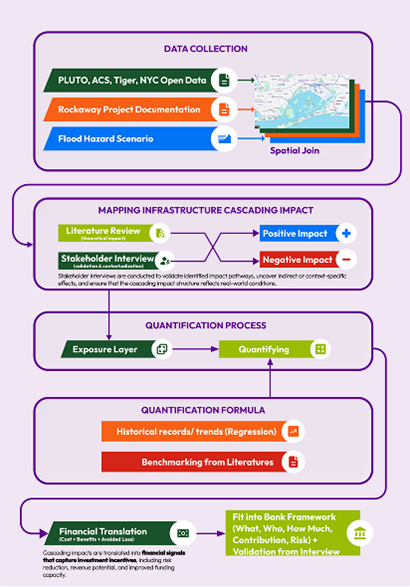
Source: NEC press release
The underlying tools are NEC's own inventory: satellite imagery and earth observation data, remote sensing, AI, digital twins. Under the MOU, NEC and NYU say they will approach financial institutions about financing methods built on exactly these technologies.
Japanese disaster-tech exports have historically meant hardware: pumps, sensors, breakwaters, tsunami gates. What NEC is trying to ship to New York is a valuation method. Whether that travels better or worse than concrete is an open question.
Meanwhile, the money
The comparison with Western adaptation spending is not flattering to anyone.
The Netherlands, widely treated as the gold standard, runs a dedicated Delta Fund: €1.9 billion (about $2.2 billion) in 2026, with roughly €29 billion expected through 2050 against an estimated €38 billion in need. Even the best-organized flood country in the world is short.
The United States has been moving in the other direction. FEMA's Building Resilient Infrastructure and Communities program, the country's largest competitive pre-disaster mitigation fund with more than $5 billion awarded since 2020, was terminated in April 2025. More than 20 states sued. In December 2025 a federal judge ruled the termination unlawful; on March 6, 2026 the court issued an enforcement order. FEMA reissued a combined fiscal 2024 and 2025 funding opportunity worth about $1 billion on March 25, with applications due July 23. The new rules cut funding for mitigation planning and technical assistance and cap awards per recipient, pushing more of the burden onto states. New York State alone had 38 BRIC projects worth over $380 million caught in the freeze. Pre-disaster funding is being litigated at the same moment NEC is arguing that private capital should be filling the gap.
Globally the arithmetic is starker still. UNEP's 2025 Adaptation Gap Report puts developing countries' adaptation finance needs at $310–365 billion a year by 2035, against $26 billion in international public flows in 2023. The report estimates the private sector could supply around $50 billion a year, given the right policy and blended finance. NEC's project is, in effect, a bet on unlocking that $50 billion.
A caution is worth keeping in view. The $800 million is a modeled estimate, not money in a bank. It moves with the storm you assume and the rate at which you discount future damage. The components do not even share a clock: the traffic figure is a ten-year total, the mental health figure is the cost of a single major flood. And the largest single line in the whole exercise is a dollar value placed on trauma. Nobody has written a check on the strength of this framework yet. What the Rockaways demonstrate is that the sum can be produced at all, which is where the argument used to stall.
In Japan, seawalls are paid for out of the public purse and the beneficiaries are never billed. NEC would like to change that, starting in Queens. Where you live, who ends up paying for the disaster that doesn't happen, taxpayers, insurers, the businesses that benefit without being asked, or nobody at all?









Global Discussion
3 comments