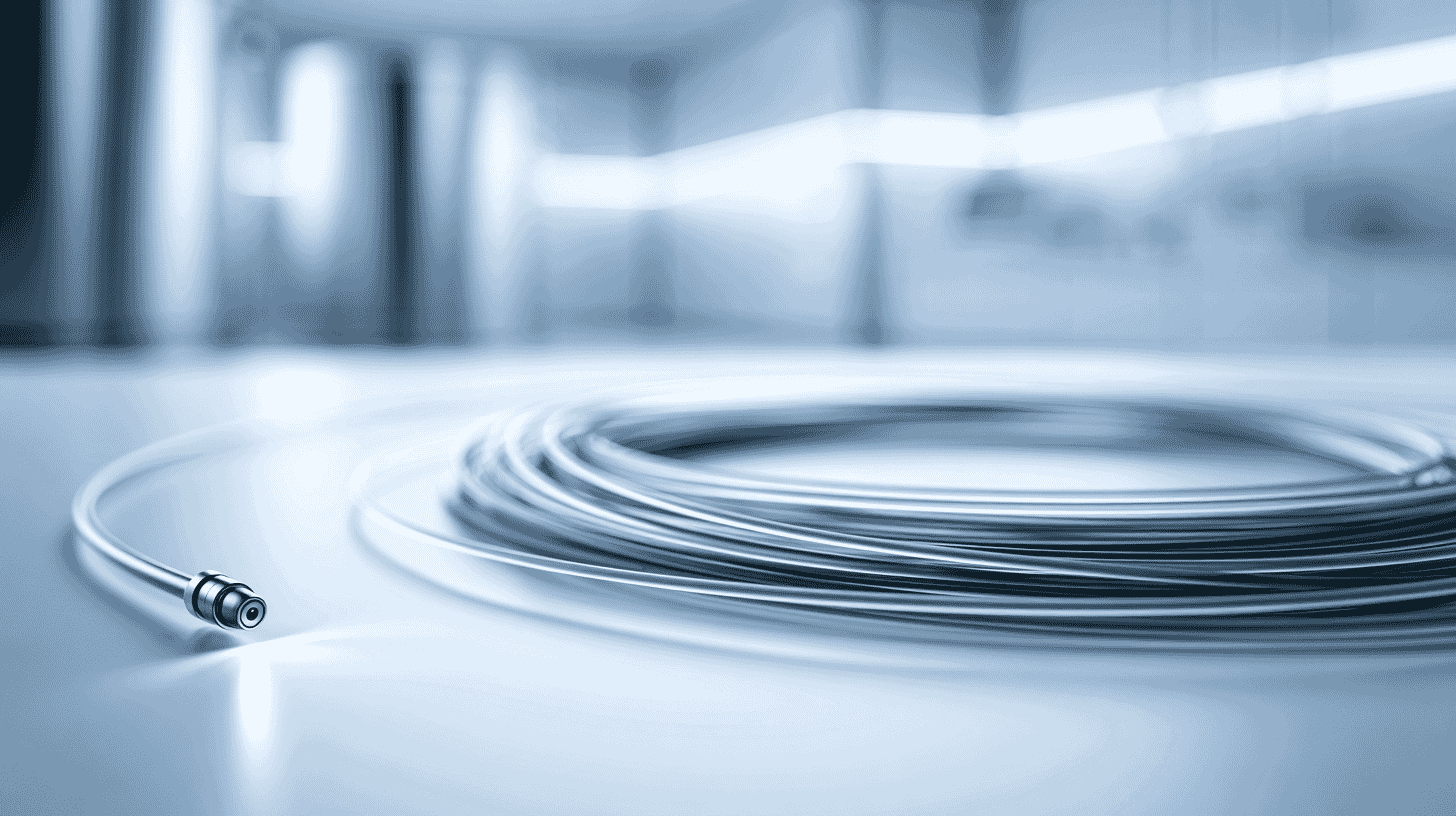
🔬 Ask anyone in Japan who has done a stomach check-up, and you'll hear the same complaint: the gagging, the tube, the barium chalk you drink and then can't get out of your system for days. A startup spun out of Osaka University thinks the fix is a camera about the width of a strand of cooked spaghetti: roughly 4 millimeters across, used once and thrown away. It won't be the best endoscope in the room. That's exactly the point.
A screening tool, not a hospital's flagship scope
Start with a distinction most people never think about: the difference between finding cancer and diagnosing it.
Japan is one of the only countries that screens its whole population for stomach cancer, testing millions of people every year. The disease still kills around 40,000 Japanese annually. For decades, mass screening leaned on the barium meal: you swallow a chalky contrast liquid, then get X-rayed while a technician tilts you around a table. It's cheap to run at scale, but it misses cancers, and it doses healthy people with radiation every year.
The obvious alternative is an endoscope. The trouble is that a modern hospital endoscope is a small marvel of engineering, loaded with magnification, special light modes, and channels for taking tissue samples, and priced accordingly. Endoluminal Solutions, the Osaka startup behind the new device, makes a blunt argument: for a first-pass screen, a screening tool doesn't need to do everything a diagnostic scope does. It needs to be cheap, painless, and good enough to flag the people who should come back for the full exam.
So the company designed backward from that job: strip the device down, make it disposable, and make it thin enough that almost anyone can tolerate it.
Why 4 millimeters is the number that matters
Thinness is the whole game here. A standard endoscope swallowed through the mouth runs about 8 to 9 millimeters, thick enough to trigger the gag reflex against the base of the tongue. The nose-insertion scopes that clinics market as "comfortable" are thinner, around 5 to 6 millimeters, and the current record-holders for transnasal scopes sit at about 5.4 millimeters.
At roughly 4 millimeters, Endoluminal's scope would undercut those. That's not a rounding-error improvement. Below a certain diameter, a tube slides through the nasal passage without pressing on the tissue that makes people retch, which is the difference between a test people dread and one they'll actually show up for.
Getting there is a miniaturization problem. The bottleneck in any thin endoscope is the imaging package crammed into the tip: the image sensor, the lens, and the light source. Shrinking the sensor while keeping the picture usable has been the central engineering tension in slim scopes for years; historically, thinner meant dimmer and blurrier, which is why nasal scopes have never fully replaced the mouth-inserted kind for careful diagnosis. Endoluminal's bet is that sensor technology has finally advanced far enough to hit 4 millimeters with picture quality that's "necessary and sufficient" for spotting suspicious areas. Not the razor-sharp magnified view a specialist wants, but enough to sort the crowd.
Two other design choices ride along with the thinness. The scope is single-use, so there's no cleaning-and-sterilizing cycle between patients and no infection risk from imperfect reprocessing, a real concern with reusable scopes. And it's meant to work alongside an AI system that helps flag findings during the exam, plus a digital records layer to manage screening data across clinics and local governments.
Japan owns the endoscope, but not this corner of it
Here's the part that makes the story bigger than one gadget.
Japan doesn't just participate in the endoscope industry; it dominates it. Olympus alone holds more than 70% of the world market for gastrointestinal endoscopes, a lead it has defended since it built the world's first gastro-camera in 1950. Add Fujifilm and Hoya's Pentax Medical, and Japanese firms effectively set the standard for the reusable, high-end scopes that hospitals worldwide depend on.
But the device Endoluminal is building lives in a different segment, single-use scopes, and that's a corner where the challengers have mostly come from the West. Denmark's Ambu built a business on disposable endoscopes; America's Boston Scientific pushed its single-use EXALT duodenoscope into hospitals to sidestep the contamination problems that dog reusable models. Disposable scopes are one of the faster-growing pieces of the endoscopy market, and Japan's giants, whose whole model is built around premium reusable hardware, have been more cautious about cannibalizing it.
The twist is that this Japanese university venture isn't trying to out-Olympus Olympus on image quality. It's going after the mass-screening layer with a cheap disposable, the format Western firms opened up, and pointing it at a disease that hits East Asia hardest. Whether the incumbents see that as a threat, a partnership opportunity, or a niche too small to bother with is one of the open questions.
The money, the map, and the caveats
The company is early. It closed a seed round of ¥85 million (about $520,000 at ¥163 to the dollar) in February 2026, backed by Japanese precision-parts maker Yamashina Seiki and Hong Kong's BlueSky Technologies Innovation, and it is preparing a Series A round next. In its July 2026 announcement, it said it aims to file for manufacturing and sales approval as early as 2028. None of this is a product on a shelf yet.
The ambition, though, is explicitly cross-border. Gastric cancer is one of the most common cancers across East Asia, and South Korea, like Japan, already screens for it at a national scale, so the potential market extends well beyond Japan. The company says it is aiming at a global market from the start, not just a domestic one. Its founder and representative director, Kiyokazu Nakajima, a specially-appointed professor of next-generation endoscopic therapy at Osaka University, frames the goal in bigger terms still: a "society with zero gastric-cancer deaths."
The caveats are real. A thin, cheap, single-use scope has to prove it actually catches early cancers at a rate that justifies replacing barium. "Good enough" is a claim that regulators and screening data will test, not a given. Disposable devices raise their own questions about per-unit cost and waste at the scale of a national screening program. And a 2028 filing is still a long runway. What's genuinely new here isn't a sensor but an order of operations: build the tool around the screening job instead of shrinking a hospital scope to fit it.
In Japan, "get your stomach checked" still conjures barium chalk and a bad afternoon, and plenty of people just skip it. Does your country screen for stomach cancer at all, and if you've done it, what was the test like?









Global Discussion
4 comments