
🧫 In January 2021, a University of Tokyo team reported a striking result: give old mice a certain drug, and the worn-out cells inside them go away.
Science published it. Nature published the sequel a year later. According to Toyo Keizai, NHK and many other outlets covered them.
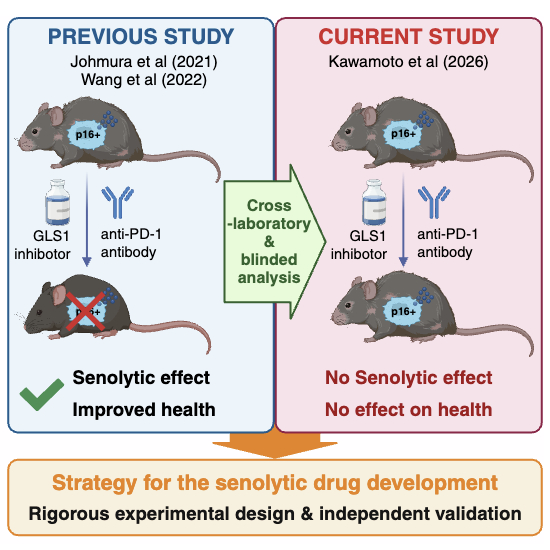
A little over five years later, seven research groups repeated the mouse experiments with the analysts blindfolded, and the reported effect did not appear. On the same day, in the same journal, the original team explained why they think the retest was measuring the wrong thing.
The papers that made senolytics a household word in Japan
Some cells stop dividing but refuse to die. These are senescent cells, and they accumulate as we age. They also leak a cocktail of inflammatory signals known as the senescence-associated secretory phenotype, or SASP, which is now suspected of feeding chronic inflammation and a long list of age-related diseases. Clear the cells out, the theory goes, and you buy healthier years. More than twenty candidate drugs, called senolytics, have been reported to do exactly that in mice.
Among the most widely covered was work from Makoto Nakanishi's group at the University of Tokyo's Institute of Medical Science. In Science in January 2021, Yoshikazu Johmura, Nakanishi and colleagues reported that BPTES, a compound that blocks an enzyme called GLS1, cleared senescent cells across multiple organs in aged mice and improved a range of age-related conditions, including obesity-driven diabetes, atherosclerosis and fatty liver disease.
The following year the same group reported in Nature that an anti-PD-1 antibody produced a comparable effect by restoring the immune system's ability to clean up senescent cells. That second result was the one that made people sit up, because anti-PD-1 antibodies are not experimental compounds. They are approved cancer drugs, already in hospitals. If one of them doubled as an anti-aging therapy, the road to human trials suddenly looked short.
Seven groups, one blindfold
On 3 April 2026, EMBO Reports published a study that set out to reproduce both findings. It was led by Shimpei Kawamoto, then at Osaka University's Research Institute for Microbial Diseases and now at Tohoku University, together with Eiji Hara at Osaka. According to the Osaka press release, seven research groups across six institutions took part: Osaka University, Kumamoto University, the Cancer Institute of the Japanese Foundation for Cancer Research, Kyoto University, the National Center for Geriatrics and Gerontology, and the National Cerebral and Cardiovascular Center.
They started in the dish. At 10 micromolar, BPTES killed about half of senescent IMR-90 cells and about 30 percent of senescent TIG-3 cells. But at that same dose it also sharply suppressed the growth of ordinary, non-senescent cells and killed some of them outright. Drop the dose to 1 micromolar and the healthy cells are left alone, but the senescent ones stop dying too. Six batches of BPTES from two different suppliers gave the same picture.
Then the mice, following the original protocol: 80-week-old male C57BL/6, 0.25 mg per 20 g of body weight, three times a week for a month. In liver, lung and kidney, expression of p16INK4a, the gene widely used as a stand-in for senescent-cell burden, did not fall.
The next experiment was designed to take the researchers themselves out of the equation. Dosing happened in Yuichi Oike's laboratory at Kumamoto. Organs were frozen and shipped to Osaka carrying nothing but codes. Osaka ran the RNA measurements without knowing which mouse got what, sent the numbers back to Kumamoto, and only there were the codes broken and the statistics run. Eleven controls, thirteen treated. Liver p = 0.36, lung 0.17, kidney 0.42. Grip strength, 0.64. Nothing moved.
Source: Kawamoto et al., EMBO Reports (2026), CC BY 4.0
The anti-PD-1 arm went the same way. Eighteen-month-old mice, 250 micrograms per dose, eight doses over three weeks, fourteen controls and sixteen treated, blinded by the same relay. No change in p16INK4a as RNA or as protein, no change in grip strength. In 24-month-old mice genetically lacking PD-1 altogether, lung p16INK4a was slightly higher rather than lower.
Nakanishi's team answers, same day, same journal
EMBO Reports ran the rebuttal alongside the study. The authors were Johmura, now at Kanazawa University, with Teh-Wei Wang and Nakanishi. They open by crediting the rigor and transparency of the replication, then set out where they part ways.
Their argument is about the ruler rather than the reading. Measuring p16INK4a across a whole organ, they say, gives you an average over a very mixed population of cells, and in mice the baseline sits so low even in aged tissue that it often hovers near the limit of detection. Worse, p16 turns up in cells that are not senescent at all, including macrophages responding to ordinary physiological signals. In their 2021 work they used CD26, a surface marker, to pick out senescent fibroblasts specifically, and it was those cells that dropped significantly in the lungs after BPTES treatment. In the 2022 anti-PD-1 study they never measured bulk p16 in the first place. They tracked labelled cells by fate-mapping.
On the culture results, they note that BPTES's effect on dividing cells was already described in their original paper. In both datasets senescent cells died far more readily than proliferating ones, roughly 50 percent against 7.5 percent in IMR-90 cells, which they read as evidence of selectivity rather than its absence.
On grip strength, they report that in their own animal facility the measure falls from about 1.0 to about 0.6 newtons between 70 and 80 weeks of age, and they point out that the replication offered no young-mouse baseline for calibration.
And on the widely circulated image of younger-looking mice, they are blunt: no claim about physical appearance was analysed or reported in either peer-reviewed paper.
Why nobody can call this yet
The usual explanation for a failed replication is that the second lab simply did it differently. That one is hard to run here. The mouse dosing in the replication was carried out under the guidance of Masataka Sugimoto of the National Center for Geriatrics and Gerontology, who performed the corresponding experiments for the 2021 Science paper and is a co-author on the replication. The authors say this makes a methodological gap unlikely to be the main cause.
The replication team is also careful about what it is not claiming. Their paper says its own results do not, by themselves, overturn what the original studies reported, and it closes by stating that the intention is not to discredit any specific group. It names its own limits too. Mice of 80 weeks and 18 months, the authors write, cannot really be called old. They chose those ages to stay comparable with the originals.
Both sides carry context worth knowing. Hara's group had already published a comparative analysis of senolytics in Nature Aging earlier in 2026 suggesting BPTES had relatively low specificity, so they did not come to this neutral. And the rebuttal's conflict-of-interest statement notes that Nakanishi is a scientific adviser to and shareholder in reverSASP Therapeutics, a company set up to commercialize senescent-cell clearance. Nakanishi's team says newer single-cell data supports them, but as of August 2026 that work is a preprint and has not been through peer review.
The unglamorous version of science working
No retraction. No finding of misconduct. Two open-access papers, published the same day, disagreeing in public with the raw data attached to both.
That is rarer than it should be. Replication studies are notoriously hard to place, because journals want new results rather than confirmations of old ones, and a scientist who re-runs someone else's mouse experiment collects little for the trouble. Meanwhile senolytics has grown into a global field with clinical trials and venture money behind it. That is exactly when someone needs to check the foundations.
The coverage is lopsided too, and not only in Japan. The 2021 and 2022 results were covered as breakthroughs, on television and across the national press. The correction, so far, appears to be running mainly on the science pages, where far fewer people will ever see it.
When a celebrated result from your own country turns out not to replicate, does the news reach you at all? And when it does arrive five years late, does it change what you believed?
References
- https://link.springer.com/article/10.1038/s44319-026-00740-5
- https://link.springer.com/article/10.1038/s44319-026-00752-1
- https://www.biken.osaka-u.ac.jp/achievement/research/2026/260
- https://www.ims.u-tokyo.ac.jp/imsut/jp/about/press/page_00065.html
- https://toyokeizai.net/articles/-/954877
- https://www.nature.com/articles/s41586-022-05388-4
- https://www.nature.com/articles/s43587-025-01057-z









Global Discussion
3 comments