💧 Melt a few grams of tin, heat it past 300°C, and let concentrated seawater fall onto the surface one drop at a time. The water flashes into steam and can be condensed back as fresh water. The magnesium sinks into the metal and stays there. Cool the tin slowly and it comes back out as a solid you can lift away. A lab in Tokyo has now published the version of this trick that finally yields something industry can use.
Dripping brine onto molten metal
Institute of Science Tokyo (Science Tokyo) announced the result on August 27, 2026. The paper behind it went online in the Elsevier journal Desalination on July 31. The authors are Toranosuke Horikawa, a third-year doctoral student in the School of Engineering, and Masatoshi Kondo, an associate professor at the university's Laboratory for Zero-Carbon Energy.
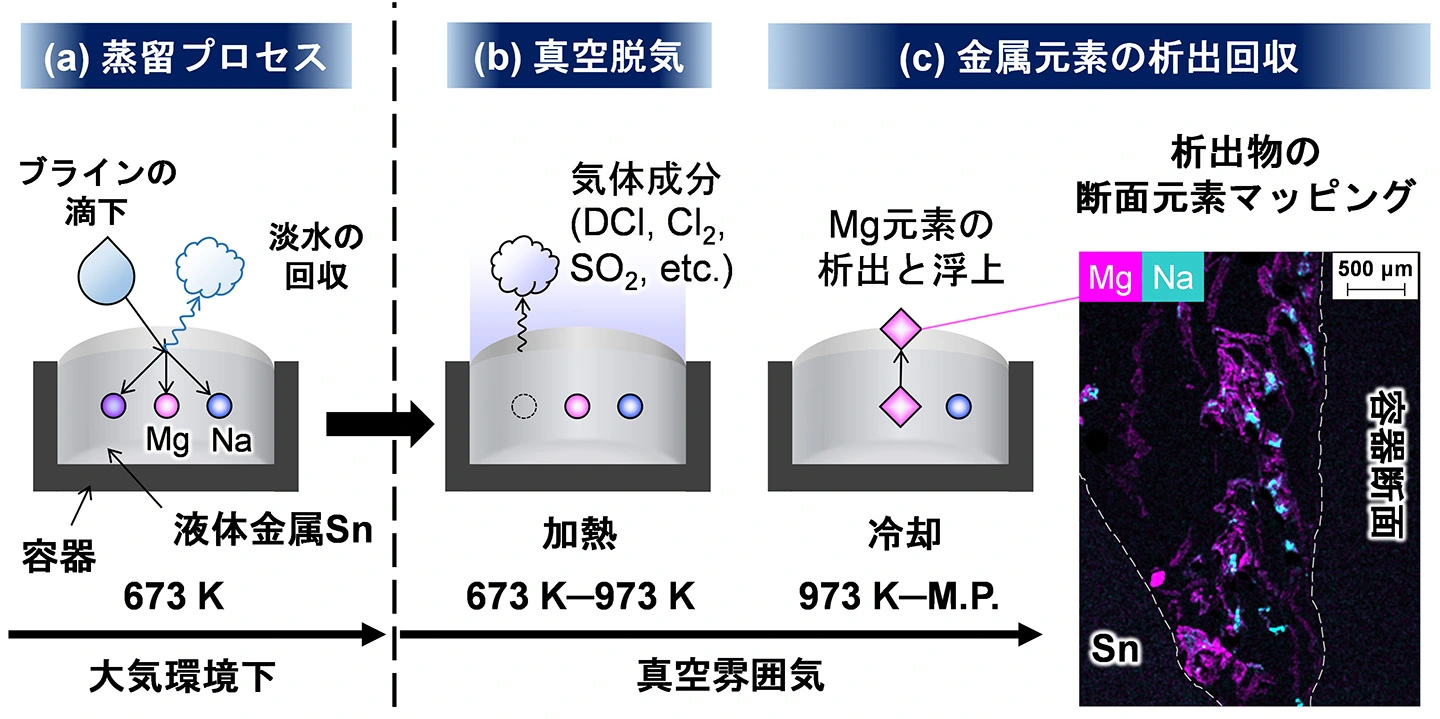
About eight grams of tin, melted and held somewhere between roughly 300 and 400°C. Tin melts at 232°C, so it stays comfortably liquid. Room-temperature artificial brine drips onto the surface at 0.1 milliliters a minute. On contact the water evaporates and is condensed and collected, while the magnesium, sodium, chlorine and sulfur it carried dissolve into the tin.
Source: Institute of Science Tokyo press release
Then the tin goes under vacuum. It is held at around 10⁻³ Pa and warmed at 2.5 K a minute up to about 700°C, then kept there for ten minutes. A quadrupole mass spectrometer tracked the chlorine and sulfur leaving as hydrogen chloride, chlorine gas, sulfur dioxide and hydrogen sulfide. Weighing the tin before and after suggested that 59 to 67 percent of the gases the brine had brought in were gone.
Cooling comes last, at the same unhurried 2.5 K a minute, back down toward tin's melting point. Metals dissolve less readily in cooler tin, so they drop out as solids, and they do not drop out together. Magnesium-rich and sodium-rich material settled in separate zones. In the run that processed 20 milliliters of brine, the magnesium in the solids came out up to roughly 280 times more concentrated than in the brine that went in, and its ratio to sodium widened by as much as 5,300 times. Electron microscopy identified the dominant crystal phase as magnesium oxide.
The 50 trillion liters nobody wants
Brine is what a desalination plant has left once it has taken the fresh water out: saltier than the sea it came from, and produced in volumes that dwarf the product. The world makes roughly 35 trillion liters of desalinated fresh water a year and roughly 50 trillion liters of brine alongside it. Almost all of that gets diluted and sent back offshore.
The US Government Accountability Office noted in July 2025 that desalination brine carries about twice the mineral concentration of seawater, which makes it a more plausible feedstock than the open sea.
The last experiment's leftover problem
Kondo's group had already shown the basic trick worked. In a 2025 paper in Water Reuse they sprayed brine onto tin at 300°C, distilled the water off, and pulled sodium, magnesium, calcium and potassium out of the cooling metal. Slow cooling made potassium precipitate first, then sodium, then calcium, and magnesium last.
The catch was chemistry. Chlorine and sulfur went into the tin along with the metals and reacted there, so the magnesium came back as magnesium sulfate. That compound sells into fertilizer, bath salts and pharmaceuticals, but it is not much use as an industrial material. Stripping the chlorine and sulfur out as gas before the cooling step is what changes the answer from magnesium sulfate to magnesium oxide, better known as magnesia, which goes into refractory linings, cement and electronic materials.
Liquid tin is a borrowed tool here. Kondo's lab studies it as a coolant for fusion reactors, where its appetite for dissolving other metals turns up as corrosion eating at structural components. In the brine rig, that same appetite is the entire mechanism.
The university's clip on liquid metals is in Japanese, but the footage carries it.
Why magnesium, specifically
Magnesium is a light-alloy workhorse. It goes into automotive castings, aluminum alloys and steel desulfurization, and it comes from an unusually narrow place. The USGS put world primary magnesium smelter production at roughly 1.1 million tons in 2025, with China accounting for about 950,000 tons of that, close to 86 percent. That figure covers magnesium metal, though. What comes out of the tin is magnesia, a compound with separate markets and its own pattern of import dependence.
Seawater magnesium itself is old news. The USGS notes that most US magnesium compounds already come from seawater and natural brines, and that magnesium-bearing brines amount to a resource measured in billions of tons. The conventional route is precipitation with sodium hydroxide, or electrolysis, both of which eat chemicals and power and leave waste of their own.
On August 4, 2026, Tohoku University and a group of companies announced that they had built prototype electrodes for magnesium-air batteries out of magnesium taken from seawater, with a vehicle test to follow.
The Gulf got there first
None of this is a Japanese first, and the press release does not claim otherwise. GAO's July 2025 review found pilot programs running in several countries and one project already at full scale: the Saudi Water Authority says it runs a plant that concentrates the magnesium in desalination brine. The output is not industrial. It goes into drinking water to counter magnesium deficiency, while SWA keeps studying filtration and extraction methods that would yield industrial-grade minerals.
Smart Water Magazine reported in May 2026 that SWA is the only operator with industrial-scale building work confirmed, having handed two brine mineral plants at Ras Al Khair to partners from China and Saudi Arabia for something near $65 million, with operations announced for early 2026. The same report found no independent confirmation, as of April 2026, that either plant had been commissioned. GAO's caveat still stands: scalability and economic viability are undemonstrated.
What the Tokyo work adds is a different physical route. The Gulf projects concentrate chemically and drop the magnesium out as a hydroxide, and Smart Water Magazine puts recovery on that established route at 90 to 100 percent already. So the number that changes here is not the recovery rate. It is the absence of added reagents, and the form the magnesium arrives in.
Eight grams of tin, twenty milliliters of brine
Eight grams. Twenty milliliters, delivered a tenth of a milliliter at a time. The 99 percent recovery figure is an estimate of how much of the magnesium that entered the tin came back out of it, and the release words it as a possibility rather than a measurement. The brine was artificial, mixed using heavy water so the gases coming off could be identified precisely, which is useful for the experiment and not the same as running a real plant's discharge.
The forward-looking numbers are conceptual designs rather than results. A vacuum-degassing power draw of about 1.7 kWh per kilogram of magnesium is an ideal-conditions estimate. So is the module sketched for Egypt, where a solar concentrator 15 meters across would deliver around 970 kilograms of fresh water and 2.8 kilograms of magnesium a day.
What comes next, as of August 2026, is a continuous rig that circulates the tin through the whole loop and back again, along with the unglamorous questions that decide whether any of this leaves the lab: how tin behaves over long runs, what it does to the vessel holding it, how the recovered magnesium gets purified, and what the energy bill really looks like.
Japan barely desalinates anything. It has rain. One of its labs is nonetheless engineering the discard end of a process the country hardly uses. What happens to the brine, or to the industrial waste stream nobody talks about, where you live?
References
- https://www.isct.ac.jp/ja/news/9g8cf4gognyx
- https://doi.org/10.1016/j.desal.2026.120582
- https://www.isct.ac.jp/en/news/one762yl9h6l
- https://doi.org/10.2166/wrd.2025.100
- https://www.gao.gov/products/gao-25-108484
- https://pubs.usgs.gov/periodicals/mcs2026/mcs2026-magnesium-metal.pdf
- https://smartwatermagazine.com/news/smart-water-magazine/brines-second-act-mineral-extraction-revenue-stream
- https://www.tohoku.ac.jp/japanese/2026/08/press20260804-04-mg.html







Global Discussion
4 comments