
🛰️ Building anything big in space runs into the same wall every time: it has to fit inside a rocket first. A Japanese startup just showed a way around that: not by folding a structure up cleverly, but by shipping flat-pack parts to orbit and sending a small crew of robots to assemble and weld them once they get there.
On June 5, Tokyo-based Space Quarters released video of a ground demonstration of DAIQ, its orbital assembly robot system. In it, three different kinds of robot work together to pull building panels off a rack, position them, and weld them into a larger structure, the full "pick, place, join" sequence that constructing anything in space actually requires. It is a ground model, not a spaceflight. But it is the first time the company has shown its entire construction concept running end to end, rather than just one piece of it.
A construction crew, not a single machine
The interesting design choice in DAIQ is that it isn't one big robotic arm. It's a team of small, specialized robots that hand work off to each other, the way a road crew splits up paving, marking, and inspection.
The first robot, called Tree, is the warehouse. It's a hexagonal column lined with shelves, each loaded with construction panels packed tightly enough to make the most of a rocket's cramped cargo space. A small traveling arm pulls panels out from the bottom of each shelf, which lets it handle curved pieces without jamming.
The second, Ant, is the mover. These self-propelled units run along rails built into the edges of each panel, and several of them work in parallel to carry a panel into place and lock it down. The third, Spider, is the welder. It straddles the seam between two panels, grips multiple rails at once to line them up to within micrometers, and fuses them together.
One honest detail worth flagging: in the demonstration video, Spider is doing ordinary MIG welding, because the test runs in normal air at ground level. The real system carries an electron beam gun instead, a method that only works in a vacuum and is the company's core technology. So what the video proves is the choreography of the robots and the precision of the joins, not the space-grade welding itself. That part is still ahead.
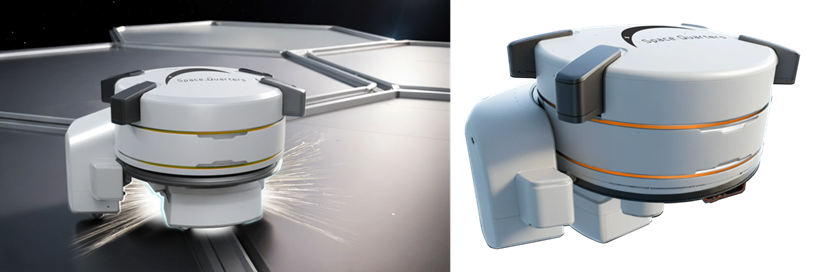
Source: Space Quarters press release
The clever part: let the building become the scaffold
The detail that makes engineers sit up is how Ant gets around.
Most ideas for building in space lean on one large arm reaching out from a central spacecraft. The problem is obvious once you picture it: the bigger the thing you're building, the longer and heavier the arm has to be, until the machine doing the construction becomes the most expensive part of the project.
DAIQ flips that. Once Ant installs a panel, that panel becomes the next stretch of track for Ant to crawl along. The robots literally walk out across the structure they're building, extending their own reach as they go. A 5-meter antenna and a 50-meter one use the same small robots: you just add more of them and let them keep walking. It's the same logic as a tower crane that climbs the building it's erecting, applied to a swarm of palm-sized machines in zero gravity.
That scalability is the whole pitch, and the reason the company can talk about building things far larger than any rocket could carry in one piece.
Why this matters beyond Japan
The constraint Space Quarters is chasing isn't a Japanese problem; it's everyone's problem, and the biggest names in space have been circling it for years.
NASA's OSAM-1 mission, originally Restore-L, would have refueled satellites and, with a robotic arm, assembled an antenna in orbit. In a coincidence that's hard to ignore, NASA's arm was also named SPIDER. Congress appropriated roughly $1.5 billion for it, and the projected lifetime cost eventually passed $2 billion. The agency cancelled the whole project in 2024 after years of delays and cost overruns, though it still backs in-space assembly research more broadly.
The more direct parallel is DARPA's NOM4D program, which exists to break the exact same "rocket fairing" barrier. Its final phase moved out of the lab and into orbital demonstrations slated for 2026: a Caltech team plans to fly a free-flying robot that builds a 1.4-meter circular truss, a stand-in for an antenna frame, while a University of Illinois team tests forming structural parts aboard the International Space Station. The philosophies differ in a telling way. NOM4D leans toward shipping up raw or semi-raw material and forming structures on the spot. Space Quarters ships finished panels and focuses on joining them: assembly and welding rather than manufacturing from scratch.
Neither approach has won yet, and they may end up complementary. But it's striking that a startup founded in 2022 out of Tohoku University is methodically working through the same problem that defeated a two-billion-dollar government program, and choosing robotics and welding, areas where Japanese industry has deep roots, as its way in.
What you'd actually build with one of these
The near-term target isn't a moon base. It's communication antennas in geostationary orbit, big enough that a single satellite could beam high-speed signal straight to an ordinary smartphone. Space Quarters' customer SKY Perfect JSAT has been sketching exactly such a giant orbital structure, nicknamed Yamato. Further out, the company points to large crewed stations and the enormous solar arrays that orbiting data centers would need.
The roster behind it is more establishment than you'd expect for a startup this young: JAXA, general contractor Obayashi, and IHI Aerospace have all put projects its way, and a 750-million-yen seed round (about $4.7 million at current rates) closed in October 2025. The plan from here is staged: a welding demonstration in actual space in 2028, an orbital construction demonstration in 2029, and commercial service targeted for 2031.
Plenty can go wrong between a ground model in open air and a swarm of robots welding in the vacuum and weightlessness of real orbit. The company is upfront that the hard parts, the electron beam welding, the autonomy and the real space environment, are still to come. What it has now is proof that the basic idea holds together: that you can break "build a giant thing in space" into small jobs and hand them to small machines.
Japan has a long habit of betting on robots and precision manufacturing where other countries bet on scale. Watching a startup apply that instinct to orbital construction feels very on-brand. What's the appetite for space infrastructure like where you are: exciting, or a distraction from problems closer to the ground?
References
- https://prtimes.jp/main/html/rd/p/000000021.000115275.html
- https://space-quarters.com/
- https://www.nasa.gov/mission/on-orbit-servicing-assembly-and-manufacturing-1/
- https://www.darpa.mil/research/programs/novel-orbital-and-moon-manufacturing-materials-and-mass-efficient-design
- https://spacenews.com/darpas-in-space-manufacturing-program-advances-with-two-teams-selected-for-orbital-demos/








Global Discussion
5 comments