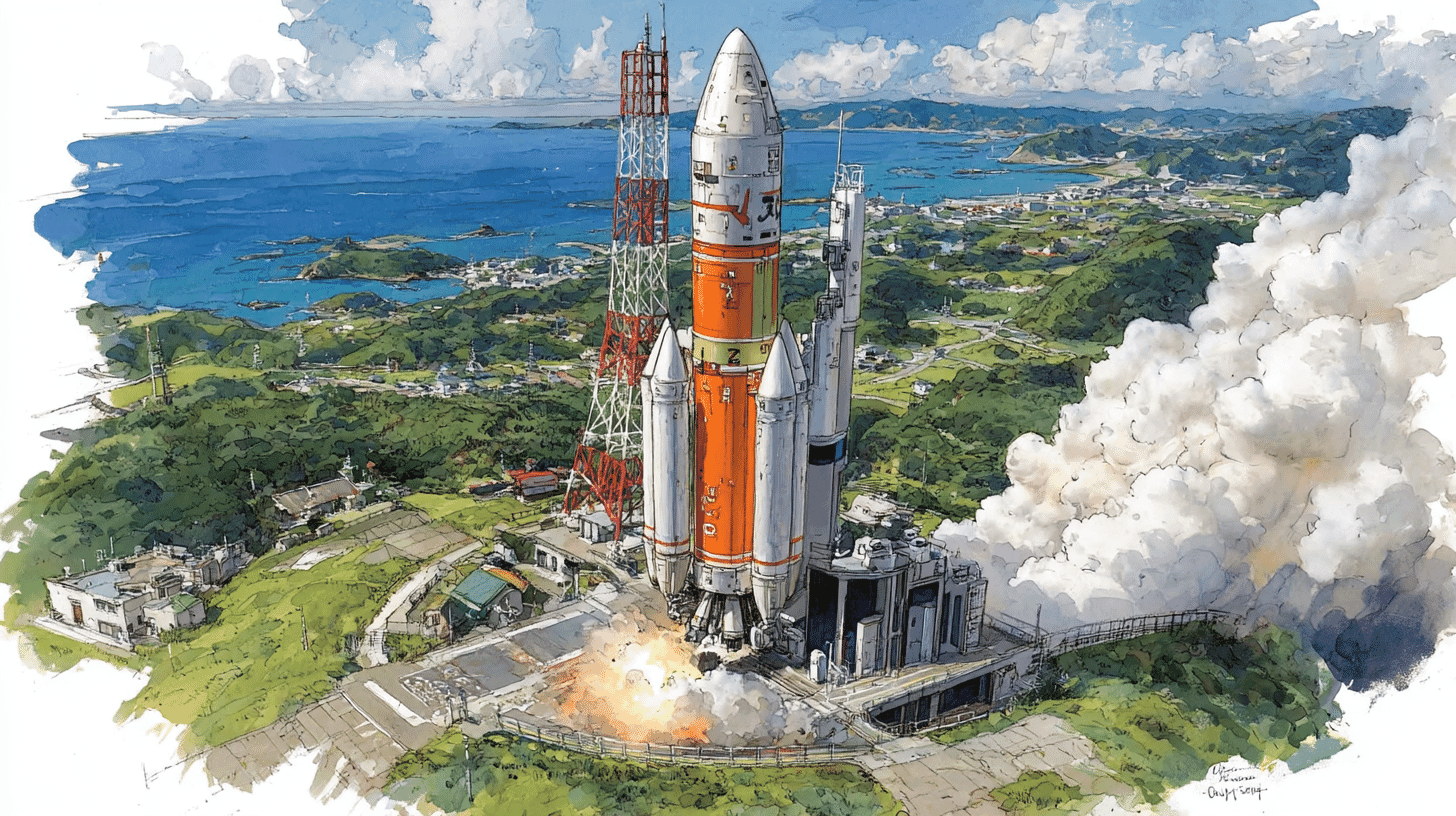
🚀 Japan's H3 rocket is flying again. On June 12, the No. 6 vehicle lifted off from Tanegashima and reached orbit, the program's first flight since a failure grounded it six months ago. This one also debuted the cheapest version of the rocket built so far. Yet within hours a question mark appeared: footage showed something coming away from near the engines during the climb, and JAXA is now looking into it.
The cheapest H3 yet finally flew
The No. 6 vehicle is a configuration called H3-30S, or "Type 30," and it is the bare-bones member of the H3 family. Instead of strapping on solid rocket boosters for extra thrust, it relies on three of the rocket's own LE-9 liquid-fuel engines and nothing else. Fewer parts bolted on means a lower price tag, which is the whole point. Among the different H3 setups, Type 30 is the cheapest way to get a satellite to orbit.
On this flight it carried a performance-verification payload called VEP-5, essentially an instrumented dummy mass, plus six small satellites along for the ride. The passengers were a mix of universities and companies: PETREL from the Institute of Science Tokyo, STARS-X from Shizuoka University, VERTECS led by the Kyushu Institute of Technology, two satellites named HORN-L and HORN-R from the firm BULL, and BRO-22 from the French operator Unseenlabs. In its launch result, JAXA said PETREL and STARS-X separated about 16 minutes after liftoff, and that the separation signals for the other four, BRO-22, VERTECS, HORN-L, and HORN-R, were confirmed from later orbital data.
The main job, putting the second stage and its payload into the planned orbit, was done. JAXA called it a success.
Climbing back from December
That word, success, carries extra weight this time, because the last H3 flight did not end well.
On December 22, 2025, the No. 8 vehicle failed to deliver the navigation satellite QZS-5 to orbit. JAXA's investigation traced the problem to a part called the satellite mounting adapter, the structure that holds the payload on top of the rocket. During manufacturing, layers inside the adapter had partially peeled apart, leaving it weaker than intended. Under the stresses of flight the satellite tore loose from the second stage, and the mission was lost.
For future vehicles, JAXA plans to change how that adapter is made. The No. 6 rocket was a special case: because its payload was light, engineers judged the existing adapter safe to use after repairs rather than building a new one. They also turned the flight into a test bench, adding high-frequency accelerometers to measure the shock when the fairing separates and extending how long the in-fairing cameras recorded. The half-year gap between the two flights was the time it took to find the cause and prove the fix.
A success with an asterisk
Then came the part that gave the launch its question mark.
Viewers watching the live feed noticed something off near the base of the rocket. Right after liftoff, a piece of material appeared to flutter near the first-stage engines, and about 43 seconds into the flight, a dark object seemed to come away from that area. Reporters asked about it at the post-launch press conference.
Makoto Arita, the H3 project manager at JAXA, said the team had spotted it in the footage but was still at the stage of reviewing images. His working explanation pointed to the engine's heat protection. The three LE-9 engines can swivel to steer the rocket, a motion called gimbaling, and to shield them from heat they are wrapped in a soft, cloth-like "thermal blanket." It was possible, he said, that this blanket flapped loose or shed a piece. Because the engines burned for close to the planned duration and the orbital insertion was accurate, he added, the team currently believes the event did not affect first-stage performance. What it might mean for future Type 30 flights, he said, is not yet clear.
Osamu Kitayama, the H3 project manager at Mitsubishi Heavy Industries, which builds the rocket, gave the same read. The engine burn times matched the plan, so as far as the company understands it, the flight was not compromised. The next step is the standard flight-evaluation analysis, working carefully through the video and the telemetry before deciding whether any response is needed.
The real race is about $31 million
The reason Japan cares so much about a booster-less budget rocket comes down to money.
H3 was built to roughly halve the cost of its predecessor, the H-IIA, from around 10 billion yen per launch to about 5 billion, or roughly $31 million at an exchange rate in the 160s to the dollar. Type 30, with no boosters to buy, sits at the cheap end of that range. The catch is that JAXA and Mitsubishi have never actually published a per-launch price, so the target is a goal rather than a confirmed sticker.
And the target alone does not win the market. SpaceX raised the Falcon 9 list price from $70 million to $74 million in February 2026, and even so its first stage flies back and is reused, and the company launches at a cadence no one else matches. Europe's Ariane 6 is wrestling with the same problem from the other side. Japan's bet is that a clean, expendable rocket built cheaply can still find buyers, especially for the small-satellite rideshares that flew on this very mission. The French satellite riding along on a Japanese rocket is a small sign that the pitch can work.
Whether it works at scale is the open question, and a flawless Type 30 record would help the case. Which is exactly why that falling object, minor as it looks, will be examined closely.
Japan watched this launch as both a relief and a test. In your country, do people follow rocket launches closely, and would a cheaper ride to orbit actually change which flag ends up on the satellites passing overhead?
References
- JAXA, H3 Launch Vehicle No. 6 (Type 30 Test Flight) launch result: https://www.jaxa.jp/press/2026/06/20260612-1_j.html
- JAXA, post-launch press conference (JAXA Channel): https://youtube.com/live/tvOjDepe5j4
- JAXA, status of the H3 Flight 8 launch failure response: https://www.jaxa.jp/hq-disclosure/h3f8/index_j.html








Global Discussion
4 comments