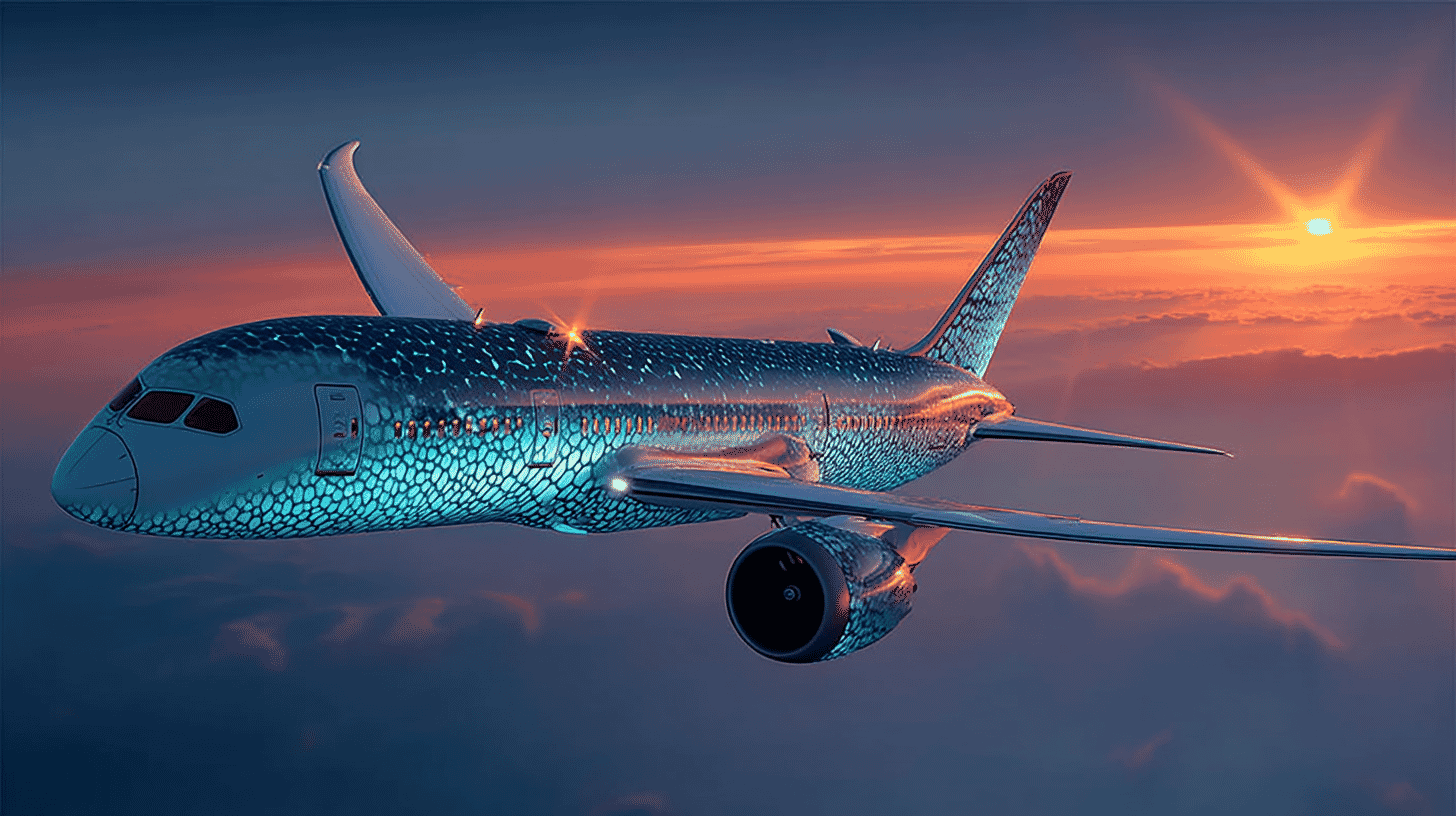
Shark skin is poised to reshape aviation. Traditional fuel efficiency gains have come mainly from better engine performance and lighter airframes. But now a microscopic groove inspired by nature is drawing attention as a new lever. The "riblet" coating technology developed jointly by JAL, JAXA, and Orwell has been applied to a ZIPAIR Boeing 787 for the first time, and the aircraft has entered service.
What Is Riblet Technology?
Riblet technology is an aerodynamic innovation that mimics the fine groove structure found on shark skin. Shark skin features microscopic grooves approximately 0.1mm wide that reduce water resistance and enable efficient swimming. By applying this principle to aircraft, surface friction resistance is reduced, improving fuel efficiency.
During flight, turbulent vortices form on the aircraft surface. When these vortices contact the fuselage, they create friction drag that worsens fuel efficiency. By applying riblet structures, vortices form farther from the aircraft surface, reducing the contact area. Research shows this can reduce surface friction by approximately 5%.
First Application on ZIPAIR and Technical Features
On January 28, 2026, Japan Airlines (JAL), ZIPAIR, JAXA (Japan Aerospace Exploration Agency), and paint manufacturer Orwell announced the first application of riblet-shaped coating to ZIPAIR's Boeing 787-8 (registration JA851J). The work was conducted at JAL's hangar at Narita Airport, and the aircraft began operations on January 27.
The "Paint-to-Paint Method" used is a patented technology jointly developed by JAXA and Orwell. A water-soluble sheet is applied to the aircraft, transferring the riblet shape onto the existing paint film. The sheet is then washed away with water, leaving the fine groove structure. Compared to conventional film-based methods, this approach offers several advantages:
- Nearly zero weight increase
- 8-10 year durability (matching aircraft paint life)
- Lower risk of peeling during flight
- Applicable to large aircraft
The groove depth is approximately 50 micrometers (about the thickness of a human hair), and this precision work requires highly skilled craftsmanship.
Fuel Efficiency Improvements and Environmental Benefits
According to JAXA's calculations, the fuel-saving effect of the technology is as follows. The figures are estimates for JAL's Boeing 787-9 (JA868J), which adopted the riblet coating earlier and had its coated area expanded in November 2025:
Before Coverage Expansion (approximately 30% of fuselage):
- Cruise drag reduction rate: 0.24%
- Annual fuel reduction: approximately 119 tons
- Annual CO2 reduction: approximately 381 tons
After Coverage Expansion (extended to upper fuselage):
- Cruise drag reduction rate: 0.31%
- Annual fuel reduction: approximately 154 tons
- Annual CO2 reduction: approximately 492 tons
These estimates are based on one year of operation on the Narita-Frankfurt route, equivalent to the annual CO2 absorption of approximately 27,000 cedar trees. About 400 flights would save the equivalent of one flight's worth of fuel.
Japanese Innovation and Global Developments
Research on riblet technology has been conducted worldwide since the 1970s, but the path to practical application has been long. In Japan, JAXA has led collaborative research with JAL, Orwell, and Nikon. Durability testing began in July 2022 on Boeing 737-800 aircraft, confirming performance was maintained after more than 1,500 flight hours.
Meanwhile, in Europe, Lufthansa Technik and BASF developed "AeroSHARK," a film-based riblet technology. Deployment began in 2022, and as of January 2025, 22 aircraft within the Lufthansa Group have been equipped. Applying approximately 830 square meters of film achieves about 1% fuel reduction per flight.
The main differences from Japan's Paint-to-Paint Method are that film-based application is relatively easier but involves weight increase and peeling risks. The paint-based method requires skilled craftsmanship but offers superior durability and weight savings.
ANA also began introducing Lufthansa's AeroSHARK to its Boeing 777F fleet in September 2024. In April 2025, application expanded to passenger 777-300ER aircraft, making ANA the first airline in Asia to adopt AeroSHARK.
Future Prospects and Challenges
JAL has been operating 787-9 aircraft with riblet coating since January 18, 2025, and the expansion to ZIPAIR demonstrates group-wide environmental technology deployment. Future verification and considerations include:
- Actual fuel efficiency improvements on long-haul international routes
- Durability and aesthetic maintenance of the coating
- Further expansion of application areas
- Potential deployment to other aircraft types
The aviation industry aims to achieve carbon neutrality by 2050 and is pursuing various initiatives including SAF (Sustainable Aviation Fuel) adoption and fleet renewal with fuel-efficient aircraft. Riblet technology is particularly noteworthy as it can be applied to existing aircraft, offering immediate environmental benefits.
What About Aviation Environmental Technology in Your Country?
In Japan, there is strong interest in "biomimetics" - imitating mechanisms found in nature - and shark skin technology is welcomed as an example. As environmental awareness grows, "flight shame" - guilt about air travel - has become a topic of discussion, but hope is placed in such technological innovations to support sustainable air travel.
What environmental aviation initiatives exist in your country? Is biomimetics (bio-inspired technology) receiving attention?





Global Discussion
15 comments