
🧠 A mouse learned where the food was. Then researchers powered its brain down for two days, and more than half the connections in its memory center disappeared. When the mouse woke up, it went straight back to the food. So what was holding the memory, if half the wiring was gone?
Half the connections vanished. The memory didn't.
The experiment comes from the Okinawa Institute of Science and Technology (OIST), with collaborators at the University of Tsukuba and two other Japanese research institutes, and was published in Science on August 13.
The setup was simple: two days in a hibernation-like state, with the hippocampus, the part of the brain that handles this kind of memory, imaged before and after.
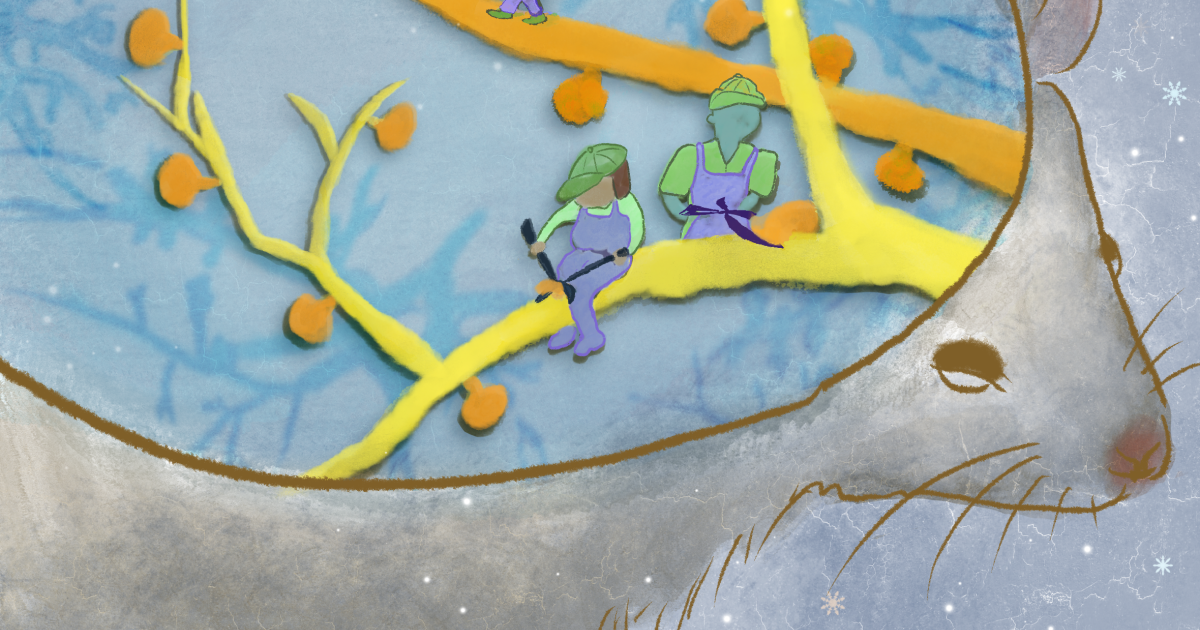
[ref src="https://www.oist.jp/sites/default/files/styles/open_graph/public/2026-06/Artificial%20hibernation%20illustration%20by%20Luo-chu%20Yang.png?h=8f6e4d86&itok=hlKj6S0n" alt="Illustration of the neural connections that carry a memory trace inside a mouse brain" origin="© Luo-chu Yang / Okinawa Institute of Science and Technology (OIST)"]
Over those two days the hippocampus went quiet. Neurons fired about 70 percent less than normal, and more than half the synapses, the junctions where one brain cell hands a signal to the next, were simply gone.
Then the mice were woken up and tested. They remembered. Recall was as good as before, and in some cases better. Yu-Ju Lin, the study's first author, has called the result astonishing. On the standard account of how memory works, losing that many connections should have taken the memory with them.
What survived was not the strong ones
The textbook version of long-term memory fits in one sentence: connections you use a lot grow physically bigger and stronger, and that thickening is the memory.
There has been trouble with that story for a while. Synapses are not permanent fixtures. They come and go over a matter of weeks, and the memory stays anyway. Hibernation made the problem impossible to ignore, because it took most of them away at once.
So the team looked at which ones the brain had held on to.
Not the big ones. Size had no bearing on which synapses were cut, and large and small went at roughly the same rate. The ones that came through were, if anything, on the small side. That is the opposite of what the thickening story predicts.
What the survivors had in common was position. Synapses belonging to the same memory that sat packed close together, in tight clumps, were the ones that stayed; isolated ones were not spared. The other survivor was a shared arrangement, where one sending terminal plugs into several receiving cells rather than into just one. A junction box instead of a private line.
Put another way, a long-term memory looks less like a set of thick cables and more like a seating chart. What counts is which connections sit next to which.
Kazumasa Tanaka, who heads OIST's Memory Research Unit, put it bluntly in the university's announcement: "not every synapse matters." Nikkan Kogyo Shimbun reports him describing the work as having brought the smallest structural unit of a memory trace into view.
Why you would hibernate a mouse to find this out
A waking brain is a crowded place. Most of what happens in it at any moment has nothing to do with any particular memory, which makes it very hard to tell which connections are the ones doing the remembering.
Hibernation clears the room. Strip out most of the activity and most of the connections, find the memory still intact afterwards, and whatever is left is a much shorter list of suspects.
The catch is that mice do not hibernate. That obstacle came down in 2020, when Takeshi Sakurai's group at the University of Tsukuba, working with RIKEN, found a small group of cells in the temperature-control region of the mouse brain. Switch those cells on and the animal sinks into a hibernation-like state for days. It is not simple chilling: the body's own temperature setting is turned down, and the mouse defends the new one. The cells were named Q neurons, and the same trick later worked in rats. Sakurai is a co-author on the new study as well.
How far this goes
What the study shows is a correlation. Clustered synapses survived and the memory survived, but nobody has wrecked the clusters to see whether the memory goes with them. Lin says the causal link is unproven, and that testing it will take better tools.
It is also not news that hibernation strips synapses out of the hippocampus. Ground squirrels have been watched doing it for decades: their dendrites and spines pull back on the way into torpor and grow again within about two hours of waking. What is new is being able to ask which ones a particular memory keeps.
And this is mice, for two days, in a laboratory. No human brain has been through anything comparable, and as of August 2026 induced hibernation in people is a research question rather than something a hospital does.
The people who were waiting on this
Several fields have wanted artificial hibernation for years without knowing what it does to a brain. That is what this study starts to answer.
In medicine, the appeal is time. Genshiro Sunagawa at RIKEN, a co-author of the 2020 Q neuron paper, worked as a pediatrician and then in emergency and intensive care before moving into research. What pushed him there, he has said, was seeing children arrive too ill to have survived the ambulance ride, or too ill to be moved at all. Slow the metabolism and tissue cut off from blood needs less oxygen, which buys minutes that do not currently exist.
In spaceflight, the appeal is mass. A 2019 assessment by the European Space Agency's Concurrent Design Facility modeled a crewed Mars mission with the crew in torpor for the 180-day cruise and 21 days of recovery afterwards. Dropping the crew quarters and cutting supplies took about a third off the spacecraft. ESA reckons a return trip means roughly 30 kg of supplies per astronaut, per day.
Both assume the person comes back intact, and comes back as themselves. Two days in a mouse is not five months to Mars. But this brain was shut down on purpose, and the load-bearing parts of the memory were still standing when it came back on.
Where does artificial hibernation sit for you: medicine, or science fiction? And if a hospital in your country offered it one day, would you take it?
References
- https://www.oist.jp/news-center/news/2026/8/13/artificial-hibernation-reveals-secrets-long-term-memory
- https://www.science.org/doi/10.1126/science.aee7004
- https://newswitch.jp/p/50006
- https://www.toonippo.co.jp/articles/-/2339466
- https://www.nature.com/articles/s41586-020-2163-6
- https://www.tsukuba.ac.jp/en/research-news/20200612090000.html
- https://www.jneurosci.org/content/26/41/10590
- https://future.hitachi-solutions.co.jp/series/fea_idomuhito/21/
- https://www.esa.int/Enabling_Support/Space_Engineering_Technology/Hibernating_astronauts_would_need_smaller_spacecraft
- https://www.esa.int/Science_Exploration/Human_and_Robotic_Exploration/Hibernate_for_a_trip_to_Mars_the_bear_way




Global Discussion
4 comments