🧂 Hayabusa2 brought back about 5.4 grams of asteroid Ryugu. Most of it is clay, the ordinary residue of water reacting with rock. Threaded through that clay, rarely, are thin veins of salt. A Japanese team has now looked at what sits next to those veins, and found the nitrogen there: ammonium tucked between clay sheets, carbon triple bonded to nitrogen, and crystals of sodium nitrate.
Nitrogen is the element that turns organic chemistry into the chemistry of living things. On Ryugu, where the nitrogen sits turns out to be a sharper clue than how much of it there is. That changes how these grains read against the ones NASA carried home from asteroid Bennu roughly three years later.
The nitrogen was next to the salt
The paper appeared in Nature Astronomy on August 27, 2026. Its first author is Toru Matsumoto of Kyoto University's Hakubi Center, and the collaboration runs across nine institutions, Yoko Kebukawa of the Institute of Science Tokyo among them. About two years earlier much of the same group had reported that Ryugu grains contain rare veins of sodium carbonate, sodium chloride (halite) and sodium sulfate. This time they went back to those veins and asked what chemical form the nitrogen around them takes.
They cut slices roughly 100 nanometres thick from spots beside the salt and put them in front of soft X-rays, at beamline BL4U of the UVSOR Synchrotron Facility in Okazaki and at BL27SU of the SPring-8 synchrotron in Hyogo. Infrared spectra of the salt-bearing grains showed ammonia absorption. The X-ray spectra placed ammonium ions in the gaps between the stacked sheets of saponite clay next to the sodium carbonate, together with nitriles or cyanides, carbon bound tightly to nitrogen. Inside the sodium carbonate itself sat crystals of sodium nitrate, the mineral South America mines as Chile saltpeter.
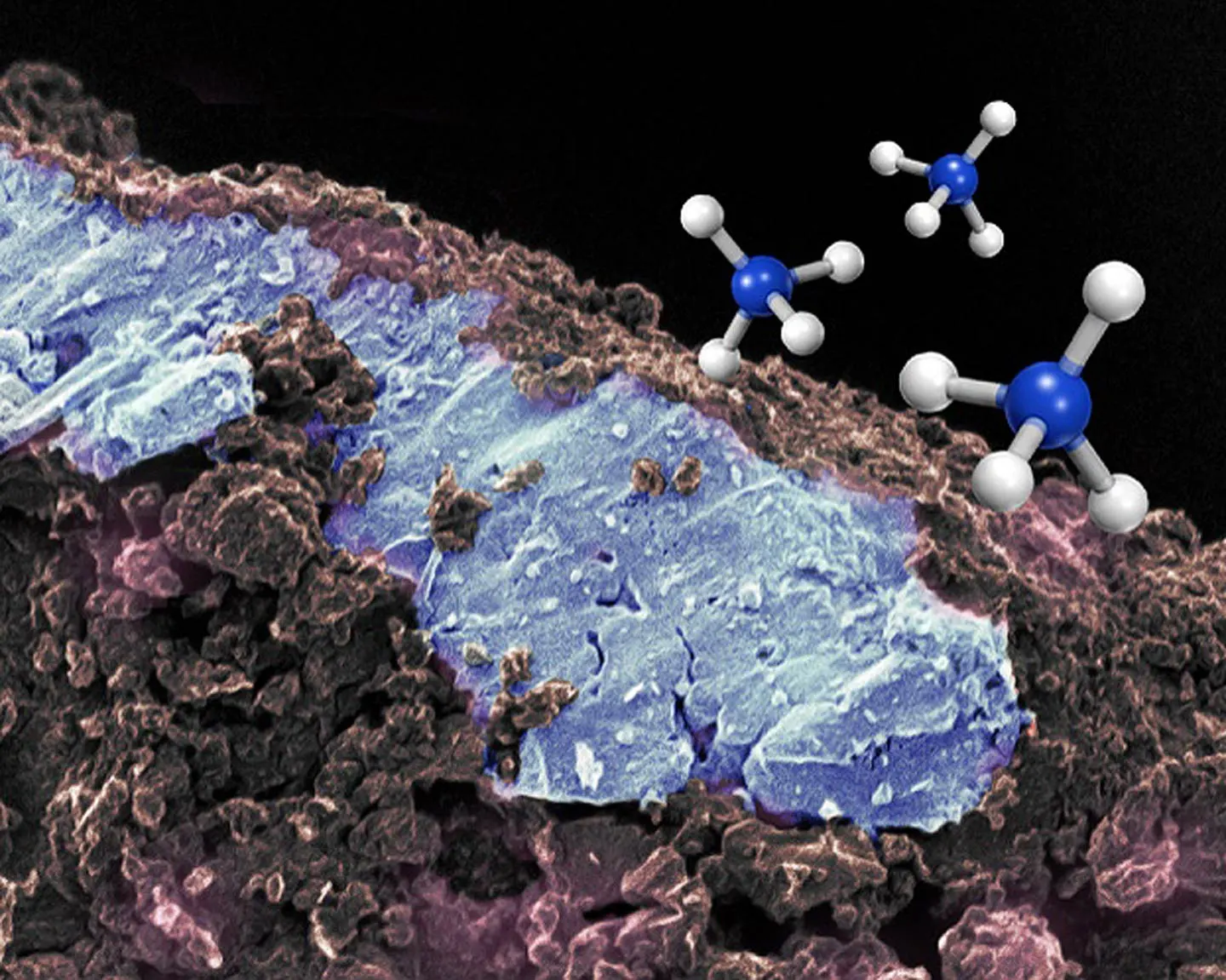
Source: Kyoto University, via Institute of Science Tokyo
The control settled it. Grains with no salt in them showed no clear nitrogen signature. In these grains, nitrogen is not spread evenly through the rock. It follows the salt.
What happens when a brine dries up
Ryugu is rubble from a larger body that formed about 4.5 billion years ago. In the young Solar System each volatile substance had a boundary, a snow line, beyond which it froze rather than staying a gas. Water, carbon dioxide and ammonia each had their own. The parent body is thought to have formed outside all three, farther out than Jupiter's orbit, and to have taken in a great deal of ice.
Heat from inside melted that ice, and the water went to work on the rock, producing clay. Then the body cooled. Some of the water froze again, some escaped through cracks as vapour, and whatever had been dissolved in it stayed behind in the shrinking puddle. It is the process that leaves a salt flat when seawater dries. Freezing concentrates a brine in the same way, because salts fit poorly into ice and pile up in the liquid that remains. The sodium carbonate and its neighbours crystallised at the very end of that.
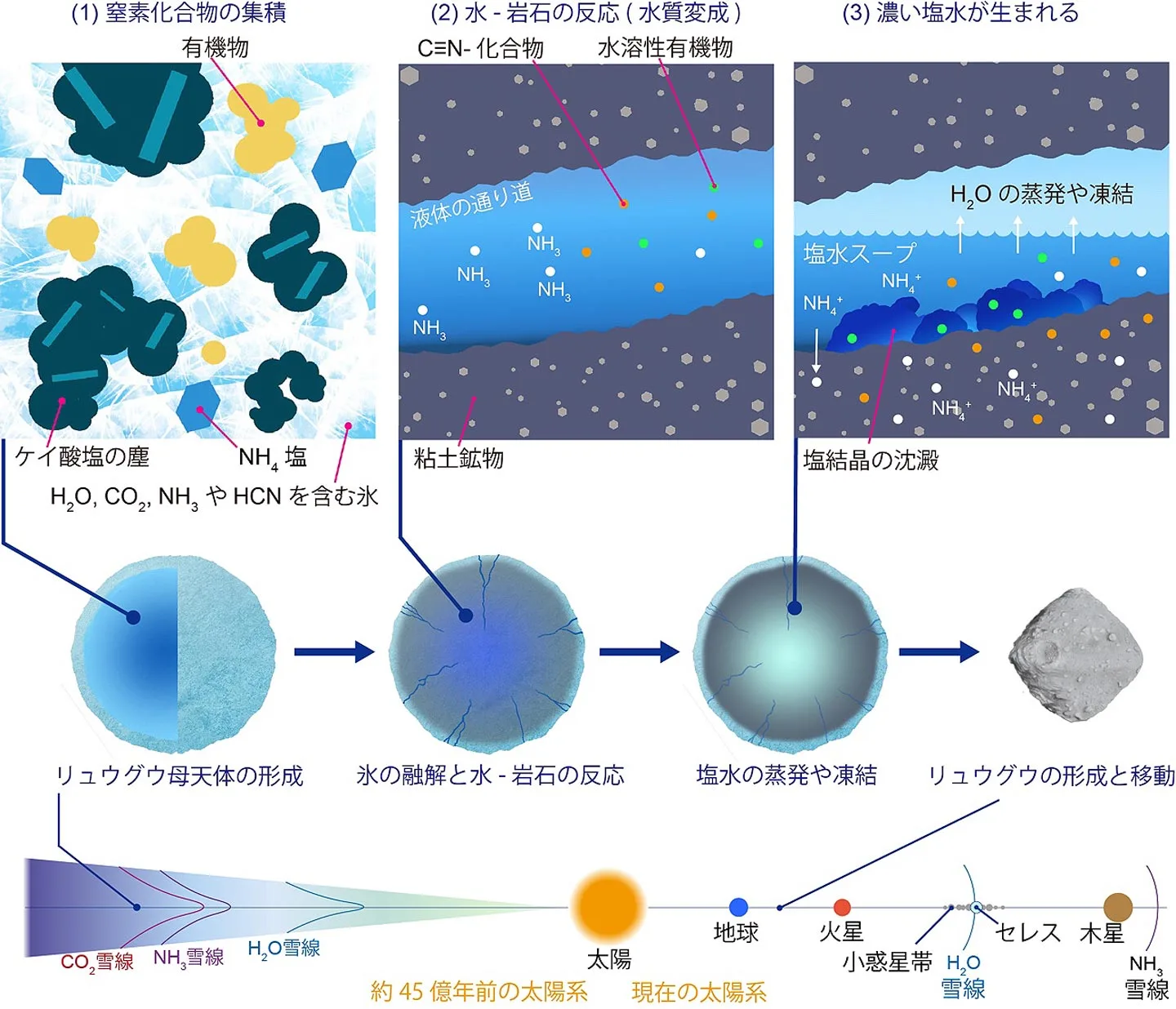
Source: Kyoto University, via Institute of Science Tokyo
The nitrogen compounds rode that concentration down. Ammonia and nitriles are the feedstock for building amino acids and nucleobases in water, and Ryugu has already yielded both. A team led by Toshiki Koga of JAMSTEC reported all five canonical nucleobases in Ryugu grains in March 2026: adenine, guanine, cytosine, thymine and uracil. A brine that is losing water pushes its reactants into each other.
Why Bennu looked 75 times richer
NASA's OSIRIS-REx set down in the Utah desert on September 24, 2023 with 121.6 grams of asteroid Bennu. In January 2025 a team led by Daniel Glavin of NASA Goddard reported the ammonia in a hot-water extract of Bennu at about 13.6 micromoles per gram, roughly 40 percent of the nitrogen in that extract. They put it at 12 times the level in the Murchison meteorite and 75 times the water-extracted level reported for Ryugu.
What that number measures is narrow: ammonia that hot water pulls out of a sample. Ammonium wedged between clay sheets is not that. Tianhao Jiang and colleagues published an infrared survey of both collections in May 2026 and found ammonium-bearing clay grains in each, 13 regions across roughly 5.4 grams of Ryugu material and 12 across roughly 0.6 grams of Bennu material. Their reading was that the two asteroids may carry broadly similar amounts of nitrogen overall, while the ammoniated clay is clearly more common in Bennu.
Bennu's salt record is also fuller. In a Nature paper published the same month as the ammonia result, Tim McCoy of the Smithsonian and colleagues laid out an entire evaporite sequence in the Bennu grains: sodium carbonates, sodium sulfate, halite, sylvite, sodium fluoride and sodium-bearing phosphates, formed at something like 20 to 29 degrees Celsius after at least 60 to 70 percent of the water had gone. Ryugu's salt survives as scattered veins instead. Two asteroids from the same broad family, caught at different points in the same process.
The bulk nitrogen question is not settled. Glavin's team also reported that their Bennu samples averaged higher in total carbon and nitrogen than the CI and CM meteorites studied before them, and higher than Ryugu aggregates, though without putting a ratio on it; Jiang's group reads the bulk nitrogen of the two asteroids as broadly similar. Neither reading explains a 75-fold gap by total abundance alone, which is reason to take that figure as a statement about one chemical pool rather than about the nitrogen budget. Matsumoto's team has now shown where a good deal of Ryugu's nitrogen is: clay interlayers, nitriles and nitrate crystals. A measurement of water-extractable ammonia does not count any of those.
Bulk chemistry answers a different question
An ordinary meteorite fall does not preserve any of this. Salts dissolve in water, and a stone that has sat in humid air has usually lost its original ones or swapped them for terrestrial ones. Ryugu's container came down at Woomera on December 6, 2020, reached the curation facility still holding a vacuum below 10 to the minus 5 pascals, and was opened inside a clean chamber on December 14. Everything since has been handled in vacuum or high-purity nitrogen. NASA ran a continuous flow of nitrogen into the Bennu capsule to push out any air trying to get in, for the same reason.
Dissolving a sample in hot water gives an accurate figure for what dissolves, and destroys the map of where any of it was. This study went the other way: a slice 100 nanometres thick, taken from a chosen position next to a salt vein, scanned point by point with soft X-rays. Bulk extraction and micro-analysis are answering different questions, and the 75-fold gap sat in the space between them.
Against 121.6 grams, 5.4 grams is no advantage in material. Japan's edge is the chain: a container that never opened on the way home, a curation facility that keeps grains out of the air for years, and domestic beamlines that a research group can book again and again to interrogate a single 100-nanometre slice. The spacecraft is the part that gets photographed. The rest of it decides which questions can still be asked nearly six years later.
Ceres is the obvious next test
The team points onward to Ceres, where sodium carbonate and ammonia-bearing clays have both been detected, the same pairing they found in the Ryugu grains. Telescopes keep turning up asteroids with ammonia signatures as well. If concentrated brine was a normal late stage in the life of an icy body, then a good many objects should carry the same chemistry.
For years, what mattered about a wet asteroid was that it had been wet at all. What Ryugu suggests is that the productive moment came later, when the water was leaving and everything dissolved in it was being forced together. Habitability research tends to look for water. This points instead at drying.
In Japan, nearly six years after the capsule landed, a university press release about clay and salt still travels straight onto the science pages. Part of that is simple arithmetic: 5.4 grams has to last decades, so every result is a fresh claim on a finite thing. How does your country treat what its missions bring home, as a headline for a week, or as a story people keep following?
References
- https://www.isct.ac.jp/ja/news/zx3l486tr1np
- https://doi.org/10.1038/s41550-026-02962-y
- https://www.isas.jaxa.jp/topics/003877.html
- https://doi.org/10.1038/s41550-024-02472-9
- https://www.nature.com/articles/s41467-026-72866-y
- https://www.nature.com/articles/s41586-024-08495-6
- https://www.nature.com/articles/s41550-026-02791-z
- https://curation.isas.jaxa.jp/sample-curation/ryugu/
- https://science.nasa.gov/mission/osiris-rex/osiris-rex-faq/








Global Discussion
0 comments