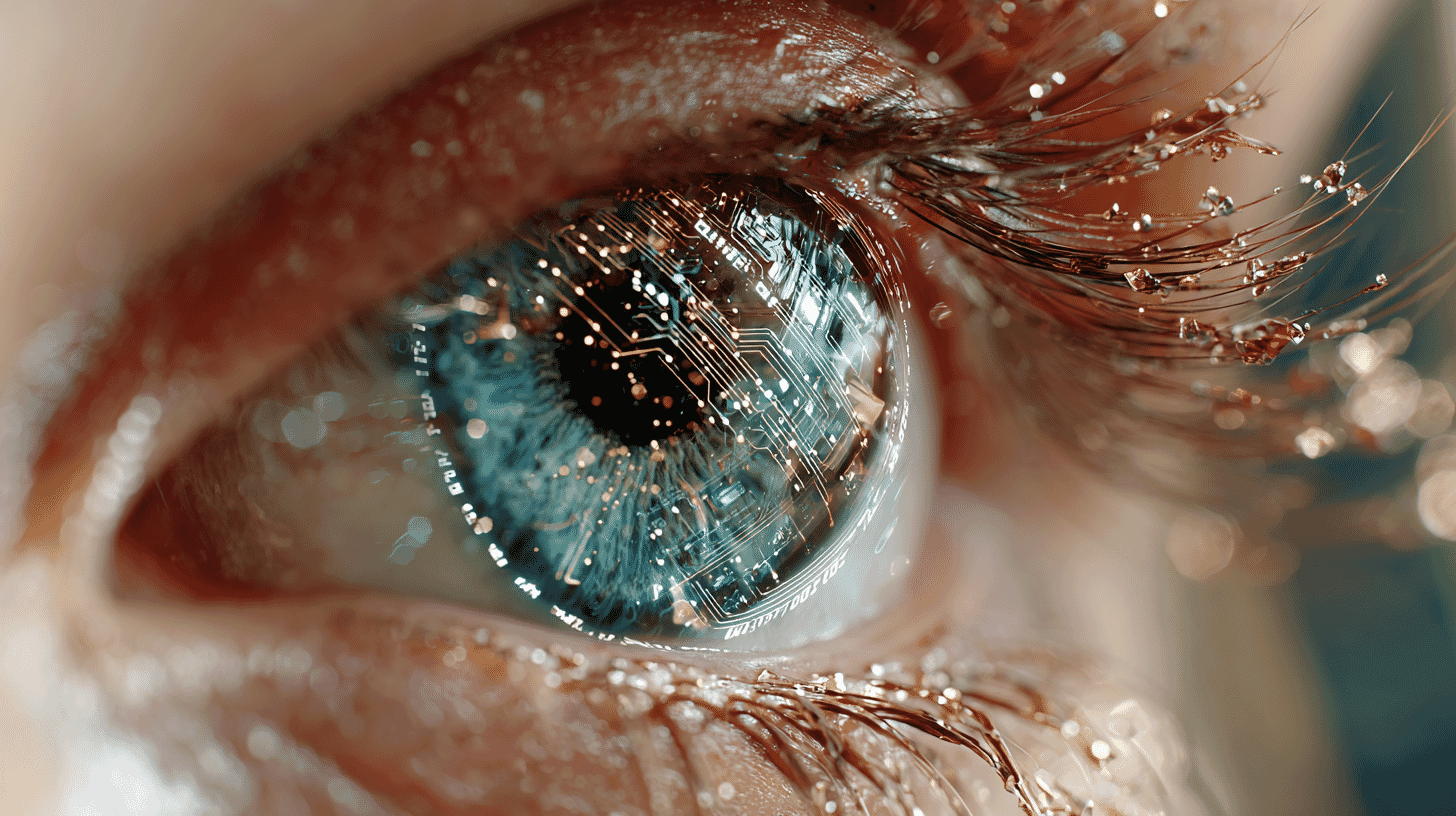
Imagine contact lenses that display maps, messages, and health data directly in your field of vision. What once seemed like science fiction is turning into a product, and Japan is among the places pushing hardest. In 2025, Japanese universities and companies posted milestone results in display, components, and safety. As the market starts to take shape, the question is how much of its core Japanese technology will end up supplying.
What Are Smart Contact Lenses?
Smart contact lenses are next-generation wearable devices that integrate electronic circuits, sensors, and display capabilities into traditional vision-correcting contact lenses. The potential applications span multiple fields.
For augmented reality, these lenses can overlay real-time information such as navigation, messages, and translated text directly onto your visual field. In healthcare, they can monitor blood glucose levels from tear fluid and track intraocular pressure for early glaucoma detection. Research is also advancing in automatic vision correction and biometric authentication.
Unlike smartphones or smart glasses, contact lenses sit directly on the eye, eliminating the need to hold a device or wear bulky headgear. As the ultimate hands-free device, smart contact lenses are considered the frontrunner for next-generation personal computing.
Japan's R&D Frontline
Tokyo University of Agriculture and Technology: Solving the "Focus Problem" with Holography
The long-standing challenge in smart contact lens development has been the eye's inability to focus on displays embedded within the lens. Because the retina is too close to the display, conventional approaches result in blurred images.
Professor Yasuhiro Takaki's research group at Tokyo University of Agriculture and Technology addressed this problem by developing a "Holographic Contact Lens Display" in 2021. Using holography to reproduce light wavefronts from objects, the eye can naturally focus on the displayed images just as it would on real objects.
In April 2024, the project, formally titled the development of innovative foundational technology for a holographic contact lens display, was selected for NICT's Beyond 5G (6G) Fund Program, launching a full-scale industry-academia collaboration with Tokushima University, Waseda University, Citizen Finedevice, and SEED. The work runs through fiscal 2026 and aims to establish the foundational technologies commercialization will require.
In October 2025, the "Smart Contact Lens Consortium" was established under Professor Takaki's leadership, with activities scheduled to begin in April 2026. The consortium aims to develop industry standards and strengthen Japan's international competitiveness in this emerging field.
SEED: Democratizing Development with an Open-Source Platform
Japanese contact lens manufacturer SEED unveiled an "Advanced Open-Source Platform" for smart contact lens development in February 2025.
Developing smart contact lenses requires expertise across semiconductors, electronic components, communication technology, materials science, and medical device certification, along with substantial investment. U.S. company Mojo Vision, for example, suspended its smart contact lens development in 2023 due to funding challenges.
SEED's platform provides a common architecture including control LSIs, flexible substrates, and chip mounting technologies, enabling external companies and research institutions to enter smart contact lens development at lower costs.
The platform's core component is an ultra-compact 1.04mm-square control LSI designed under contract by RAMXEED, featuring FeRAM (ferroelectric memory) with wireless communication and AD converter capabilities. Century Arcs handled the flexible substrate and chip-mounting process.
SEED took a controlling stake in 2019 in SENSIMED, the Swiss company behind "Triggerfish," a contact lens with an intraocular pressure sensor used in glaucoma diagnosis; the system cleared Japanese regulatory certification as a controlled medical device in 2015. SEED Group built the platform on that technology base.
Waseda University: Ensuring Safety with Electromagnetic Shielding
While wireless communication and power transfer are essential for smart contact lenses, the harmful effects of electromagnetic waves on the eyes presented a significant challenge.
In June 2025, Professor Takeo Miyake's research group at Waseda University successfully developed a transparent electromagnetic shield using MXene, a two-dimensional material. This technology enables safe use of smart contact lenses with wireless functionality while protecting the eyes from electromagnetic radiation.
Additionally, this coating provides moisturizing effects that reduce eye dryness, improving comfort during extended wear. Professor Miyake stated that "this technology will become the foundation for all smart contact lenses."
Global Development Competition
XPANCEO: Dubai Startup Targeting 2026 Completion
Dubai-based XPANCEO has emerged as a leader in smart contact lens development, securing $40 million in funding in 2023 and $250 million in summer 2025.
At GITEX Global 2025 in October, the company unveiled six prototypes featuring AR display capabilities, intraocular pressure sensors, and integrated micro-batteries. Utilizing two-dimensional materials and nanophotonics, XPANCEO aims to complete a fully functional prototype by the end of 2026.
Market Projections and Future Outlook
Forecasts vary widely depending on who is counting. The research cited by the Smart Contact Lens Consortium puts the global market at about $13.4 billion by 2030. A separate forecast covering only Japan projects roughly 14.5 percent annual growth from 2025 to 2032, reaching about $120 million by 2032. Because each firm defines the category differently, these figures are best read as rough indicators.
The International Electrotechnical Commission (IEC) has also initiated standardization work for contact lens displays, and Japan's consortium plans to participate in developing industry standards in coordination with these international efforts.
Challenges Toward Commercialization
Several challenges remain before smart contact lenses can be commercialized.
Technical challenges include developing ultra-compact batteries, ensuring durability for extended use, and improving water- and moisture-resistant technologies. Safety considerations require medical device certification, assessment of long-term effects on the eyes, and ensuring data security.
However, Japan's industry-academia collaborations are steadily advancing and addressing these challenges one by one. As the next-generation device after smartphones, smart contact lenses may transform our daily lives sooner than we think.
Japan has an estimated 15 to 18 million contact lens wearers, roughly one person in ten, according to the Consumer Affairs Agency. What changes when a device that ordinary becomes "smart"?
What are the attitudes toward smart contact lenses and wearable devices in your country? What features would make you want to try them?
References
- https://www.tuat.ac.jp/outline/disclosure/pressrelease/2025/20251008_01.html
- https://prtimes.jp/main/html/rd/p/000000127.000038735.html
- https://www.waseda.jp/inst/research/news/80980
- https://newswitch.jp/p/46300
- https://www.seed.co.jp/smartcl-platform/
- https://eetimes.itmedia.co.jp/ee/articles/2508/01/news002.html







Global Discussion
15 comments