🔬 Your biology textbook tells a small lie. It draws metabolism as a tidy queue: enzyme one does its job, lets go of the product, enzyme two picks it up, and so on, with molecules drifting freely through the cell to find their next station. For about 40 years, scientists have suspected the truth is stranger: that enzymes physically huddle together and pass fragile molecules hand to hand, never letting them touch the open water of the cell. The trouble was that nobody could ever see it. A Japanese-led team has now caught a piece of that hidden machinery at atomic resolution for the first time, and in doing so found a control trick no one had described before.
A 40-year-old hunch
The idea has a name: a metabolon. The term was coined in 1985 by the American biochemist Paul Srere, who pictured a metabolic pathway not as scattered workers but as an assembly line, with sequential enzymes loosely bound into one cluster.
The appeal is easy to grasp. Many of the in-between molecules in metabolism (chemists call them intermediates) are unstable. Set one loose in the watery interior of a cell and it may break down, drift off, or react with the wrong thing. But if the enzymes that make and then consume that intermediate are sitting right next to each other, the molecule can be handed straight from one active site (the small pocket where an enzyme does its chemistry) to the next, without ever being released. That makes the step faster and less prone to error.
For plants, one place this matters is the production of flavonoids, the large family of compounds behind most red, blue, purple and yellow flower colors. Flavonoids also help plants fend off pests and cope with stress, and they are the same compounds often flagged as healthful in plant-based foods. Building them correctly is worth a plant's while.
There, but invisible
So if metabolons are such a good idea, why did it take four decades to see one?
Because they are built to fall apart. A metabolon is held together by weak, reversible bonds: the enzymes touch, do their handoff, and let go. That flimsiness is the whole point inside a living cell, but it is a nightmare in the lab. Try to pull a metabolon out to study it, and it dissolves into loose parts. Leave it intact inside the cell, and it is too small and too fleeting to image clearly. The structure was there and not there at the same time. Despite how far biology has come over those 40 years, almost no metabolon had ever been pinned down at the level of individual atoms.
Catching the guide in the act
The team, led by Rikio Imaizumi and Toshiyuki Waki of Tohoku University's Graduate School of Engineering, with Kanazawa University, Tokushima University, RIKEN, Hokkaido University, the University of Hyogo and the Japan Synchrotron Radiation Research Institute, went after a specific pair in the flavonoid line. Their results were published in Nature Catalysis on June 15, 2026.
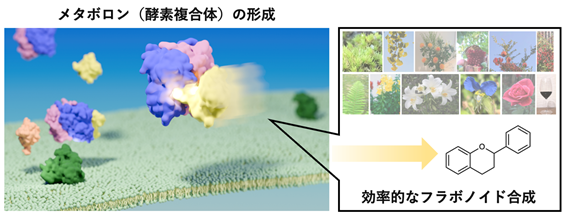
The star enzyme is chalcone synthase (CHS), which performs one of the key early steps. Alongside it works a helper called CHIL, short for chalcone isomerase-like protein. The same group had shown in earlier work that CHIL somehow steers CHS toward the right product. What it had never seen was how.
This time they solved the three-dimensional structure of the CHS–CHIL pair locked together, using the intense X-rays of synchrotron facilities to read the atomic layout, and a high-speed scanning probe microscope at Kanazawa's Nano Life Science Institute to watch the parts move. The combination let them capture both the still picture and the motion.
Source: Tohoku University / RIKEN press release
What they found reframes what a helper protein can do. CHIL does not just sit beside CHS. When it binds, briefly, and then lets go, it changes the shape of CHS's active site, tuning that little pocket so the unstable reaction runs the right way and unwanted byproducts are held back. CHIL behaves less like a fixed partner and more like an attendant who adjusts the worker's tool at the exact moment of the handoff, then steps away.
The researchers gave this principle a name: the GATE mechanism, for Guided Active-site Tuning via transient Enzyme association. The "gate" is literal in spirit: a fleeting contact that guides the reaction toward the correct entrance.
What a flower's color can teach us
It is worth being precise about what this is and isn't. The team did not map an entire metabolon, and did not discover a new enzyme. They resolved a partial structure at atomic resolution, a first of its kind, and from it read out a new principle of how metabolism gets controlled.
That distinction is where the interest lies. For decades, the assumed job of a metabolon was simple: gather the players together so reactions go faster. The GATE mechanism adds a second job. A transient partner actively reshapes the main enzyme to steer the chemistry. Because the same kind of weak, on-off protein contact shows up across living things, the team suggests the principle may not be a plant quirk but something closer to a general rule of metabolic control. That part is a hypothesis to be tested, not a settled fact.
The practical hook is what the researchers call smart bio-manufacturing. If you understand how a helper tunes an enzyme to make exactly the product you want and little else, you have a new lever for designing microbes or plants that produce medicines and functional-food ingredients efficiently and at high purity, a goal at the heart of synthetic biology and metabolic engineering.
There is something humbling in all this. The color of a flower is about as ordinary a thing as nature offers. Behind it sits a piece of machinery that hid from one of biology's best-equipped fields for forty years. It makes you wonder what other everyday, taken-for-granted things are running on mechanisms we still cannot see. What would you want science to finally catch in the act?







Global Discussion
3 comments