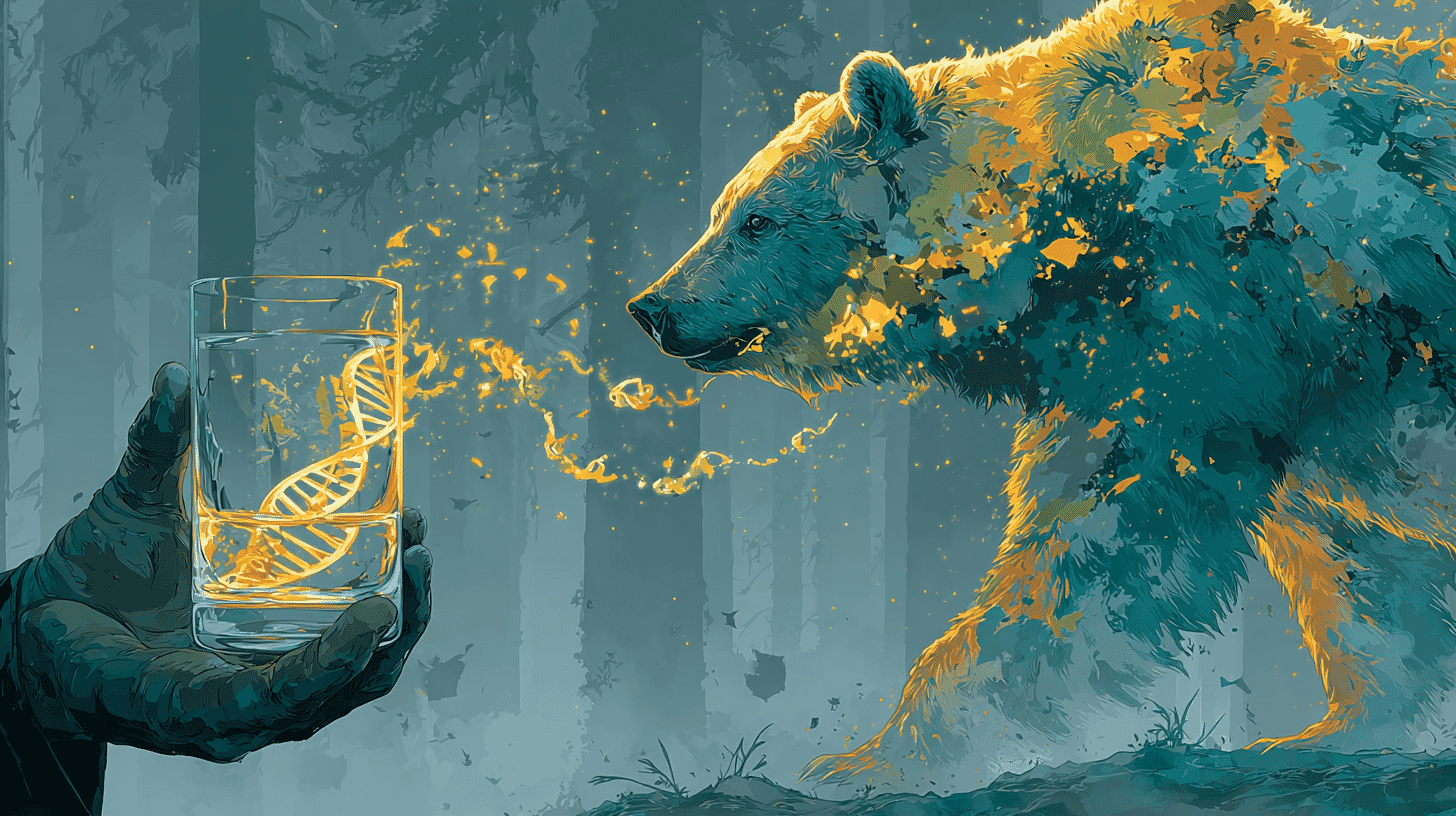
💧 Scoop a single glass of water from a river, and within 24 hours a lab can tell you whether a bear walked past somewhere within a kilometer upstream, and roughly how many. No camera, no footprint, no sighting required. Akita, the Japanese prefecture hit hardest by the country's bear crisis, has been running these surveys since the autumn of 2025. And the technology behind it was shaped by a man who nearly lost his life to a bear.
A survivor who turned his attack into a tool
Keiji Minatoya runs a confectionery shop in Akita. Two years ago, he opened his garage shutter to find a bear already inside; it left him with deep wounds to his face, arms, and torso and a serious head injury. According to a company announcement, rather than simply trying to move on, Minatoya decided to help, providing bear tissue so that researchers could build a detection kit. His reasoning was blunt: he didn't want anyone else to go through what he went through.
That tissue became the basis for a "bear-specific primer," the lab component that can pick a bear's genetic signature out of a murky soup of river water. The project was led by FishPass, a small company in Sakai City, Fukui Prefecture, selected for the "ICT Startup League" run by Japan's communications ministry. It formally began surveying in Akita in December 2025.
How a cup of water "sees" an invisible bear
The science is called environmental DNA, or eDNA. Every animal constantly sheds genetic material into its surroundings: a strand of hair, a bit of saliva when it drinks, traces in its droppings. When a bear walks through or near a river, some of that DNA washes into the water. Scoop up a glass, run it through the right reagents, and you can read which species left their mark.
FishPass didn't start with bears. It built a smartphone app that lets anglers buy fishing permits around the clock, then moved into eDNA to help fishing cooperatives survey their rivers, work that used to require nets, electric shockers, and a lot of labor. A glass of river water, the company says, can reveal what fish are present roughly a kilometer upstream within the previous 24 hours. Applying that same trick to a land mammal like a bear was a first for the team.
The appeal is that it turns scattered dots on a map into something closer to a coverage area. According to FishPass, sampling can flag bear DNA from up to about a kilometer upstream of the collection point, letting officials map where bears are concentrated and how far they've pushed toward town, without sending anyone deep into the mountains to find out.
From "after the sighting" to "before"
Until now, knowing where bears were meant waiting for evidence after the fact: a reported sighting, a footprint, claw marks on bark, droppings on a trail. That tells you a bear was there, but not much about how many, where they're heading, or how dense the population is.
The stakes in Akita are not abstract. Preliminary figures released by the Environment Ministry in May 2026 put nationwide bear encounters in fiscal 2025 at 50,776, a record and more than double the 24,348 logged in fiscal 2023, with 14,720 animals captured. Akita led every prefecture with 13,592, ahead of Iwate's 9,739 and Miyagi's 3,559. In April 2026, local reporting had Akita's sightings running at a record pace, roughly four times the same month a year earlier, with animals turning up in the middle of residential areas. A nursing-home worker filmed a bear calmly grazing on the grounds; parents arranged escorts from bus stops.
eDNA promises to flip the timing. Place traps where the data says bears actually are. Issue warnings before someone is hurt. And, a point FishPass emphasizes, calm people down when there's nothing to fear. Right now, a rustle in the bushes sends a jolt of dread through anyone who's been following the news. A water test that comes back "no bear, probably a wild boar" can dial that fear back down. The team also plans to survey areas like the Oga Peninsula, where sightings are few and nobody is quite sure whether bears are present at all.
The world is fishing for mammals, too
Japan is not alone in pulling land animals out of water samples. In a widely cited study, World Wildlife Fund scientists sampled streams in the South Chilcotin Mountains of British Columbia and detected grizzly bears, wolverines, mule deer and more: 35 mammal types in all, about 25% more than a parallel camera-trap survey turned up, and at lower cost (roughly US$46,000 versus US$64,000). Other teams are testing whether polar bear DNA can be lifted from the snow inside their tracks.
What sets Akita's effort apart is less the science than the purpose. Most eDNA wildlife work abroad is about biodiversity and conservation, counting what lives in a forest. Japan is bending the same tool toward immediate human safety, in a country where two-thirds of the land is forest and bear habitat presses right up against where people live.
Not a silver bullet
It's worth being clear-eyed about the limits, because the technology is genuinely new and easy to oversell. eDNA tells you a bear was probably present; it doesn't pin down the exact moment or the exact spot. Research shows detection rates swing with the seasons and with how active an animal is, and DNA can drift some distance downstream before you sample it, blurring the picture. It won't replace cameras, patrols, deterrents, or the hard decisions about culling. At best it's a powerful new layer, and one that needs careful sampling design to be trusted.
Japan is betting that science can help it live alongside an animal it can't simply wall off. Would you want wildlife managers in your country dipping a cup in the local river to track what's out there?
References
- https://news.yahoo.co.jp/articles/7a455431babe9534668e4e761e31d95ece49cf20
- https://prtimes.jp/main/html/rd/p/000000018.000118467.html
- https://fishpass.jp/news/3276/
- https://www.nikkei.com/article/DGKKZO95506270X00C26A4LB0000/
- https://www.sakigake.jp/news/article/20260429AK0036/
- https://www.worldwildlife.org/news/press-releases/environmental-dna-is-as-effective-as-camera-traps-for-monitoring-terrestrial-mammal-diversity/





Global Discussion
4 comments