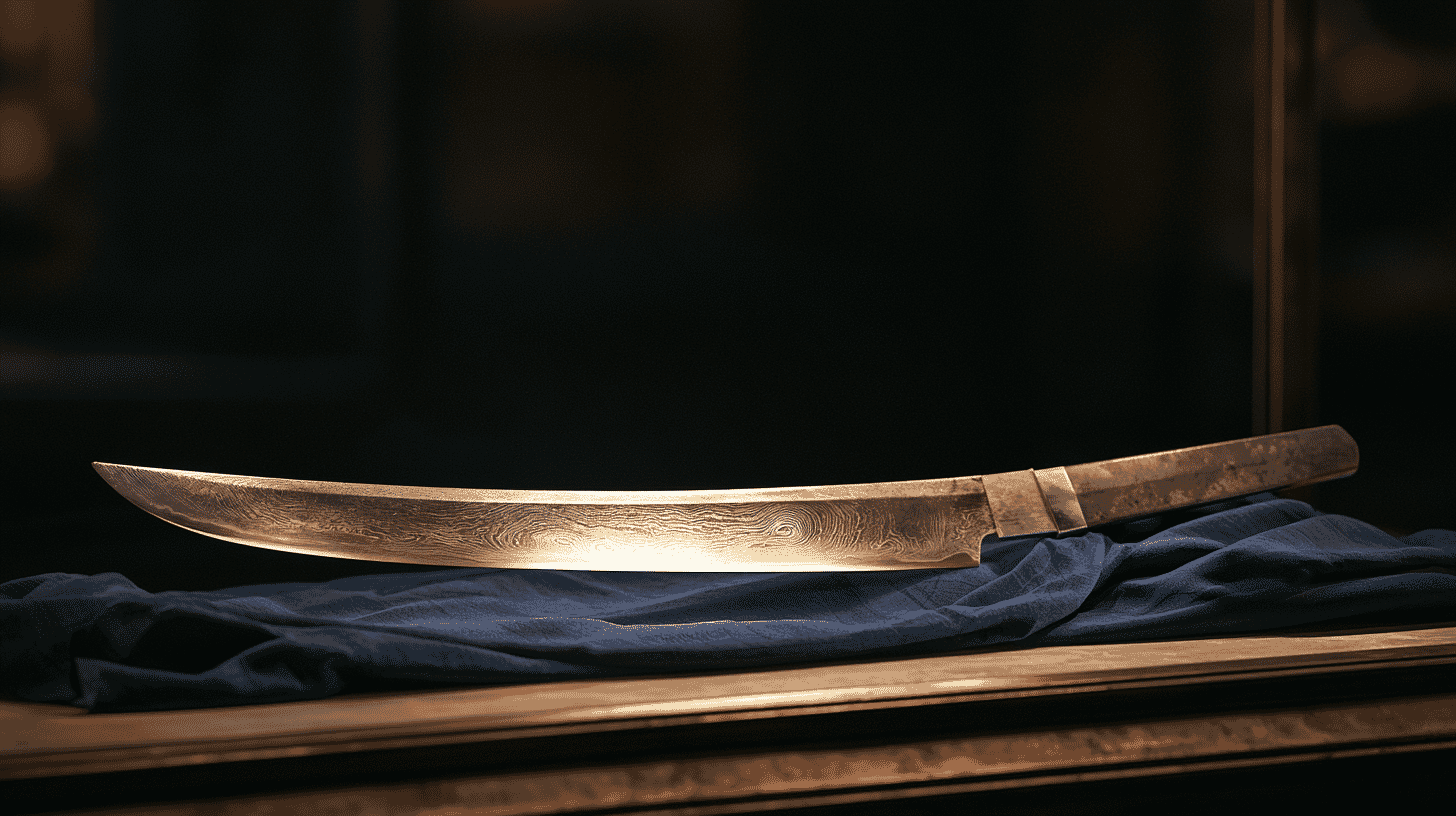
🌠 A blade forged from a fallen star sounds like loot from a role-playing game. Japan made five of them, in 1898. They were commissioned by a Tokugawa naval officer turned Meiji cabinet minister who got the idea from a Russian tsar, and the rock they came from later turned out to be useful to scientists reading a 3,300-year-old pharaoh's dagger.
The pickling weight that came from space
When the Perseids arced over Hokkaido in the early hours of August 13, 2026, a crew from Toyama Television used the occasion to chase something stranger than a meteor shower: a Japanese sword made out of one. Their report went out nationally on FNN.
Around 1890, somewhere upstream on the Kamiichi River in what was then Shirahagi village (today the town of Kamiichi, Toyama Prefecture), someone picked up a lump of iron. Accounts disagree about who: a miner in one version, a farmer digging in another. The thing was far too heavy for its size, so it was sent to the Osaka Mint, which concluded it was a lump of iron. For a few years afterward, by local telling, it did service as a weight on a barrel of pickles.
In 1895 the Geological Survey under the Ministry of Agriculture and Commerce took a second look and found the giveaway: a Widmanstätten pattern, the crossed crystalline banding that forms only in metal cooling over millions of years inside an asteroid. The 22.7-kilogram, U-shaped lump was an iron meteorite. It was named Shirahagi, after the village.
The sword he saw in Russia
Enomoto Takeaki (1836–1908) heard about the find and bought it with his own money in March of that year.
By then Enomoto had already lived several lives. He entered the shogunate's naval training school in Nagasaki in 1856 and went to the Netherlands to study in 1862, coming home with naval engineering, international law and four European languages. When Edo Castle was handed over in 1868 he refused to let the imperial forces seize the shogunate's warships, sailed north, and held out at the fortress of Goryokaku in Hakodate until he surrendered. Then he did what almost nobody on the losing side of that war managed: under the patronage of Kuroda Kiyotaka he took up the development of Hokkaido, and went on to hold the communications, education, foreign affairs and agriculture portfolios in the government that had beaten him.
From 1874 he served as Japan's minister to Russia, where he negotiated the Sakhalin and Kuril Islands Exchange Treaty of 1875, under which Japan gave up Sakhalin and took the Kurils. Ryugu Shrine, which now holds one of his swords, says it was during that posting, at the Tsarskoye Selo palace outside the capital, that Enomoto first saw a blade of star iron belonging to Alexander I.
In 1814, as Europe celebrated Napoleon's defeat, the English naturalist James Sowerby had a sword forged from his fragment of the Cape of Good Hope meteorite, then tried to give it to the visiting tsar. Diplomatic protocol beat him; Alexander left London without ever learning it existed, and Sowerby had to send it after him in a diplomatic pouch. The sword then disappeared for well over a century, with a search in 1937 turning up nothing, until the geologist Paul Henderson traced it to the Hermitage in 2013. Its blade runs past 600 millimetres and is still in fine condition, which the nickel content explains.
Enomoto wanted one of his own. In 1898, three years after buying Shirahagi, the swordsmith Okayoshi Kunimune delivered five blades, two long and three short, made from roughly four kilograms of the meteorite. Enomoto named them ryūseitō: meteor swords.
What a blade from space actually looks like
Forging them was miserable work. Meteoritic iron is not better sword steel than the domestic kind, only weirder, and later research pinned down why: sulphur and phosphorus inclusions make it crack under the hammer. Ryugu Shrine's account has Kunimune praying at a shrine and keeping three weeks of ritual abstinence before he found a method that held. He ended up blending the meteorite with tamahagane, the traditional steel of Japanese swordmaking, and folding the metal far past the usual count, sixteen times for one blade and twenty-four for another.
Then Enomoto wrote the whole thing up. His paper, "Ryūseitō Kiji," ran in 1902 in the Journal of Geography, published by the Tokyo Geographical Society, an organisation he had helped found. Researchers today describe it as one of the first scientific papers on an iron meteorite written in Japan. In it he records that the blades carried a mottled figure across the surface resembling the ring grain of zelkova wood, and that this was the signature of star iron. The blade on which the figure came out largest, clearest and free of flaws was the one he presented to the crown prince, the future Emperor Taishō.
A team led by Mutsumi Komatsu examined the short sword held by the Toyama City Science Museum and reported on it at the Meteoritical Society's 2019 meeting. It measures about 30 centimetres overall, with a 21-centimetre blade. Two characters are inlaid in gold on the tang, 星鉄, meaning star iron, with the date, March 1898, on the reverse. The surface, they found, is homogeneous, with none of the cracking that the material's impurities normally produce.
How a Meiji whim became a laboratory standard
In February 2020, a team from the Chiba Institute of Technology led by Takafumi Matsui carried a portable X-ray fluorescence unit into the Egyptian Museum in Cairo and, without touching or damaging it, mapped the elements in the iron dagger found in Tutankhamun's coffin.
An Italian-led study in 2016 had already shown that the blade came from a meteorite. What Matsui's team wanted was the how. They found 10 to 12 percent nickel, iron sulphide inclusions, and nickel arranged in bands with cubic symmetry, which is what a Widmanstätten pattern looks like when you map it rather than etch it, and therefore points to an octahedrite. Heat that pattern hard enough and it vanishes, so its survival meant the dagger had been worked cold. Their paper appeared in the journal Meteoritics and Planetary Science in February 2022.
To be confident of what they were seeing, they needed a known meteorite measured on the same machine in the same way. So they went to the Toyama City Science Museum and analysed the piece of Shirahagi kept there, a second fragment picked up two years after the first and later shown to have come from the same fall. The rock Enomoto had chased for its romance was serving, a hundred and twenty-five years on, as a calibration standard for Egyptology.
Calcium in the gold hilt indicates plaster, which Egypt did not adopt until more than a millennium after Tutankhamun, so the dagger probably came from abroad. The Amarna letters record an iron dagger sent to the boy king's grandfather from Mitanni, in what is now northern Syria and southeastern Turkey. That conclusion is contested. A comment published in the same journal the following year argued that the calcium is probably an analytical artefact, that banding one millimetre wide cannot be resolved by a scan stepping almost a millimetre at a time, and that the hilt and the blade need not share an origin in any case.
Matsui also directed the Gifu-Kakamigahara Air and Space Museum, where he had swordsmiths from Seki forge three blades out of meteoritic iron to test how the ancient world might have handled the material. He died in March 2023.
Where the five swords are now
The long sword presented in 1898 went to the imperial household. The second long sword is at Tokyo University of Agriculture, which grew out of an agricultural school Enomoto founded in 1891. One short sword belongs to the Toyama City Science Museum. Another was dedicated in 2017 by his great-grandson Enomoto Takamitsu to Ryugu Shrine in Otaru, Hokkaido, which Enomoto himself established in 1876. That one, a 19-centimetre blade, is shown only on special occasions; its first public viewing came in June 2020, when the head priest put the "spirit sword" out in the hope it would help end the pandemic.
The fifth is where the story goes soft. Staff at the National Museum of Nature and Science say one was lost to fire during the war. The Toyama City Science Museum's own page says a short sword is kept by the family into which Enomoto's niece married. Both accounts are current, and both come from institutions in a position to know.
What was left of the piece the swords came from is in Tokyo. Enomoto's son Takenori donated it to the National Museum of Nature and Science in 1909, and it sits on display there: a U-shaped mass with one face cut flat and smooth, which is the wound where five swords came out. Back in Kamiichi, a stone marker at Sengoku Shrine, raised in 1981, records where it landed.
And the Toyama short sword, normally kept out of public view, goes into the museum's ground-floor lobby from September 19 to October 18, 2026. Admission is 530 yen, a little over three dollars, for adults and free for high school age and under.
Sky metal turns up in plenty of places once you start looking, and Tutankhamun's dagger is only the most famous case. What makes the Japanese version odd is that it is not ancient at all. A Meiji politician bought a rock, had it turned into swords, published a paper about it, and in doing so left modern science something to measure against. Does anything in your country come from off the planet, and what did people decide to do with it once they had it?
References
- https://www.fnn.jp/articles/-/1090405
- https://www.tsm.toyama.toyama.jp/?tid=101911
- https://www.tsm.toyama.toyama.jp/?tid=104320
- https://doi.org/10.5026/jgeography.14.33
- https://www.hou.usra.edu/meetings/metsoc2019/pdf/6216.pdf
- https://www.perc.it-chiba.ac.jp/news/2022/02/14/1636/
- https://onlinelibrary.wiley.com/doi/10.1111/maps.13787
- https://ryugujinja.jp/treasure/
- https://royalsocietypublishing.org/doi/10.1098/rsnr.2013.0044
- https://www.sorahaku.net/exhibition/permanent/other/tetsuinsekitou/
- https://www.nodai.ac.jp/about/guide/enomoto1891/
- https://www.ndl.go.jp/portrait/e/datas/28
- https://www.hokkaido-np.co.jp/movies/detail/6166243023001/
- https://ryugujinja.jp/history/
- https://onlinelibrary.wiley.com/doi/10.1111/maps.13942






Global Discussion
4 comments