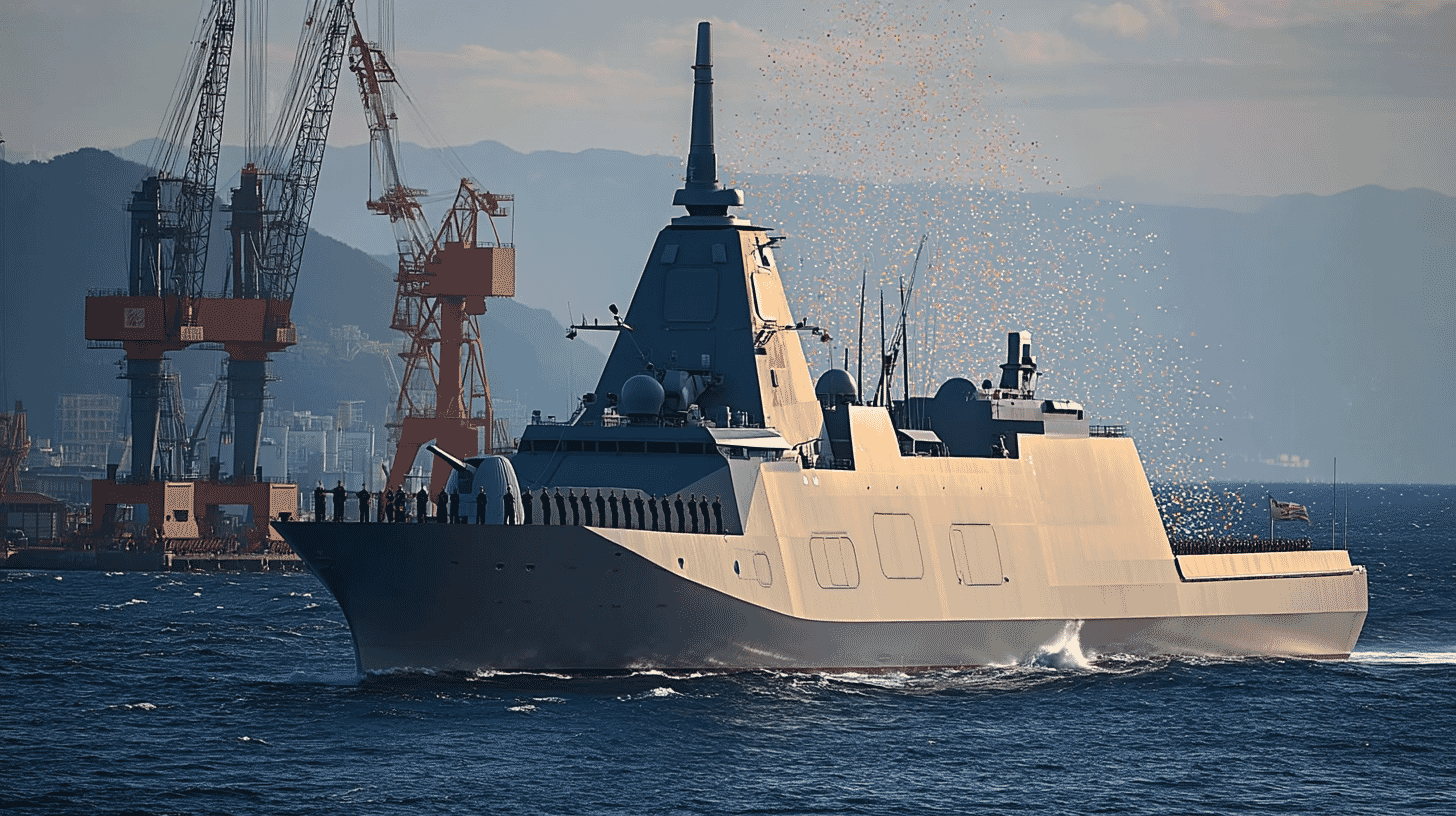
The US Navy has just truncated its next-generation frigate programme. Japan, over the same stretch, launched 12 warships in five years, on schedule. As Western navies slip further behind on shipbuilding, Japan is the one yard still hitting its dates, and that is why Australia went shopping in Nagasaki.
Japan Launches "Yoshii" - The Final Mogami-class Frigate
On December 22, 2025, the Japan Maritime Self-Defense Force (JMSDF) held a naming and launching ceremony for the "Yoshii" at Mitsubishi Heavy Industries' Nagasaki Shipyard. Defense Minister Shinjiro Koizumi attended the ceremony and officially named the vessel.
The name "Yoshii" derives from the Yoshii River, a major river flowing through eastern Okayama Prefecture. This is the first time the name has been given to a vessel in Japanese naval history, counting both the Imperial Navy and the JMSDF. Laid down in July 2024, the ship is due to be handed over to the Ministry of Defense during fiscal 2026, after fitting out and sea trials. Around 200 people attended the ceremony. Construction cost, together with the 11th ship Tatsuta, came to roughly ¥116.6 billion.
12 Ships in 5 Years
Construction of the Mogami-class began in fiscal year 2018. The first ship "Mogami" was launched in March 2021, while the second ship "Kumano" actually launched earlier in December 2020. Since then, the class has maintained a steady pace of approximately two ships per year, completing all 12 vessels within just five years.
Each ship takes about 18 months from keel-laying to launch, and approximately three years total until commissioning, remarkably short by global standards. European nations typically require 3-6 years to build destroyers or frigates of similar displacement, while American shipyards often take even longer.
Mitsubishi Heavy Industries' Nagasaki Shipyard built 10 of the 12 ships, with Japan Marine United handling the remaining two. This division of labor helped maintain the consistent construction pace.
Key Features of the Mogami-class
The Mogami-class is a 3,900-ton multi-function frigate (FFM) measuring 133 meters in length. Its key characteristics include several notable innovations.
While traditional JMSDF destroyers require around 200 crew members, the Mogami-class operates with only about 90 personnel. This crew reduction addresses Japan's ongoing military recruitment challenges through automation and streamlined operations. The ships feature smooth, angular hull designs that minimize radar cross-section, providing excellent stealth capabilities.
Additionally, these frigates are the first JMSDF escorts to incorporate mine countermeasure capabilities. In June 2025, a Mogami-class ship successfully conducted the JMSDF's first unmanned mine disposal operation using its Unmanned Surface Vehicle (USV) system near Iwo Jima.
It is not an all-rounder, though. The Mogami class is a compact ship built mainly for waters close to Japan, and it carries no surface-to-air missiles, which leaves its air defence limited. That gap is what the New FFM is meant to close.
Japan's Excellence Amid Western Struggles
On November 25, 2025, the US Navy announced it would truncate the Constellation-class frigate programme to no more than two ships. Awarded in 2020 and based on the Franco-Italian FREMM design, it was supposed to be the low-risk, cheap, fast option. Specification changes piled up until commonality with the parent design was reported at around 15%. As of November 25, 2025, the first ship was about 12% complete. Navy Secretary John Phelan put it plainly: the Constellation was 80% of the cost of a destroyer and 60% of the capability, so the Navy might as well build destroyers. The service has switched to a new programme, FF(X), based on the Coast Guard's Legend-class National Security Cutter, and wants the first hull in the water by 2028.
Australia has also faced significant delays with its Hunter-class frigates, based on the British Type 26 design. Originally expected in the late 2020s, the first ship may not arrive until 2034 according to some reports.
In contrast, Mitsubishi Heavy Industries boasts a 35-year track record of on-time delivery for JMSDF vessels, a reliability that has earned international recognition.
Australia Selects Japanese Design
In August 2025, the Australian government announced the selection of Japan's "New FFM" (an upgraded Mogami variant) as its next general-purpose frigate. The contract is valued at approximately 100 billion AUD, making it Japan's first major warship export since World War II.
Schedule certainty was the decisive factor. Australian Deputy Prime Minister and Defence Minister Richard Marles cited several key reasons for the selection. The ships feature excellent stealth performance and 32 vertical launch cells, along with advanced radar and sonar systems. They can operate with just 90 crew members, offering superior long-term cost efficiency. Their 10,000 nautical mile range provides extensive operational reach. And most importantly, Japan was assessed as capable of meeting delivery schedules.
Eleven ships are planned. The first three will be built in Japan and delivered to the Royal Australian Navy by 2029; ships four through eleven will be constructed in Australia. Germany, the UK and South Korea had also bid.
Update: On April 18, 2026, the Australian government announced contracts with Mitsubishi Heavy Industries for the first three ships. The signing took place aboard the visiting JMSDF frigate Kumano, where Deputy Prime Minister Richard Marles and Defense Minister Shinjiro Koizumi signed a "Mogami Memorandum" confirming the two governments' cooperation. The three ships will be built at the Nagasaki yard, with the first delivered in 2029, and Canberra has committed up to A0 billion over the decade to the general purpose frigate program. (Added September 2026)
The New FFM and Future Prospects
With the completion of the 12 Mogami-class ships, Japan will now focus on building 12 "New FFM" vessels with enhanced capabilities. The upgraded design increases displacement to 4,800 tons and will carry more powerful air defense missiles and long-range standoff weapons.
The Ministry of Defense plans to build these ships at an even faster pace, completing all 12 between fiscal years 2024 and 2028. Some years will see three ships under construction, pushing Japan's shipbuilding capacity to new heights.
Interest has also come from Indonesia and New Zealand, suggesting new opportunities for Japanese defense equipment exports.
How is warship construction going in your country? Are delays and cost overruns a problem? We'd love to hear your thoughts!
References
- https://www.minister.defence.gov.au/media-releases/2026-04-18/australia-locks-delivery-our-first-three-general-purpose-frigates
- https://motor-fan.jp/article/1378377/
- https://www.mhi.com/jp/news/25122203.html
- https://trafficnews.jp/post/618493
- https://thediplomat.com/2025/08/japan-wins-australias-multi-billion-dollar-frigate-project/
- https://en.wikipedia.org/wiki/Mogami-class_frigate
- https://www.csis.org/analysis/mogami-advancing-australia-japan-defense-cooperation
- https://www.cnn.com/2025/08/11/asia/japan-australia-frigate-deal-intl-hnk-ml




Global Discussion
15 comments