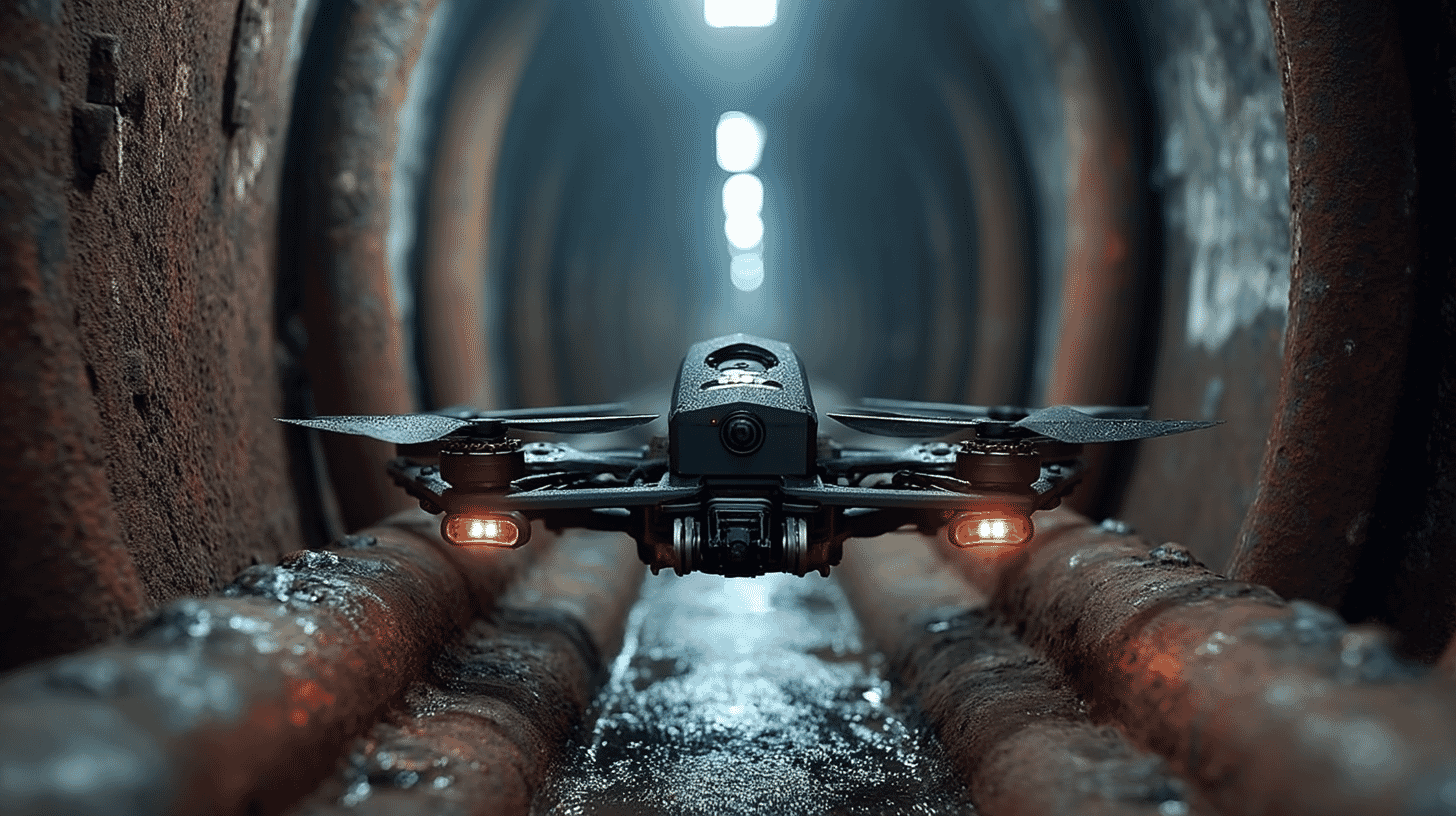
🛸 Inside a factory, a 680-gram drone hangs in the air and simply… stops. No pilot feathering the sticks, no GPS lock, no slow drift toward the wall. It just holds, dead still, in a space barely wider than a dinner plate.
That stillness is harder than it looks, and the company behind it, DRONE SPORTS, didn't learn it on an inspection site. It learned it on a racetrack.
The hard part isn't flying. It's holding still.
Most drones that hover on their own are cheating a little. They lean on GNSS, the family of satellite systems that includes America's GPS, to answer one constant question: where am I right now? Outdoors, with a clear view of the sky, that works beautifully. Step inside a factory, a tunnel, or a length of pipe, and the satellite signal disappears. The drone loses its fix and starts to wander, which in a cramped space full of hard surfaces usually ends in a crash.
DRONE SPORTS' new flagship, the Rangle Pro, gets around this by not asking the satellites at all. It carries a cluster of onboard sensors that continuously work out its own position from its surroundings and its own motion, so it can hang motionless with nobody steadying it. The company calls it a proprietary system and hasn't spelled out the exact sensor mix in public, but the result is the part that matters: hands-free hover in spaces as narrow as 300 millimeters across. That's tight enough to fly inside industrial piping, above a ceiling, or down a sewer and still bring back clean measurements and footage from places people can't easily reach.
From the racetrack to the sewer
Here's the twist. DRONE SPORTS, founded in 2018, is headquartered in Minoh, Osaka, with a development base in Yokohama, and it didn't start life as an inspection company. It started as a racing outfit, and a small one at that, with capital of about ¥15.5 million (roughly $96,000).
Its team, RAIDEN RACING, was Japan's first professional drone-racing squad and the only Japanese entrant in the Drone Champions League, the sport's top international circuit, where the company says it has taken three straight titles. In 2024 the company went further, teaming up with the league to build the machines for the AI Drone Challenge, the drone division of Abu Dhabi's A2RL autonomous-racing project, run by the emirate's ASPIRE technology agency, with a $1 million prize on the line. According to the Japanese transport outlet Norimono News, more than 200 of the company's craft were supplied for that race.
Modern drone racing has changed what it rewards. The frontier is no longer a human pilot's reflexes but the accuracy of the machine's own control system: how precisely software can place an aircraft in space, at speed, on its own. That happens to be exactly what a pipe-inspection drone needs, just slowed down. Instead of threading a race gate at 100 km/h, it has to sit perfectly still in the dark. The racing program became a de facto R&D lab, and its control tech got poured into the Rangle line.
[ref src="https://prcdn.freetls.fastly.net/release_image/33439/131/33439-131-20f8a1e13b559df51832a9c04290470e-1398x834.png?format=jpeg&auto=webp&fit=bounds&width=1200" alt="DRONE SPORTS' Rangle Pro, a Japanese confined-space inspection drone" origin="Source: DRONE SPORTS / PR TIMES"]
Three days, not three months
Clever engineering only counts if someone on site can actually fly the thing, and that has long been the quiet bottleneck for confined-space inspection. Hand-piloting a drone inside a pipe, with no GPS to help, used to take three to six months of training before an operator was any good. DRONE SPORTS says the Rangle Pro cuts that to about three days.
That changes the math. Inspecting steelworks, power plants, bridges, and sewers is precisely the dull, dirty, dangerous work that Japan's shrinking workforce struggles to staff. A tool a near-beginner can run in a week is worth more than a marginally faster one that needs a specialist. The company points to a track record across those heavy-industry sites, including a continuous 1.6-kilometer inspection run through a sewer line by Rangle X, its fiber-optic tethered model, and sells the Rangle not as one super-drone but as an eight-model family, each airframe tuned to a different pipe diameter and task.
Why "no GPS" travels beyond the pipe
Flying without satellites is marketed here as an indoor convenience, but the capability is bigger than plumbing. Satellite positioning can be jammed, spoofed, or simply knocked out, whether by a collapsed grid after a disaster or deliberately in a conflict zone. A drone that fixes its own position from onboard sensors keeps working when GPS doesn't. Rangle is a civilian inspection tool, not a weapon, but the underlying autonomy is the same capability that disaster responders and militaries increasingly want.
Can a niche player dent DJI?
Then there's the shadow over every drone story: DJI. The Chinese giant dominates the global market on price and scale, and Japanese makers have mostly failed to meet it head-on. DRONE SPORTS isn't trying to. Its bet is to own a niche DJI doesn't optimize for, GPS-denied inspection of tight, ugly spaces, where domestic design, hands-on service, and on-site data delivery count for more than shipping millions of units cheaply.
Whether that's enough to "crack the stronghold," as Japanese coverage likes to put it, is far from settled. Scale and price still favor DJI by a wide margin. But operators of security-sensitive power, water, and rail infrastructure are increasingly wary of foreign-made hardware on their networks, and that unease is quietly widening the door for domestic makers. A racing team turning its reflexes into pipe-inspection software is a very Japanese way to walk through it.
Japan is leaning into the niche rather than the mass market. In your country, who crawls into the pipes, tunnels, and sewers to check them, and would you rather a drone did it, built at home or bought abroad?






Global Discussion
4 comments