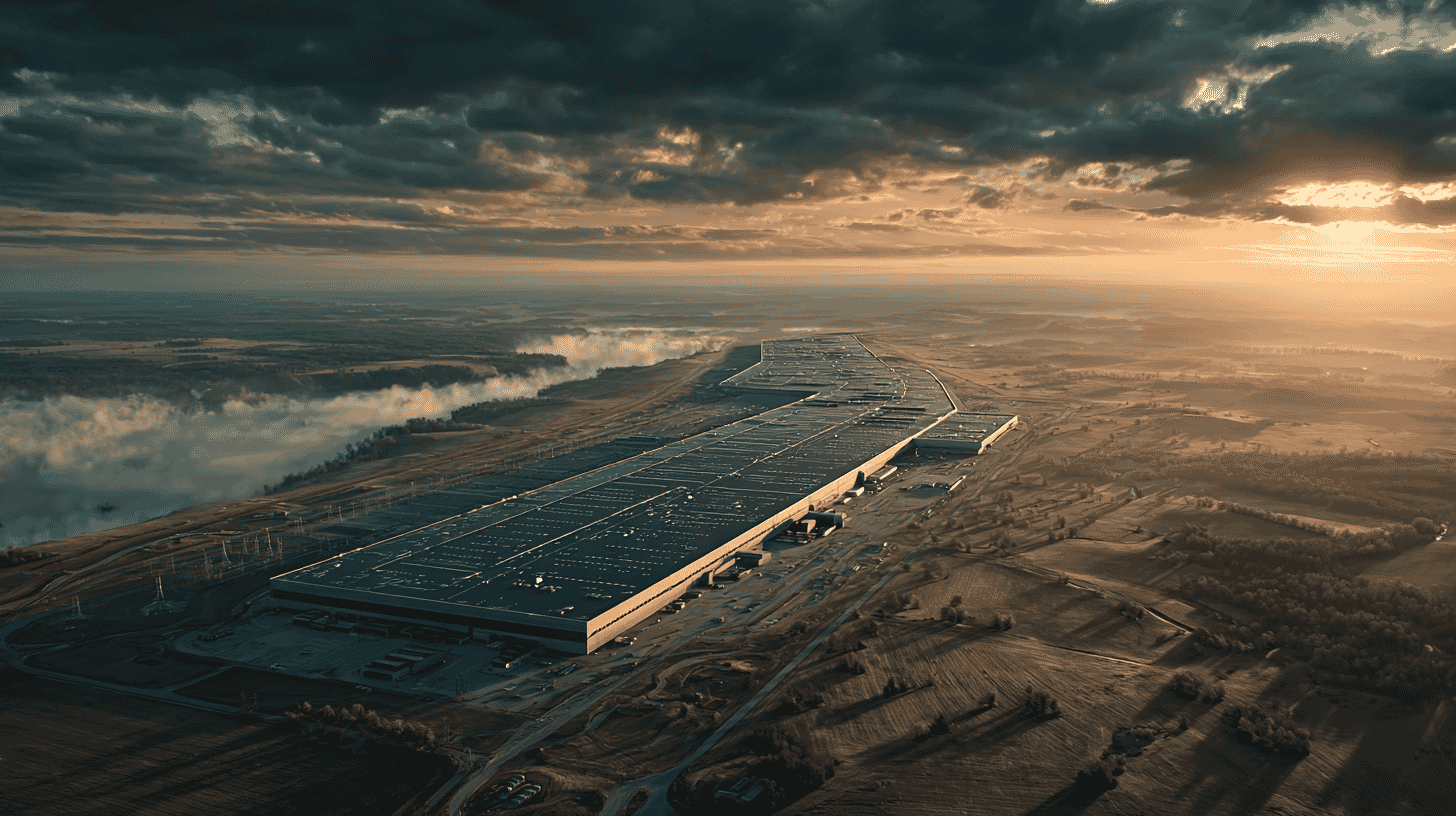
$500 billion in a single location. That is not a national budget. It is what SoftBank CEO Masayoshi Son has pledged to pour into one AI data center campus, a sum he calls the largest single-site investment in human history. Twenty-one Japanese and American companies have signed on. The site is a Cold War-era uranium enrichment plant in rural Ohio.
What Happened in Piketon
On March 20, 2026, in Piketon, Ohio, a historic announcement unfolded at the site of the Portsmouth Gaseous Diffusion Plant, a facility that once enriched uranium for nuclear weapons during the Cold War.
SoftBank Group Chairman and CEO Masayoshi Son revealed plans to build a $500 billion AI data center campus on this very ground. Three U.S. cabinet secretaries, Energy Secretary Chris Wright, Commerce Secretary Howard Lutnick, and Interior Secretary Doug Burgum, attended the groundbreaking ceremony, underscoring the project's national significance.
"We are going to do the largest construction project in the country," Lutnick declared. Son added that this single campus would surpass the combined capacity of every AI data center currently in existence worldwide.
Inside the PORTS Technology Campus
The former nuclear site, rebranded as the "PORTS Technology Campus," will be developed at a staggering scale.
The site sits on roughly 3,700 acres of Department of Energy land, leased for the project. The data center will run at 10 gigawatts (GW), roughly ten nuclear plants' worth. Most of that power comes from 9.2 GW of natural gas-fired generation, about $33.3 billion of equipment to be installed by around 2030. SB Energy, a SoftBank subsidiary, is partnering with AEP Ohio to invest $4.2 billion in upgrading and building transmission lines across the region, which DOE says will not raise customer rates.
The first phase, an 800-megawatt (MW) data center costing $30–40 billion, is expected to be completed by early 2028, with construction beginning in 2026.
Son also addressed local concerns directly: "I will commit right here, right now, that we will protect the electricity bill. We will not take electricity away from the grid. We will generate the entire electricity use by ourselves." He pledged $40 million in donations to support local schools and medical infrastructure.
A Coalition of 21 Companies
What makes this project remarkable is not just its size but the breadth of corporate participation. Twenty-one companies from Japan and the United States are involved.
On the Japanese side, major manufacturers like Panasonic Holdings, Murata Manufacturing, Hitachi, Toshiba, and Mitsubishi Electric are contributing equipment and technology. Financial institutions including Mizuho Bank are also participating. From the U.S., Goldman Sachs and other firms are involved in financing.
The project sits under the $550 billion U.S.-Japan Strategic Trade and Investment Agreement, and DOE says $33.3 billion of Japanese funding is tied to the natural gas generation component alone. This is not just a business deal but a pillar of the bilateral economic relationship.
Why Natural Gas? The AI Power Problem
AI data centers are extraordinarily power-hungry. The widely quoted figure, from a 2024 EPRI estimate, puts a single ChatGPT query at about 2.9 watt-hours, roughly ten times a Google search. That ratio is contested: in June 2025 OpenAI's Sam Altman put the average at 0.34 watt-hours, close to a search query. The real pressure is volume rather than any single prompt. The IEA expects global data center electricity consumption to reach about 945 terawatt-hours by 2030, more than Japan consumes in total.
Son chose natural gas for several practical reasons. Speed: gas turbines can be deployed far faster than nuclear plants or large renewable installations, and turbines have already been procured, with the first units expected within a year. Reliability: AI workloads need round-the-clock stable power that solar and wind alone cannot guarantee. Self-sufficiency: generating its own power on-site keeps the project off the local grid and off local electricity bills.
A commitment this large to fossil fuel infrastructure invites environmental criticism. It also aligns neatly with the Trump administration's twin priorities of AI dominance and fossil fuel promotion.
The Pivot Away From Stargate's Original Plan
The Ohio project represents an evolution of the "Stargate" initiative that Son announced alongside President Trump in January 2025.
Stargate began as a joint venture among SoftBank, OpenAI, Oracle, and UAE-based MGX, promising $500 billion over four years for AI infrastructure across the United States. The flagship site in Abilene, Texas, was followed by expansion to Ohio (Lordstown), New Mexico, Wisconsin, and beyond.
But progress wasn't always smooth. In July 2025, the Wall Street Journal reported that Stargate was "struggling," citing disagreements between SoftBank and OpenAI over construction locations.
The Ohio announcement signals a pivot. Instead of spreading investment across many smaller sites over many years, Son is concentrating $500 billion into one campus. "Instead of many locations, many years, now we are delivering $500 billion in one campus," he said.
Where Son Fits in the Global AI Buildout
The world's tech giants are pouring astronomical sums into AI infrastructure. Microsoft has committed over $80 billion in 2025 alone for AI data centers. Google parent Alphabet has announced roughly $75 billion, and Amazon is spending at a similar pace.
Against that backdrop, Son's $500 billion for a single campus dwarfs any individual project. The difference is position: Microsoft and Google build infrastructure to run their own AI services, while SoftBank casts itself as the builder and operator of infrastructure others will use.
Son's vision rests on three pillars: Arm for chip design, OpenAI for AI development, and data centers for physical capacity. At SoftBank's 2025 shareholders' meeting, he declared his ambition to become the platform provider for ASI, or Artificial Super Intelligence. Ohio is where that ambition meets concrete.
From Component Supplier to Infrastructure Builder
This project could mark a turning point for Japan's role in the global AI competition.
Japan has largely been absent from the AI spotlight. It has no equivalent of GAFAM (Google, Apple, Facebook/Meta, Amazon, Microsoft), no homegrown rival to OpenAI or Anthropic. What Japan does have, and what this project leans on, is manufacturing depth.
Panasonic's battery technology, Murata's electronic components, Hitachi and Toshiba's energy equipment, and Mitsubishi Electric's heavy electrical systems all matter once AI infrastructure has to be physically built. SoftBank subsidiary Arm provides chip designs used in roughly 99% of the world's smartphones and sits increasingly close to the center of AI chip architecture. Japanese companies are ending up on both the brain and the body side of AI.
Challenges and Concerns
Despite the grand vision, significant questions remain.
The biggest is funding. Elon Musk has repeatedly questioned SoftBank's financial capacity, claiming the company had well under $10 billion in available cash when Stargate was first announced. SoftBank has raised substantial capital since, but marshalling $500 billion over time remains a monumental challenge.
Environmentally, 9.2 GW of gas-fired generation will produce significant carbon emissions. Across the United States, communities have pushed back against large data center projects over electricity costs and environmental impact. Ohio is unlikely to be an exception.
The site itself carries unresolved questions. Enrichment at Portsmouth ended in 2001, but the environmental cleanup is still underway, and building on a former nuclear weapons site brings safety and regulatory scrutiny that will not go away quietly.
Son's Biggest Bet Yet
Masayoshi Son's career has been defined by audacious bets: the Vodafone Japan acquisition, the $32 billion Arm purchase, the $100 billion Vision Fund. Ohio is the largest number he has ever put on the table.
A Cold War nuclear site becoming AI compute is a neat symbol, but the arithmetic is unsentimental. Whether the investment pays off depends on whether AI demand holds, whether the capital keeps arriving, and whether U.S.-Japan relations stay steady. The ground at Piketon will find out first.
In Japan, reactions range from excitement to skepticism. Some see Son as a visionary betting on the right future; others worry about overreach and financial risk. What about in your country: how do people view massive tech investments in AI infrastructure? Is it the future, or a bubble waiting to burst?
References
- https://www.nikkei.com/article/DGXZQOGN2035V0Q6A320C2000000/
- https://www.bloomberg.com/news/articles/2026-03-20/softbank-plans-giant-ohio-ai-data-center-powered-by-gas-plants
- https://woub.org/2026/03/20/federal-government-pike-county-site-courntrys-largest-data-center-federal-trade-deal/
- https://www.washingtontimes.com/news/2026/mar/20/trump-admin-announces-10-gigawatt-data-center-gas-plants-former-ohio/
- https://en.wikipedia.org/wiki/Stargate_LLC









Global Discussion
14 comments