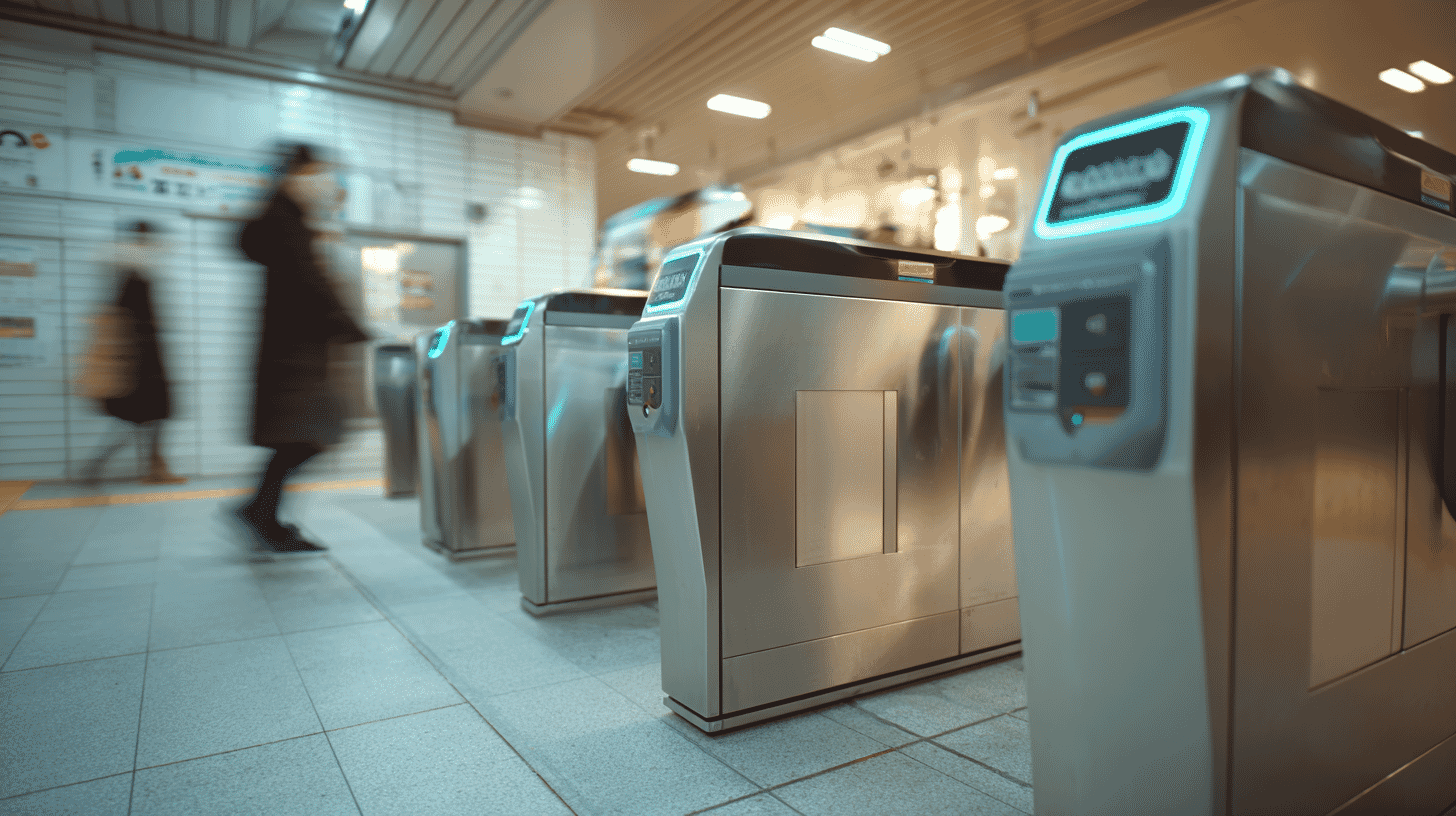
Imagine walking through a train station gate without touching your wallet, phone, or card. Just your face. That's already happening in Japan, and now JR West is ditching its flashy arch-style gates for something far more important: a standard gate design that can be deployed everywhere.
JR West's Facial Recognition Gates Enter Phase 2
On January 30, 2026, JR West announced that it would install a new type of facial recognition ticket gate at Osaka Station and Shin-Osaka Station. The new system began operating on March 2, 2026, and the company continues to recruit volunteer monitors for the ongoing trial.
The most significant change? The new gates are built by retrofitting existing IC card-only gates with facial recognition cameras. This marks a fundamental shift from the previous approach, a dramatic, tunnel-shaped walkthrough gate at Osaka Station's Umekita area that featured embedded displays, floor projections, and a futuristic gateless design. That eye-catching arch-style gate will be removed.
In its place comes a standard-looking ticket gate with two cameras mounted on top. It's not flashy, but this "boring evolution" carries enormous strategic weight.
Why "Retrofit-Ready" Changes Everything
The original arch-style gate was expensive, space-hungry, and only practical for brand-new large-scale stations. The new design flips that equation entirely: any existing IC-only gate can be converted into a facial recognition gate through modification.
This design philosophy clearly targets future expansion. JR West has stated it will consider extending the technology to other gates and stations based on usage data from this trial. With thousands of existing gates across the network, the retrofit approach dramatically reduces the capital investment needed to scale facial recognition infrastructure nationwide.
IC Cards and Face Recognition: Coexistence as Strategy
The technical improvements are noteworthy. The new gates position two cameras in tandem along the direction of travel, improving recognition accuracy. But the most important feature is dual compatibility, a single gate that handles both IC card taps and facial recognition.
In the previous trial, the walkthrough gate at Osaka Station's Umekita underground entrance supported both IC cards and face authentication, but the Shin-Osaka east gate was face-only, no IC card access. Users who entered via facial recognition could only exit via facial recognition, effectively limiting the service to commuters traveling between Osaka and Shin-Osaka.
The new gates eliminate this friction. IC card users and facial recognition users share the same hardware, meaning no gate capacity is lost when facial recognition is added.
Expanded Locations: Adding Osaka's Busiest Gate
The new facial recognition gates will be installed at three locations:
- Osaka Station, Umekita underground entrance, Replacing the arch-style gate with one new unit
- Osaka Station, Renrakukyo (connecting bridge) entrance, Newly added, one unit
- Shin-Osaka Station, east entrance, Replacing the face-only gate with one new unit
The addition of the Renrakukyo entrance is particularly significant. It's one of Osaka Station's busiest gates, and testing facial recognition during peak rush-hour crowds will generate critical performance data.
Japan's Rail Companies Race Toward Face Authentication
JR West isn't alone. Multiple Japanese rail operators are pursuing facial recognition gates:
Osaka Metro deployed walkthrough facial recognition gates across all stations ahead of Expo 2025 Osaka-Kansai. The system has been processing large volumes of users including expo visitors since April 2025.
JR East launched facial recognition gate trials on the Joetsu Shinkansen in fall 2025, testing two different technologies, Panasonic Connect and NEC, at Nagaoka and Niigata stations respectively. This is part of JR East's ambitious "Suica Renaissance" initiative to move beyond the tap-and-go paradigm.
Tobu Railway began commercial operation of facial recognition gates in November 2025, becoming one of the first private railways to move beyond the trial phase.
The approaches differ, but the destination is the same: a future where commuters pass through gates without reaching for anything.
Privacy: How the Data Is Handled
Privacy is the elephant in the room for any facial recognition deployment. JR West's system addresses this with several safeguards. When a user passes through the gate, the camera extracts facial feature data, sends it to a dedicated server for matching against registered data, and the extracted feature data is immediately deleted once verification is complete. The cameras run continuously but do not record video.
Personal data from monitor registrations is managed on a dedicated network with no external connections, and is not used for purposes beyond the trial. The system was jointly developed by Dai Nippon Printing (DNP), JR West Techsia, and JR West, with DNP bringing experience from high-security financial sector deployments.
Japan's bar association issued guidelines in 2021 stating that facial recognition should not be applied to non-consenting individuals and that opting out should carry no penalties. JR West's trial meets these criteria, it's voluntary, and non-participants simply use regular gates.
Beyond the Gate: The Bigger Vision
JR West has indicated that facial recognition technology could eventually extend far beyond ticket gates. The company envisions integration with MaaS (Mobility as a Service) platforms, enabling seamless hotel check-ins, room access, and retail payments at station shops, all authenticated by face.
The March 2026 trial is just the entry point for this broader vision. The transition from "spectacular prototype" to "practical standard" may seem like a step backward in terms of visual impact, but it's a giant leap forward for scalability. If the retrofit model proves successful, facial recognition gates could appear at stations across Japan sooner than anyone expects.
Japan's railways are steadily moving toward face authentication at ticket gates. What kind of authentication technology is used in public transit where you live?
References
- https://www.westjr.co.jp/press/article/2026/01/page_30027.html
- https://railf.jp/news/2026/02/01/001000.html
- https://travel.watch.impress.co.jp/docs/news/2082407.html
- https://www.watch.impress.co.jp/docs/news/2082419.html
- https://media.kepco.co.jp/study/17639588
- https://www.watch.impress.co.jp/docs/series/suzukij/2005876.html






Global Discussion
0 comments