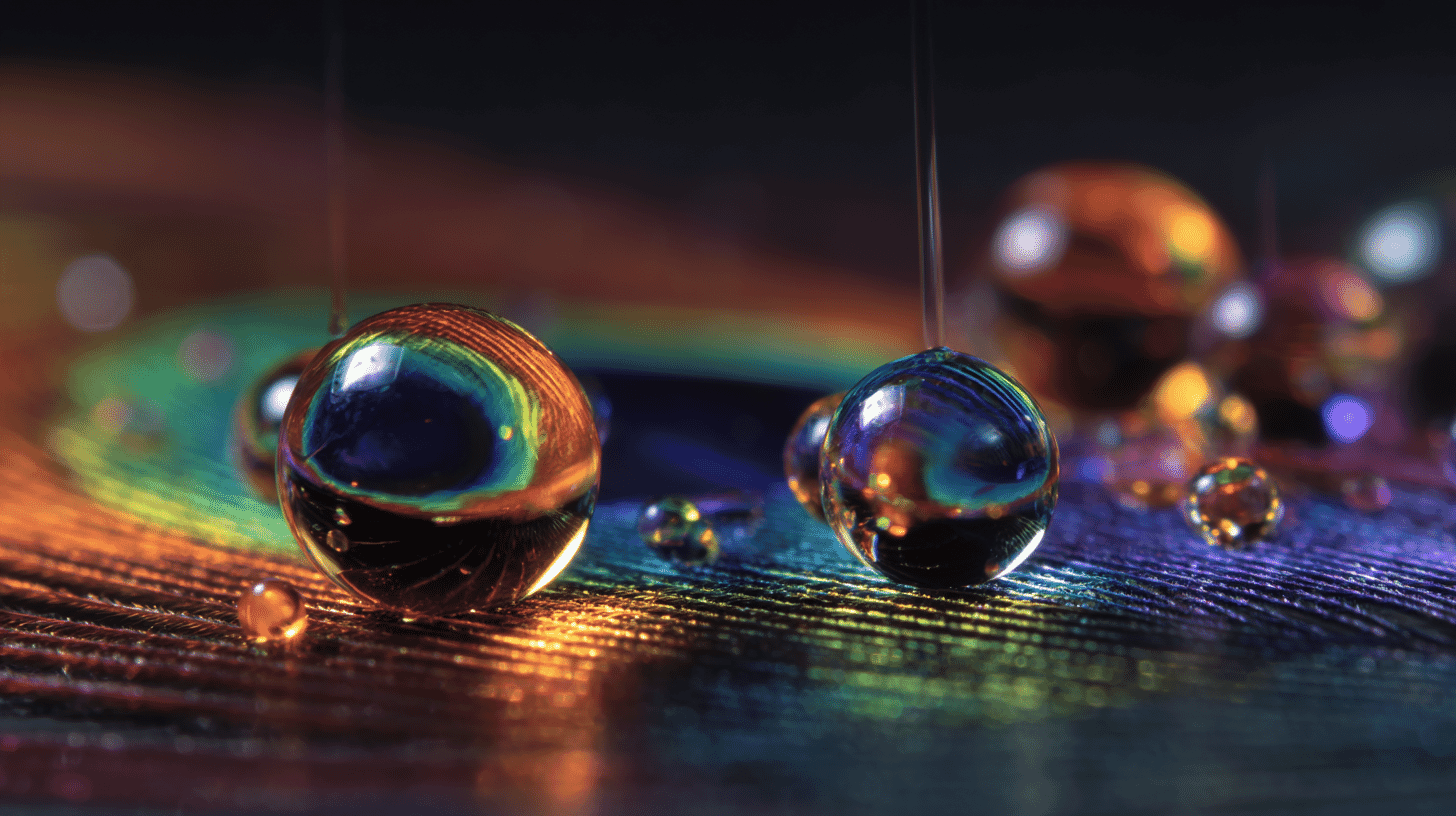
What if ink had no color, yet could still print vivid images? Researchers at Japan's Kobe University have done exactly that, creating a completely transparent ink that produces full-color prints using nothing but the physics of light. And the colors never fade: not in sunlight, not in heat, not ever.
The Secret of "Structural Color": Nature's Own Trick
On April 6, 2026, a research team led by Associate Professor Hiroshi Sugimoto and Professor Minoru Fujii at Kobe University's Graduate School of Engineering announced they had successfully achieved inkjet printing using "structural color nanoparticle ink." The findings were published in the international journal Advanced Materials.
So what is structural color? It's the phenomenon where color appears not from pigments or dyes, but from nanoscale structures that interfere with and scatter light. You've seen it in nature, the iridescent blue of a morpho butterfly's wings, the shimmer of a beetle's shell, or the rainbow gleam of an abalone. None of these creatures use chemical pigments. Instead, microscopic structures on their surfaces reflect specific wavelengths of light, creating vivid colors through pure physics.
The Breakthrough: Mie Resonance in Silicon Nanoparticles
Previous structural color technologies had a major limitation: they typically required precisely arranged periodic nanostructures (like photonic crystals), making them expensive and difficult to manufacture. Worse, the colors would shift depending on the viewing angle, not ideal for practical printing.
Kobe University's approach is fundamentally different. Their ink uses silicon nanoparticles just 100 to 200 nanometers in diameter (roughly 1/500th the width of a human hair) that exhibit a phenomenon called "Mie resonance." When light hits these perfectly spherical particles, they strongly scatter specific wavelengths depending on their size. Change the particle diameter, and you change the color, from violet to orange across the visible spectrum.
The critical advantage: each individual particle produces color independently. There's no need for periodic arrangements or complex structures. This means the particles can simply be dispersed in liquid and sprayed through a standard inkjet printer.
What They Actually Printed
The team developed a water-based color ink by dispersing size-controlled silicon nanoparticles in transparent resin. Using an inkjet printer, they produced a detailed image of a peacock with rich, multicolor reproduction.
Three additional achievements stand out:
First, they demonstrated direct printing on 3D objects, not just flat surfaces. This opens the door to coating and decorating curved products without traditional painting processes.
Second, by combining inks with different particle sizes, they achieved multicolor printing in a single process.
Third, and perhaps most fascinating, the printed films display different colors depending on whether you view them in reflection or transmission. Look at the print from the front and you see one color; hold it up to the light and you see another. This dual-color property is entirely unique to this technology.
Why This Matters: The Problem With Traditional Ink
Every color print you've ever seen relies on dyes or pigments that absorb specific wavelengths of light. But these chemical colorants inevitably degrade, ultraviolet radiation, heat, and chemical reactions break down their molecular structure, causing colors to fade. That billboard that looked vibrant last year? Give it a few more seasons.
Structural color nanoparticle ink works on a completely different principle. Color comes from the physical scattering of light, not chemical absorption. Since silicon is thermally and chemically stable, the colors are theoretically permanent, they simply cannot fade because there's no chemical process to degrade.
It's worth noting that Fujifilm announced a structural color inkjet technology in 2022, but that approach was designed to embrace the angle-dependent color shifts as a decorative feature. Kobe University's technology is the opposite, it minimizes angle dependence to produce stable, consistent colors, positioning itself as a potential replacement for conventional paints and pigments.
Environmental and Industrial Potential
The implications span multiple industries:
Environmental impact: No toxic chemical dyes or pigments are needed. Silicon is the second most abundant element in Earth's crust and is biocompatible. As chemical regulations on paint ingredients tighten worldwide, this technology aligns with sustainability goals.
Signage and outdoor advertising: Colors that never fade mean no costly repainting. The researchers note that dangerous maintenance work on faded signs could be eliminated.
Aviation: Earlier research by the same team showed that their structural color ink could coat surfaces at approximately 0.3–0.5 grams per square meter, roughly 1/10th the weight of conventional aircraft paint. For a large commercial aircraft that typically carries several hundred kilograms of paint, the weight savings would be significant in fuel efficiency.
Anti-counterfeiting: The nanoparticle-based coloring is virtually impossible to replicate with standard printers, making it ideal for currency, luxury goods, and pharmaceutical packaging.
Cosmetics and displays: The ability to control color with particle size and create films with dual reflection/transmission colors opens possibilities for optical filters, smart windows, and specialty cosmetics.
Challenges Ahead
The technology isn't ready to replace your office printer just yet. The achievable color gamut is still narrower than conventional CMYK printing, and scaling up production of precisely size-controlled silicon nanoparticles remains an engineering challenge with associated costs.
But the trajectory is promising. The Kobe University team first created the world's first structural color ink in 2020, demonstrated the world's lightest structural color coating in 2024, and now achieved inkjet printing in 2026. Associate Professor Sugimoto has stated that practical applications as fade-resistant paints and specialty inks are the next target, with industry partnerships to drive commercialization.
This is fundamental research from a Japanese university that could reshape how we think about color in printing, painting, and beyond. What do you think, would fade-proof, eco-friendly color technology change things in your country? We'd love to hear your perspective.








Global Discussion
14 comments