Hydrogen fuel cells generate clean electricity from hydrogen and oxygen, but their key component, the electrolyte membrane, has long relied on fluorine-based materials linked to the "forever chemicals" that never break down in nature. A team of Japanese researchers has now built a fluorine-free alternative that actually outperforms the original. Here is why it matters.
A Fluorine-Free Membrane That Beats the Conventional Standard
In February 2026, a joint research team from the University of Yamanashi, Waseda University, and Shinshu University announced a breakthrough that could reshape the hydrogen fuel cell industry. They developed a completely fluorine-free electrolyte membrane for Polymer Electrolyte Fuel Cells (PEFCs) that surpasses conventional fluorine-based membranes in both performance and durability.
The research was led by Professor Kenji Miyatake of the University of Yamanashi's Clean Energy Research Center and Waseda University, Distinguished Professor Ick Soo Kim of Shinshu University's Fiber Science Research Institute, and Research Assistant Professor Liu Fanghua of the University of Yamanashi. Their findings were published in Advanced Materials, one of the world's leading materials science journals.
A fuel cell works by combining hydrogen and oxygen through a chemical reaction to produce electricity, with water as the only byproduct. At the core of this process is the electrolyte membrane, which transports protons (hydrogen ions) from one electrode to the other. Think of it as the fuel cell's beating heart, if it fails, the whole system fails.
Until now, these membranes have been made from fluorine-containing polymers. While effective, these materials come with a significant environmental problem.
The PFAS Problem: Why Going Fluorine-Free Matters
The fluorine compounds used in conventional fuel cell membranes belong to a family of chemicals known as PFAS (per- and polyfluoroalkyl substances). Often called "forever chemicals," PFAS molecules are extraordinarily stable, which makes them useful in industrial applications but devastating for the environment. They persist in soil, water, and living organisms for decades or even centuries.
The regulatory response has been swift. The European Union proposed a comprehensive ban on PFAS in 2023. The U.S. Environmental Protection Agency established strict limits on PFAS in drinking water. Japan has also faced PFAS contamination concerns in areas like Tokyo's Tama region and Settsu City in Osaka Prefecture, driving momentum toward stricter regulations.
The irony has not been lost on the industry: fuel cells are promoted as clean energy technology, yet their most critical component contains chemicals that may harm the environment. A high-performance, fluorine-free alternative has been one of the field's most sought-after goals.
Inside the New Membrane: SP-PAC12-QP-PE7
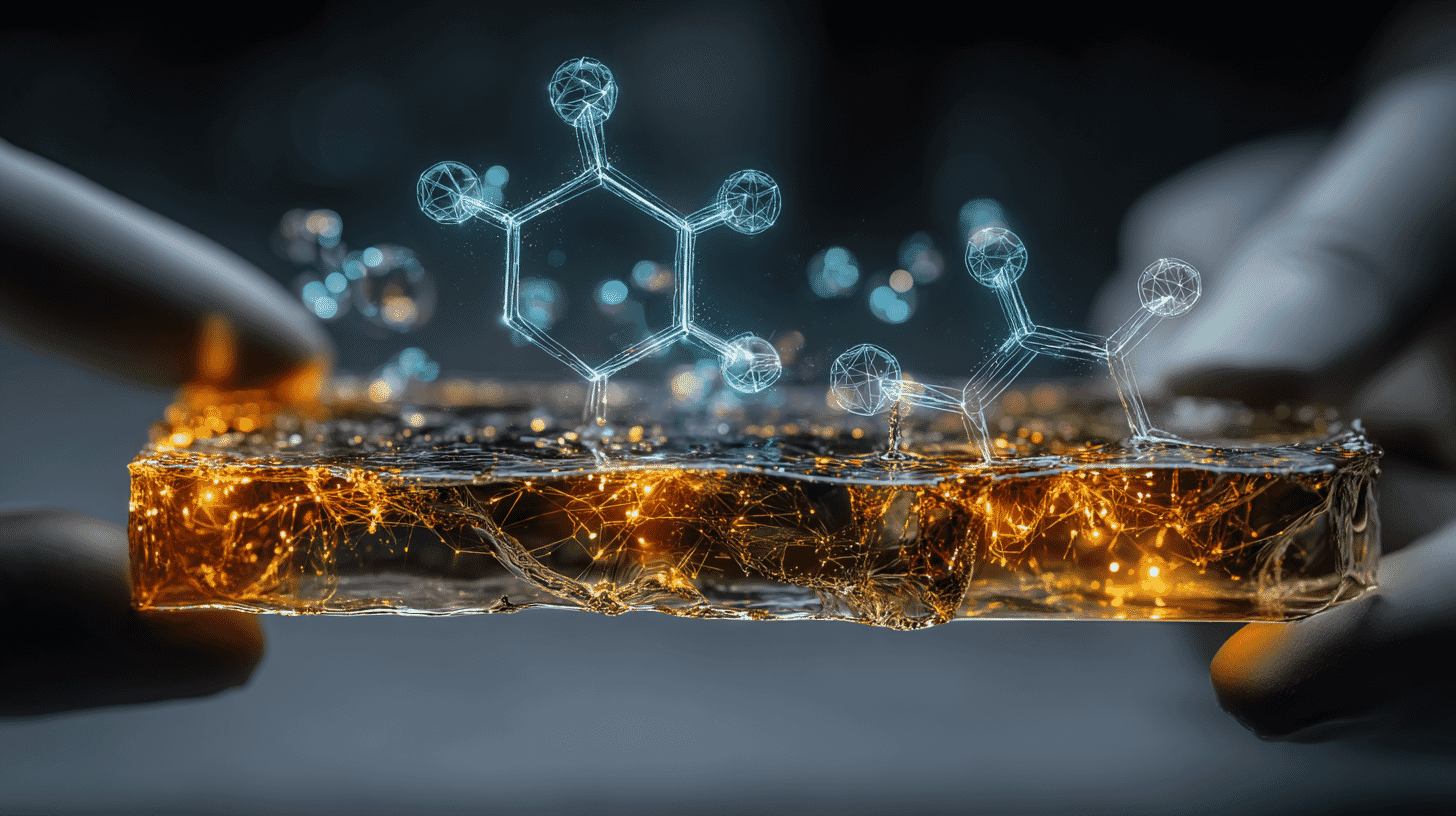
The team's solution is a carefully designed material called a "terpolymer," a polymer made from three different building blocks. These components are a sulfonated phenylene unit (which attracts water and conducts protons), a quinquephenylene unit consisting of five connected benzene rings (which repels water and provides structural stability), and an aliphatic unit (which adds flexibility).
This terpolymer was combined with a porous polyethylene substrate just 7 micrometers thick (about one-tenth the width of a human hair), creating a composite membrane designated SP-PAC12-QP-PE7.
The results are remarkable:
Proton conductivity: 0.3–0.7 S/cm across a temperature range of 176–248°F (80–120°C), matching fluorine-based membranes.
Gas barrier properties: Hydrogen permeation is roughly one-quarter that of fluorine-based membranes, meaning far less fuel leakage and better efficiency.
Flexibility: Elongation at break exceeds 300% at 176°F (80°C) and 60% relative humidity, ensuring the membrane can handle the repeated swelling and shrinking that occurs during fuel cell operation.
Power output: Over 150 mW/cm² at 248°F (120°C) and 30% relative humidity, outperforming commercially available fluorine-based membranes under demanding conditions.
Durability: Over 100,000 cycles in accelerated degradation testing (alternating between dry and humid conditions). This is 1.3 times the durability of fluorine-based composite membranes and unprecedented for a fluorine-free material.
Why This Is a True Breakthrough
What makes this achievement exceptional is that it simultaneously solves multiple problems that had previously been considered impossible to address without fluorine.
Researchers around the world have been working on fluorine-free alternatives for years, but earlier attempts consistently fell short in at least one critical area: insufficient proton conductivity, poor chemical stability, or inadequate mechanical strength. This team took a meticulous approach, systematically optimizing the ratio of the three components and the length of the aliphatic chains.
They discovered that using a dodecyl group (a 12-carbon aliphatic chain) at 67 mol% produced the optimal balance of properties. This precise molecular engineering is the key that unlocked the seemingly contradictory goals of high conductivity and exceptional durability.
Japan's Hydrogen Strategy: The Bigger Picture
This research fits into Japan's ambitious vision for a hydrogen-powered society. Japan was the first country to establish a national "Hydrogen Basic Strategy" in 2017, updated in 2023. The strategy sets targets of introducing 12 million tons of hydrogen annually by 2040 and achieving carbon neutrality by 2050, backed by over $100 billion in planned investment over 15 years.
Japan already leads in hydrogen technology commercialization. Toyota's Mirai fuel cell vehicle, residential "ENE-FARM" fuel cell systems, and hydrogen-powered buses are all in operation. Japan holds approximately 24% of the world's hydrogen-related patents, the highest share of any country.
However, widespread adoption of fuel cells still requires cost reduction and improved durability. The fluorine-free membrane developed in this study addresses both goals. By eliminating expensive fluorine-based materials, manufacturing costs could decrease. And by exceeding the durability of conventional membranes, it extends the operational lifespan of fuel cell systems.
Perhaps most strategically, a PFAS-free fuel cell opens doors to the European market, where stringent PFAS regulations could otherwise block market entry for conventional fuel cell products.
Applications Beyond Fuel Cells
The research team emphasizes that the terpolymer technology has applications far beyond fuel cells.
Because the three-component polymer system allows for numerous compositional variations, it can be tailored for different electrochemical devices. Planned applications include water electrolysis cells for green hydrogen production, next-generation rechargeable batteries, and various types of electrochemical sensors.
If the technology can be applied to water electrolysis, it would enable a fully PFAS-free system from hydrogen production to hydrogen consumption, a truly clean energy chain.
Challenges Ahead
Some hurdles remain before commercialization. The experiments used small cells with an electrode area of just 4.41 cm² (about 0.68 square inches). Scaling up to practical sizes while maintaining performance will be a critical next step. Long-term durability testing with multi-cell stacks is also needed.
The team also notes that exploring different compositional variations of the terpolymer could yield even better performance. With numerous possible combinations, the optimal formulation may not yet have been found.
Still, the achievement of creating a fluorine-free membrane that outperforms the fluorinated standard marks a significant turning point. This university-born research from Japan has brought the global hydrogen economy one step closer to reality.
In Japan, fuel cell technology continues to advance as part of the country's national strategy to build a hydrogen-powered society. This fluorine-free membrane from the University of Yamanashi and its partners is a breakthrough that addresses both environmental regulations and performance demands simultaneously.
What is your country doing to advance hydrogen energy and fuel cell technology? How are PFAS and environmental regulations being handled where you live?
References
- https://www.waseda.jp/inst/research/news/83464
- https://news.mynavi.jp/techplus/article/20260212-4111971/
- https://www.shinshu-u.ac.jp/faculty/textiles/news/2026/02/221476.html
- https://eetimes.itmedia.co.jp/ee/articles/2602/12/news030.html
- https://www.enecho.meti.go.jp/category/saving_and_new/advanced_systems/hydrogen_society/






Global Discussion
16 comments