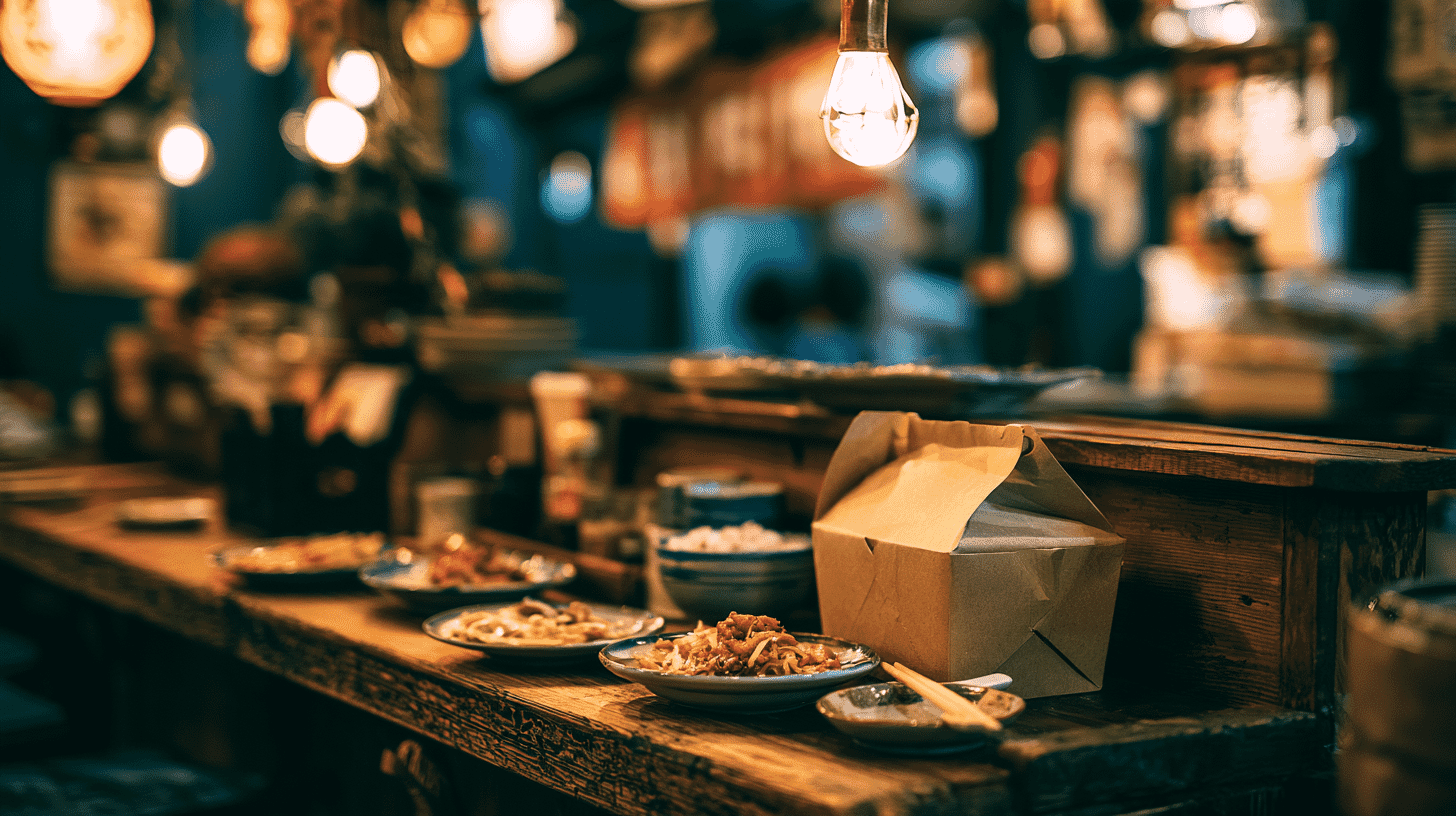
🥡 Japan gave the world mottainai, a word for the regret of letting something useful go to waste. Yet ask a Japanese restaurant to box up what you couldn't finish, and there is a fair chance the answer will be a polite no, even after the government issued a guideline in December 2024 meant to make the answer yes. The sticking point is legal: once the food leaves the table, whose problem is it?
A word Japan lent the world
Mottainai, roughly "what a waste," went global in 2005, when Wangari Maathai, the Kenyan activist who had won the 2004 Nobel Peace Prize, took up the word after a visit to Japan and brought the Mottainai campaign before the United Nations in New York. Even the government's 2024 guideline on taking restaurant leftovers home opens by describing mottainai as an old Japanese custom of treating food with care.
Even so, Japan threw away an estimated 4.61 million tonnes of edible food in fiscal 2024, according to the environment and agriculture ministries. Restaurants and other food-service businesses produced about 700,000 tonnes of that. The guideline cites an estimate that roughly half of food-service losses come from a source no other part of the food industry has: what diners leave on their plates.
Taking leftovers home would keep them out of the bin, but few people do it. In a Consumer Affairs Agency survey of 5,000 people in September 2025, only 10.8% said they had taken restaurant leftovers home in the past year. Another 6.7% said they had wanted to but were refused. The most common reason for not trying was that the idea had never occurred to them (8.7%), with hygiene worries close behind (8.5%).
Legally, the default is "eat it here"
The guideline, issued on December 25, 2024 by the Consumer Affairs Agency and the Ministry of Health, Labour and Welfare, is unusually frank about why restaurants hesitate. When you order a meal, it says, you enter a contract to eat it on the premises, and that contract restricts carrying the food out. Taking your leftovers is therefore not an automatic right but a second, separate agreement with the restaurant.
That second agreement comes with duties. The restaurant is expected to decide which dishes can go, turning down high-risk items such as raw food, and to explain how to handle the food afterwards. If it skips those steps and a customer falls ill, it can be liable for damages.
Could a restaurant simply ask diners to waive their claims? According to the guideline, Japan's Consumer Contract Act voids clauses releasing a business from all liability. Partial waivers do not cover intent or gross negligence, and may fail even for minor negligence.
The guideline does offer restaurants some comfort. If bacteria grow after the food has left, product liability does not apply, and proper warnings make a finding of fault less likely. The harder risks are the ones no contract can manage. If someone falls ill, the local public health center may investigate the restaurant to check whether the food was contaminated before it left. Whatever that inquiry finds, a customer's social media post can still damage the restaurant's name. The guideline itself admits that for these reasons, many restaurants cannot bring themselves to take part actively.
On paper, the customer carries the risk. In practice, the restaurant picks the dishes, gives the explanation, keeps the records and faces the inspector if anything goes wrong. Saying no is the cheapest choice.
A risk no one has counted
Japan recorded 1,172 food poisoning incidents and 24,727 patients in 2025, according to the health ministry, and restaurants were the source in 56.1% of incidents. The guideline also tells diners to give up on takeaways when the weather is hot or the trip home is long.
No official figure shows how much takeaways add to those numbers. The national statistics sort cases by the facility where the food came from, such as restaurants, homes, caterers and inns, and do not single out leftovers carried home. Without a figure, the risk looks open-ended to the people who would carry it.
Japanese menus make the line harder to draw. The guideline's table of food-poisoning bacteria names sashimi and sushi as typical sources of Vibrio parahaemolyticus, and undercooked chicken such as torisashi (chicken sashimi) as a typical source of Campylobacter, and advises against taking either home. For a visitor, that rules out some of Japan's best-known dishes.
Zenkoku Shodanren, a national federation of consumer groups, surveyed 226 people online in June and July 2026. Its respondents were already engaged with the issue: 79.6% had taken leftovers home before. Of all respondents, 44.2% said a restaurant had turned down a request to take food home, citing food-poisoning fears, hotels and banquet halls, and raw dishes. Yet even in this group, 81.0% had never heard of mottECO, the name the Environment Ministry chose in 2020 for taking restaurant leftovers home.
France had similar worries
In 2019, a member of France's National Assembly asked the government in writing how it planned to support a doggy-bag rule that parliament had already passed. Her question noted that restaurateurs feared both the cost and the hygiene problems of handing out takeaway boxes. It also cited the environment agency ADEME as saying the French were not used to such containers. That could pass for a description of Japan today.
The rule went ahead anyway. Under the EGalim food law of October 30, 2018, restaurants and bars have had to provide reusable or recyclable containers to any customer who asks since July 1, 2021, with an exception for all-you-can-eat offers. The authorities also promoted a friendlier name, the Gourmet Bag. Japan, too, picked a catchy name in an Environment Ministry contest: mottECO, which blends motto eco (more eco) with mottekaerou (let's take it home). But in France the box is a duty the restaurant owes on request, while Japan's guideline only asks restaurants to respond to requests in principle, as guidance rather than law.
Hesitant diners are not a Japanese peculiarity either. In the United States, the doggy bag is fading, especially in New York, according to experts quoted by the trade publication The Food Institute in 2025. Northeastern University professor Darin Detwiler told the publication that at upscale restaurants or in groups, asking for one can seem embarrassing, and that a stigma about looking frugal lingers. The publication also cited the food-waste nonprofit ReFED as finding that the average American left $329 worth of food on restaurant plates in 2023.
The gap between the three countries looks less like a matter of national character than of design: who has to say yes, and who holds the risk once they do.
If you're eating out in Japan
The guideline says a growing number of restaurants have started to allow takeaways, and the Environment Ministry supplies mottECO stickers, posters and logos for them to display.
- Ask first, and keep it simple. "Mochikaette mo ii desu ka?" means "May I take this home?" If the answer is no, let it go. Under the guideline, the restaurant decides what can leave.
- Expect to pack it yourself. The guideline says customers should, in principle, move the food into the container themselves, using the container and clean utensils the restaurant provides.
- Some things rarely travel. The official precautions single out raw or undercooked food and ask diners to leave soups and drinks behind. In summer, expect more refusals.
- Follow the rules on the way home. Go straight back, refrigerate the food if you won't eat it soon, and reheat it thoroughly. Don't give it to anyone with food allergies. The Consumer Affairs Agency publishes these precautions in English, Chinese and Korean.
Better still is what the guideline puts first: order what you can finish. If a full bowl of rice is too much, "gohan sukuname de" asks for a smaller portion.
Where you live, is asking for a box as ordinary as asking for the bill?
References
- https://news.yahoo.co.jp/expert/articles/d5f5c7f756e7886da9c8a8d50bcf44c42c566c21
- https://www.caa.go.jp/policies/policy/consumer_policy/information/food_loss/promote/assets/consumer_education_cms201_250120_04.pdf
- https://www.env.go.jp/press/press_05155.html
- https://www.maff.go.jp/j/press/shokuhin/recycle/260630.html
- https://www.caa.go.jp/policies/policy/consumer_research/research_report/survey_003/assets/consumer_research_cms201_251009_02.pdf
- https://www.mhlw.go.jp/content/10906000/001679199.pdf
- https://www.shodanren.gr.jp/Annai/915.htm
- https://www.env.go.jp/press/108796.html
- https://www.env.go.jp/press/109486.html
- https://www.caa.go.jp/policies/policy/consumer_policy/information/food_loss/efforts/assets/consumer_education_cms201_250415_03.pdf
- https://www.gov-online.go.jp/eng/publicity/book/hlj/html/201807/201807_12_en.html
- https://www.assemblee-nationale.fr/dyn/15/questions/QANR5L15QE18251.pdf
- https://www.assemblee-nationale.fr/dyn/15/amendements/3725/CION-ECO/CE22.pdf
- https://foodinstitute.com/focus/death-of-the-doggie-bag-why-restaurant-leftovers-are-being-left-behind/




Global Discussion
4 comments