
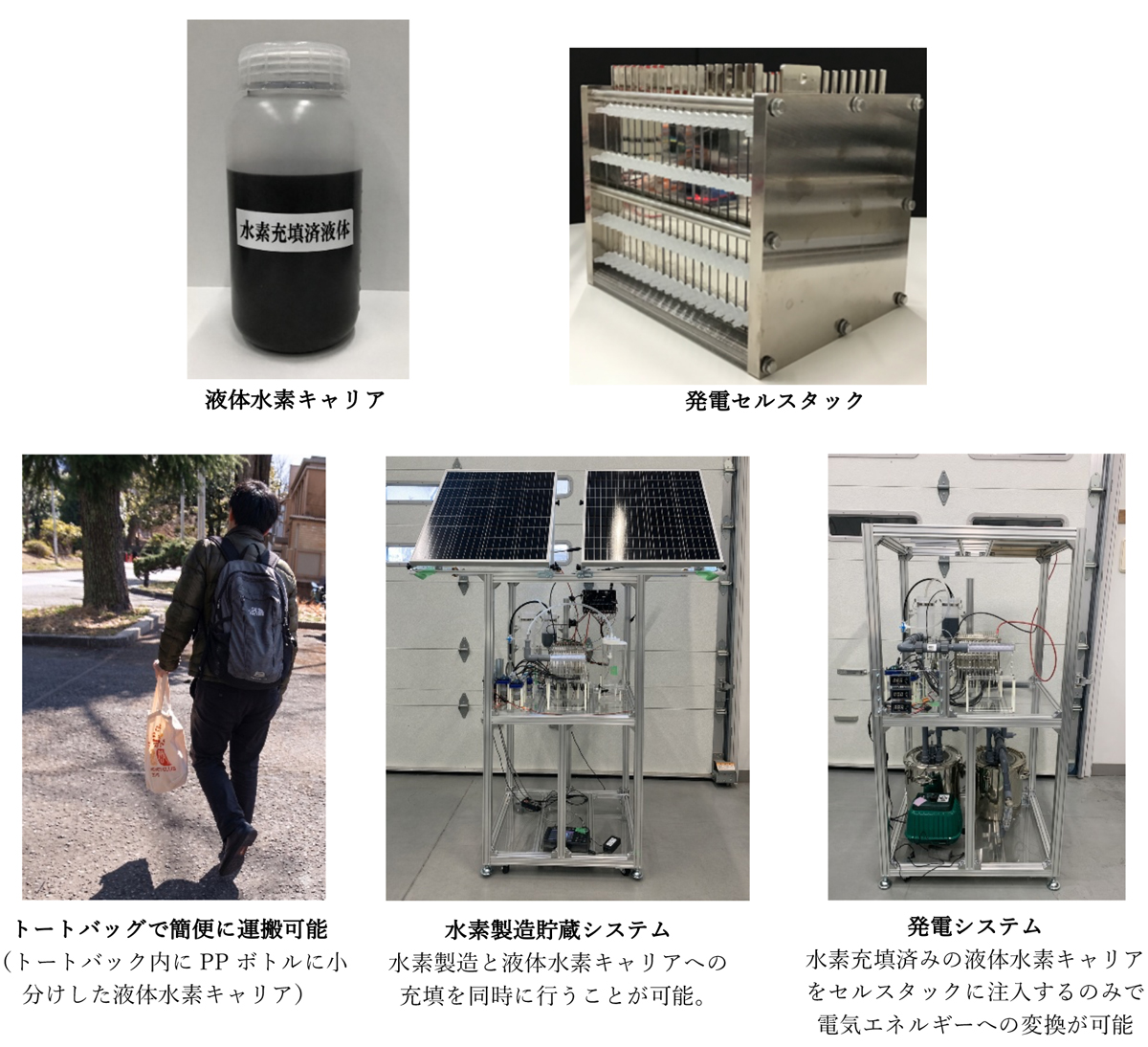
A person walks out of a lab in Sagamihara carrying a plastic container in a tote bag. Inside is hydrogen. Not a pressurized tank, not a cryogenic flask chilled to minus 253°C, just a liquid sloshing around at room temperature that you could, in principle, pour like water. They carry it by hand into central Tokyo, plug it into a small generator, and the lights come on.
That, stripped of the engineering, is what a team at the University of Tokyo says it pulled off in early June 2026: the first demonstration anywhere of green hydrogen made, stored, moved between cities, and turned back into electricity as a single connected chain, using a liquid you can handle like an ordinary fuel.
The part that sounds impossible
Hydrogen is a nightmare to move. As a gas it has almost no energy per liter unless you squeeze it to hundreds of atmospheres. As a liquid it has to be kept colder than the surface of Pluto. Either way you need heavy steel, specialized terminals, and a public that still half-remembers the Hindenburg.
The University of Tokyo's Kono Lab, working with the automotive supplier Aisin and a Sagamihara company called ARM Technologies, took a different route. ARM Technologies developed a liquid "hydrogen carrier" with a set of properties that, on paper, sidestep most of the fear. According to the announcement, the liquid stays liquid at normal temperature and pressure, it is water-based and non-flammable, it falls outside Japan's legal categories for high-pressure gas, hazardous materials and toxic substances, and it can be moved with an ordinary pump.
In the demonstration, the team did not use a tanker or a pressure vessel. They stored the carrier in a simple polypropylene container and a person carried it by hand, in a tote bag, from Sagamihara to the university.
Source: Research Center for Advanced Science and Technology, the University of Tokyo
Why "direct" is the whole point
The interesting claim is not really the tote bag. It is the word "direct."
Most plans for shipping hydrogen long distances convert it into something easier to carry, then convert it back. The leading candidates are ammonia, liquid hydrogen, and a class of oily liquids called LOHC, of which the best known in Japan is methylcyclohexane (MCH). All three work. All three leak energy at the joins.
Liquid hydrogen burns a large share of its own energy just getting cold enough to liquefy, and keeps boiling off in storage. MCH soaks up hydrogen easily but demands a lot of heat to release it again at the destination. Ammonia is dense and ships well, but making it and then cracking it back into usable hydrogen both cost energy. Add it all up and a widely cited 2019 study put the well-to-power efficiency of ammonia at roughly 34 to 37 percent, liquid hydrogen at 30 to 33 percent, and MCH at about 25 percent. The University of Tokyo announcement frames the ammonia-and-MCH style routes more bluntly, at around 20 to 30 percent overall.
The new system is built to skip those lossy conversion steps. Solar electricity drives a custom electrolyzer that stores hydrogen straight into the liquid, no separate synthesis plant. At the other end, you inject the liquid into a generator and it produces power at room temperature, no high-heat cracking stage. Fewer conversions, less waste heat, more of the original energy surviving the trip.

Source: Research Center for Advanced Science and Technology, the University of Tokyo
Here is the honest catch. The team says the result is "high efficiency" but did not publish its own number, and the exact chemistry of the liquid is proprietary and undisclosed. So we know what it claims to beat, but not by how much, and not how. This is a press release from the parties who built it, not a peer-reviewed paper, and the whole thing ran at the scale of a single tote bag. Promising, not proven.
A quiet argument with Japan's own strategy
What makes this more than a lab curiosity is the company it keeps. Around the world, the serious money in hydrogen transport is flowing in almost the opposite direction.
Japan's national bet is ammonia, at scale, imported. The industry ministry wants 20 percent ammonia co-firing rolled out at coal stations by 2030, and by 2050 a co-firing rate of 50 percent plus commercially viable mono-firing, and it has earmarked about 3 trillion yen (roughly $19 billion) to close the price gap with fossil fuels. The country's largest generator, JERA, has committed to shipping low-carbon ammonia from Louisiana to its Hekinan thermal plant in Aichi, aiming for a full value chain by fiscal 2029. Mitsubishi Heavy Industries reported cracking ammonia back into 99-percent-pure hydrogen at a pilot plant in late 2025. The plan is big, centralized, and built around tankers crossing oceans.
Europe is on a similar track for different reasons. Germany expects to import 50 to 70 percent of its hydrogen, leaning on pipelines from neighbors for the short haul and ammonia by ship for the long, with a Mediterranean pipeline from North Africa under discussion.
China barely plays the carrier game at all. With the world's largest fleet of renewables and cheap domestic electrolyzers, it is building green hydrogen next to where it will be used, in industrial clusters in Inner Mongolia, Hebei and Qinghai. Industry tallies put the number of hydrogen projects launched there in 2025 alone at more than 500.
The United States, meanwhile, has stepped back. In October 2025 the Trump administration cancelled federal funding for two of the seven regional hydrogen hubs, the two built specifically around renewable hydrogen, while keeping the ones tied to natural gas with carbon capture or nuclear power. Blue hydrogen is now the center of gravity.
Against all that, the Tokyo demonstration is an argument for the small and the local. Not oceans and tankers, but a liquid you make from your own rooftop solar and carry across town. Even within Japan, in other words, there is more than one idea about what a hydrogen future should look like.
What it could change, if it holds up
The team's stated ambitions are broad. The biggest is to soak up surplus solar and wind as a stable liquid and move it between regions, smoothing the maddening intermittency of renewables. They also float a model for charging electric cars that sidesteps the strain fast chargers put on the grid, trucking in energy as liquid the way gas stations already do, and, further off, a mobile battery you refill with a safe liquid instead of plugging in for hours.
Every one of those is a future-tense sentence. None was demonstrated. The questions that decide whether this matters are the unglamorous ones: what does the liquid actually cost to make and recycle, how much energy really survives a round trip, does it hold up outside a controlled run, and will independent researchers get to check the numbers.
This demonstration is a bet that the answer might fit in your hand. How does your country plan to move and store its renewable energy? Giant import terminals, or something you could carry yourself?
References
- https://www.rcast.u-tokyo.ac.jp/ja/news/report/page_00446.html
- https://ammoniaenergy.org/articles/nh3-vs-mch-energy-efficiency-of-hydrogen-carriers-compared/
- https://www.jera.co.jp/en/news/information/20251219_2329
- https://www.cleanenergywire.org/news/german-govt-adopts-import-strategy-green-hydrogen
- https://www.canarymedia.com/articles/hydrogen/hydrogen-hub-cuts-trump-doe-list





Global Discussion
3 comments