
The reason your phone won't connect to 6G? It might be your window. 6G's ultra-high frequencies are so short-waved they don't even scatter once they pass through glass, they punch straight to the opposite wall and die there, leaving "dead zones" in every interior room. NTT's answer to this problem is delightfully weird: a 3.5-micrometer transparent sheet you stick on windows that electrically bends radio waves around your building. World's thinnest. Mass-producible on existing LCD factory lines. In the global RIS race where Nokia, Ericsson, and Samsung are also sprinting, Japan just pulled ahead.
6G's dirty secret: it loses to a wall
6G (sixth-generation mobile communication) is expected to roll out commercially around 2030, but it has one fundamental weakness: its radio waves travel almost too straight.
The frequency bands earmarked for 6G are the FR3 band (7–24 GHz) and the sub-terahertz band (100–300 GHz). These are orders of magnitude higher than the 2 GHz band that powered 4G. Higher frequencies can carry more data per second, but their wavelengths become so short that the waves behave almost like light: they barely bend around obstacles at all.
With 4G and 5G, radio waves from a base station would bounce off walls and diffuse once they entered a room through a window, filling the space reasonably well. With 6G, those same waves travel through the window like a laser pointer, straight to the opposite wall and done. Anywhere in the room that isn't in the direct line from the window becomes a "dead zone" where the base station signal simply doesn't reach.
To solve this, telecom researchers worldwide are now focused on a technology called RIS, Reconfigurable Intelligent Surface. The idea is to install "radio-controlling surfaces" on walls and windows to eliminate dead zones without deploying more base stations.
NTT's world-first: a 3.5-micrometer liquid-crystal metasurface
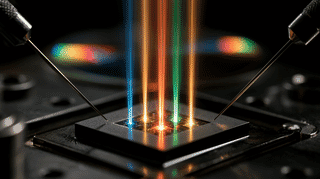
On March 27, 2026, NTT announced a "transmissive metasurface device" that applies liquid-crystal technology to this problem. A metasurface is an artificial structure made of patterns smaller than the wavelength of the radio wave, arranged periodically on a flat surface to control the wave's direction and phase. NTT combined this with liquid crystal so that applying voltage changes the metasurface's electromagnetic response, and thus the direction in which radio waves are bent, dynamically.
The work was led by Daisuke Kitayama, Senior Research Engineer at NTT's Device Technology Laboratories. The core breakthrough is shrinking the liquid-crystal layer to just 3.5 micrometers, the world's thinnest for a metasurface device. In conventional designs, the required liquid-crystal thickness grows as the operating frequency drops, sometimes reaching several hundred micrometers. Thick liquid crystal means heavy devices, difficult manufacturing, and, crucially, slow response times.
NTT's new unit-cell structure abandons the magnetic resonance mode used in earlier designs and instead uses an "electric field resonance mode" that concentrates the field inside the liquid-crystal layer. This decoupled liquid-crystal thickness from operating frequency, letting a single 3.5-micrometer design work across the entire range from microwave bands up to sub-terahertz, essentially all the frequencies 6G cares about.
Why "LCD-thin" is commercially decisive
This "same thickness as an LCD display" detail turns out to matter enormously for commercialization.
LCD manufacturing is a mature industry that has been refined for decades in Japan, South Korea, China, and Taiwan. The equipment and know-how to produce large, uniform, low-cost liquid-crystal panels already exists globally. If NTT's metasurface uses the same thickness as an LCD display, that means, in plain terms, it can be mass-produced on existing LCD factory lines with minimal retooling.
The unit cell (pixel) size is also tiny, just one-eighth of a wavelength, which makes scaling to large areas straightforward. For a use case of extending coverage a few hundred meters at 100 GHz, the window-mounted device only needs to be about 20–30 cm square, roughly the size of a small laptop screen, easy to stick onto a building window.
By constructing the metasurface from two materials with different conductivities, NTT also handled vertical and horizontal polarization simultaneously, and ensured that high-frequency signals only couple into the resonator structure rather than into the 2D control wiring. The result: complex beam shapes that conventional phased-array antennas can't produce.
The decisive new capability: dynamic beam control
NTT DOCOMO has actually been a world leader in metasurface research for years. In 2021, the company successfully turned a window into a "radio-wave lens" using metasurface technology. In 2023, it demonstrated how a transmissive metasurface could deliver indoor radio waves to shaded outdoor spots at the base of a building. Both were world-first achievements.
But those earlier devices were static, once installed, the direction in which they bent radio waves was fixed. Design your surface to deliver signal to point A in a room, and someone standing at point B with a phone is out of luck.
This new device is dynamic. Applying voltage to the liquid crystal electronically changes the beam's direction and focal point on the fly. NTT built a prototype with a 3.5-micrometer liquid-crystal layer and tested it at 115 GHz (sub-terahertz), confirming that multi-beam formation, focal-point control, and direction control all work as designed.
What this means practically: a single metasurface can track multiple users in real time, adjusting the beam to follow them as they move around a room. In environments like crowded stations or conference rooms where people are constantly moving, dead zones stop forming. 6G coverage can be extended across a whole floor by adding windowsill power and a sheet on the glass, without ever building another base station.
Nokia, Ericsson, Samsung, and the global RIS race
Metasurface/RIS technology has become central to the 6G standardization race.
Europe's standards body ETSI launched the Industry Specification Group "ISG RIS" in September 2021, the world's first standardization group dedicated to RIS. Arman Shojaeifard of InterDigital chairs it, with Richie Leo of ZTE and Professor Marco Di Renzo of France's CNRS serving as vice chairs. By 2023, the group had defined 11 use-case scenarios and moved from Phase I (technical evaluation) into deeper implementation specifications.
Surveys of technical literature name the companies actively researching RIS: Huawei, Ericsson, Nokia, Samsung, NEC, NTT DOCOMO, ZTE, China Mobile, China Telecom, BT (UK), and Orange (France). IEEE reports specifically note that "scientists in Asia are concentrating on extending in-building wireless coverage by affixing transparent RIS film to windows." NTT's approach sits squarely at the cutting edge of that trend.
The major players' strategies, however, differ in important ways:
Nokia (Finland) leverages its Bell Labs heritage for strengths in RIS algorithms and signal processing. It leads the European Commission's flagship 6G research project "Hexa-X" and is working to embed RIS into the broader 6G architecture.
Ericsson (Sweden) has been comparatively cautious about RIS, still evaluating whether the technology can deliver commercially meaningful gains. Its current bets lean more toward evolving massive MIMO and Open RAN rather than RIS.
Samsung (South Korea) has positioned RIS among its "top 10 key technologies for 6G" and demonstrated an RIS-enabled 28 GHz prototype back in 2021. Samsung is notable for investing across both the hardware and software layers.
The Chinese players (Huawei, ZTE, China Mobile) dominate on volume, the most published papers, the most patents filed, the earliest commercial trials. They're already targeting RIS deployment at the 5G-Advanced stage, not waiting for 6G.
Against this backdrop, NTT's announcement stakes out a unique claim: manufacturability. Excellent technical papers don't win standardization battles, commercialization does. The country that can actually deliver "window-mountable" RIS devices at realistic prices is the one most likely to drive the next generation of wireless infrastructure.
The roadmap: targeting 2030's 6G commercial launch
NTT describes the current state as "lab-scale characterization complete." The plan from here is staged.
Near term (2026–2027): Field testing in real offices and residences. Engineers need to verify that the device works when glued to actual building glass, under real temperature swings, UV exposure, and long-term aging.
Medium term (2028–2029): Partner with manufacturers to build mass-production capacity. LCD display makers are the obvious partners. Japan still retains LCD manufacturing know-how through JDI and Sharp (now under Hon Hai/Foxconn). South Korea's LG Display and China's BOE are also potential partners.
Long term (2030+): Commercial service aligned with 6G launch. Office buildings, shopping centers, and apartment buildings may come with RIS-coated windows as standard. NTT has also hinted the technology could serve "sensors, radar, and other use cases", meaning applications could extend beyond telecom into automotive millimeter-wave radar and smart-city sensing.
A paradigm shift: editing the environment instead of building more towers
Conventional wisdom in mobile communications has always been: "To expand coverage, build more base stations." Even with 5G, the cost of base-station deployment has been a bottleneck in less-populated regions. 6G makes this worse, its high-frequency bands attenuate so quickly that base stations need to be packed several times more densely than for 5G, with costs to match.
The sticker-on-window approach turns this logic upside down. Instead of building infrastructure to emit more radio waves, you reshape the environment so waves already in the air reach further. All you need at each installation point is wiring and a few watts of control power.
Challenges remain, of course. What happens to daylight transmission and visual aesthetics? How do renters get landlord permission to install the devices? Who controls the beam direction, the carrier, the building owner, or the user? What are the security implications of letting anyone edit the physics of radio propagation? These social-implementation questions will multiply as the technology matures.
But the paradigm itself, "instead of building radio infrastructure, edit the paths radio waves travel through", has the potential to fundamentally change how wireless networks are built.
In Japan, a future where sticking a sheet on your window expands 6G coverage is starting to come into focus. How far along is the 6G conversation in your country? Between the "more base stations" approach and the "smarter environment" approach of metasurfaces, which feels more realistic to you? We'd love to hear your perspective.







Global Discussion
14 comments