
🧲 In 2024, physics got a third kind of magnet. Then came the catch. Nobody could quite use it. A team in Tokyo has now worked out how to steer it, using a whisper of a magnetic field and a beam of neutrons to watch the change happen inside the crystal.
A magnet that hides its own field
For most of the history of magnetism, there were two kinds of magnet, and only two.
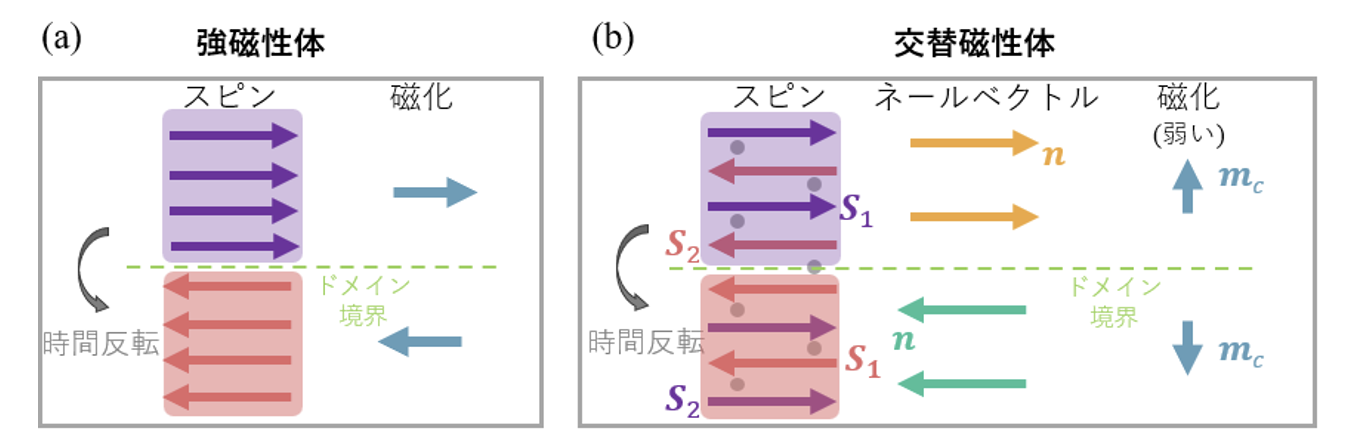
Picture a stadium crowd. In a ferromagnet, everyone faces the same way. All those aligned spins add up, and the material broadcasts a magnetic field you can feel from outside. That is the magnet on your fridge, and it is what a hard drive uses to store a bit.
Now have alternating rows face opposite directions. Seen from outside, the crowd cancels out to nothing. That is an antiferromagnet: no net field, very stable, and largely useless for storing or moving information, because there is no direction to grab onto.
In 2024, physicists confirmed a third arrangement that refuses to sit in either box. In an altermagnet, neighboring spins still point opposite ways, so from the outside it looks as quiet as an antiferromagnet. But there is a twist, almost literally: the crystal environment around each atom is rotated relative to its neighbor's, as if every other seat in the stadium sat on a turntable turned a quarter-turn. That hidden rotation means the electrons inside still feel a preferred direction. The material can push a spin current the way a ferromagnet does, while broadcasting almost no field to the world outside.
Ferromagnet-like function, without the ferromagnet's leaky field. For anyone trying to cram memory cells closer together, that combination is close to a wish list.
Why the world got excited
It starts in 2019. A joint team from Johannes Gutenberg University Mainz in Germany and the Institute of Physics in Prague found an intact momentum current inside an antiferromagnet that neither existing category could explain, and reasoned from the symmetry of the spins that it demanded a third class of magnetic order. In 2021 Libor Šmejkal, Jairo Sinova and Tomáš Jungwirth proposed it as a third fundamental type of magnetism, naming it altermagnetism in a paper the following year. For several years it stayed a prediction on paper.
Then, in 2024, the experiments arrived. In February, an international team led by the Czech Academy of Sciences and the Paul Scherrer Institute used angle-resolved photoemission at the Swiss Light Source to observe the spin-split band structure altermagnetism requires. That December, a team at the University of Nottingham imaged the domains at the nanoscale for the first time, showed the new class of magnetism could be controlled in microscopic devices, and pointed to magnetic memory with the potential to run up to a thousand times faster. Both worked on manganese telluride, MnTe, whose Néel temperature is 307 K, a little above room temperature. Remember that name.
The field was suddenly crowded and loud. The journal Science named the discovery of altermagnetism one of its top physics breakthroughs of 2024. (The overall Breakthrough of the Year went to lenacapavir, an HIV prevention drug; altermagnetism was a runner-up.) Almost all of this early story is European.
The catch nobody could get around
Here is where the excitement ran into a wall.
A textbook altermagnet is tidy. A real crystal is not. Inside an actual sample, the hidden direction points one way in some regions and the exact opposite way in others. Physicists call these regions domains, and they are a problem, because the useful effect, the spin current, reverses along with the direction. Mix domains together and their spin currents fight to a draw. You are back to zero, and the material does nothing useful.
So to actually use an altermagnet, you have to make all its domains agree. The obvious tool for herding magnetic domains is a magnetic field. But this is exactly where altermagnets fight back: they have almost no net magnetization, so a field seems to have nothing to push on. The very property that makes them attractive, their invisibility from outside, also seemed to make them uncontrollable.
Source: University of Tokyo Institute for Solid State Physics
How Tokyo grabbed the ungrabbable
The team that found a handle was led by Takatsugu Masuda and Taro Nakajima at the University of Tokyo's Institute for Solid State Physics, working with the High Energy Accelerator Research Organization (KEK), with graduate student Zheyuan Liu as lead author.
Their opening was a subtle imperfection. In MnTe, the spins are not perfectly antiparallel. They tilt by a hair, and that tiny tilt leaves each domain with a very faint magnetic lean, a "weak ferromagnetic" moment that is tied directly to which way the domain points. It is far too small to be useful on its own. But it is something a field can grab.
So the team cooled the crystal while applying a small magnetic field. As MnTe settled into its magnetic order, the faint lean lined up with the field, and because that lean is locked to the domain, the whole domain lined up too. The field needed was only on the order of a millitesla, faint enough to make with a simple coil and far below the fields inside an MRI scanner. A problem that looked like it demanded a roomful of superconducting magnet turned out to need almost nothing.
Proving the domains had actually flipped was the harder half, because you cannot see a domain by eye. Here the team used a tool Japan happens to be very good at: neutrons. At the JRR-3 research reactor, on a polarized-neutron instrument called PONTA, they fired spin-aligned neutrons through the crystal. A neutron scatters off both the atomic nuclei and the electron spins, and with polarized neutrons you can catch the interference between those two echoes. Crucially, that interference flips its sign depending on which way a domain is oriented. When the researchers reversed the cooling field, the interference signal reversed its sign right on cue. Direct evidence the domains had turned. Not all of them, though: the paper reports a domain imbalance of only about 12%, some way short of a single-domain crystal.
One number seals the point. The stray field leaking out of that weak moment measured about 10⁻³ millitesla, against roughly 10 millitesla for a typical ferromagnet. That is a factor of about ten thousand smaller. You get the steering handle of a ferromagnet with almost none of the field that ordinarily spills out and blurs the neighbors.
What it actually changes
It helps to be precise about what happened and what didn't. The discovery of altermagnetism belongs to Europe. The thousandfold speed figure is a hope for the whole field, drawn from that 2024 imaging work, not a result this paper measured. And this is basic research: there is no altermagnetic memory chip, and no timeline for one.
What the Tokyo and KEK team did is remove one of the field's central roadblocks. They showed that an altermagnet's domains can be set with a tiny, cheap magnetic field, and that you can confirm the switch directly with neutrons, all while the material keeps the near-zero external field that made it interesting in the first place. Symmetry arguments suggest the same weak-ferromagnetic handle should exist in many other altermagnets, not just MnTe, and spontaneous weak ferromagnetism has already been seen in FeS, Mn5Si3 and CoF2. That is what turns a single clever measurement into a general recipe. The world spent 2024 marveling that a third magnet exists. This is a step toward making it do a job.
Sometimes a whole category we assumed was settled turns out to have a third option hiding in it. Where in the tools you use every day might there be a "third magnet" nobody has thought to look for yet?
References
- https://www.u-tokyo.ac.jp/focus/ja/press/z0209_00127.html
- https://www.kek.jp/ja/press/202606241400
- https://doi.org/10.1103/yklc-9n6t
- https://www.sciencedaily.com/releases/2024/12/241211124354.htm
- https://press.uni-mainz.de/science-lists-the-discovery-of-altermagnetism-as-scientific-breakthrough-in-physics-in-2024/








Global Discussion
4 comments