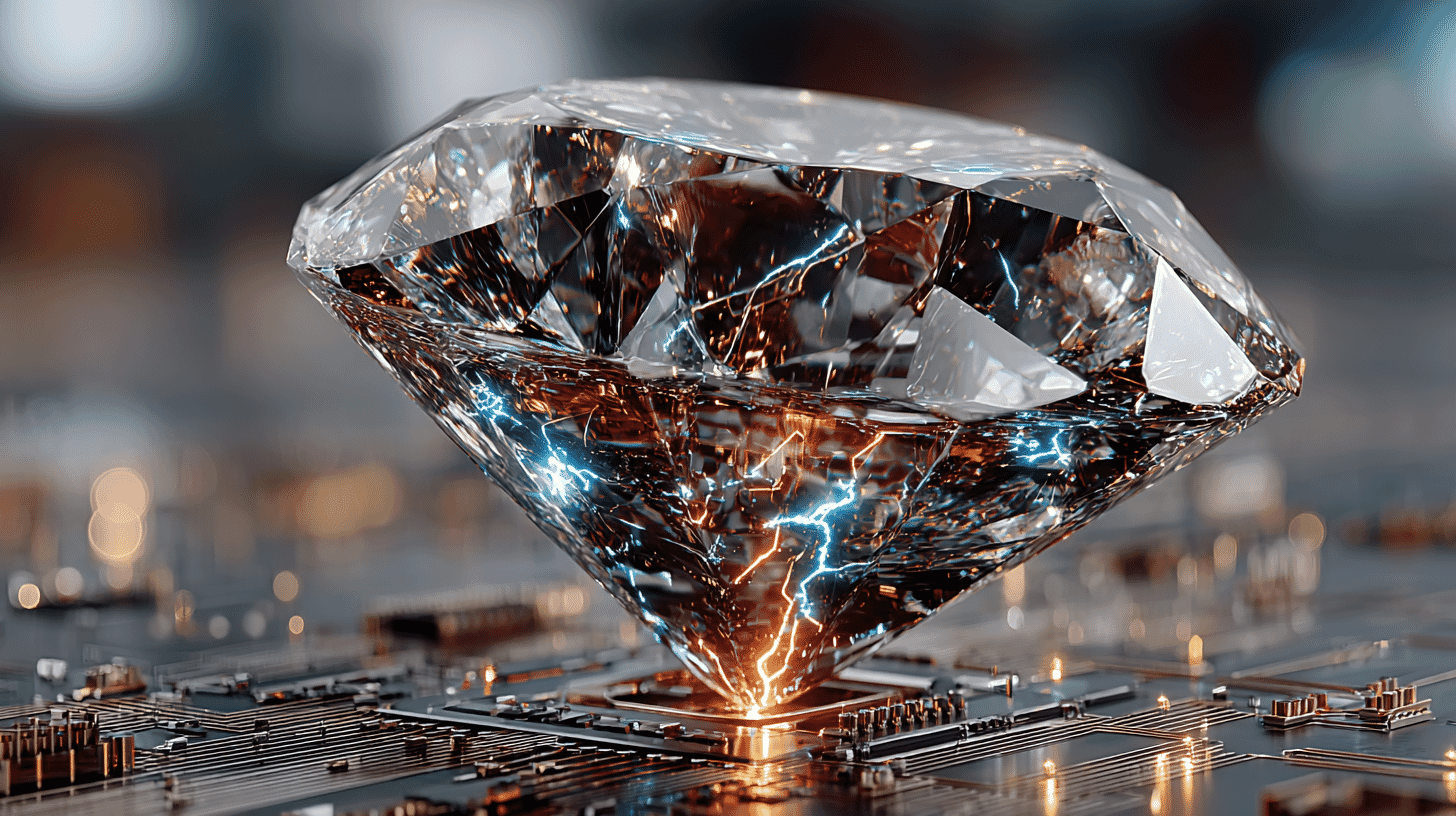
Making semiconductors out of diamond sounds like a fantasy. It is getting close to real. A startup out of Japan's Waseda University has achieved the world's first 200V, 1A switching operation with a diamond MOSFET. The "ultimate" power semiconductor, the one that beats both SiC and GaN on paper, is finally coming into view.
A World First in Diamond Power Semiconductors
On March 12, 2026, a Tokyo-based startup called Power Diamond Systems announced a breakthrough that could reshape the future of power electronics. The company successfully demonstrated 200V/1A switching operation using a diamond MOSFET (Metal-Oxide-Semiconductor Field-Effect Transistor), the first time this has ever been achieved with a diamond-based device.
In the same single device, the team also achieved a breakdown voltage of 550V and a drain current of 0.8A. These results were published in Applied Physics Express, a respected peer-reviewed journal, lending scientific weight to the achievement.
But why does this matter, and what makes diamonds so special for semiconductors?
Power Semiconductors: The Hidden Heroes of Modern Life
Every time you charge your phone, drive an electric car, or use solar-generated electricity, power semiconductors are working behind the scenes. These devices act as ultra-fast switches that control how electrical energy flows, converting it from one form to another with minimal waste.
A MOSFET is one of the most important types of power semiconductor. The faster and more efficiently it can switch on and off, the less energy is lost as heat, which means smaller, lighter, and more efficient devices.
Why Diamond Is Called the "Ultimate" Semiconductor Material
Today's power semiconductor market is dominated by silicon (Si), with newer materials like silicon carbide (SiC) and gallium nitride (GaN) gaining ground. Companies like Wolfspeed recently launched Gen 4 SiC MOSFETs covering 750V to 2,300V ranges, and even introduced the industry's first commercial 10kV SiC MOSFET in March 2026. In the GaN space, companies like EPC (Efficient Power Conversion) are pushing high-efficiency devices into mainstream applications.
But diamond surpasses them all in raw material properties.
Dielectric breakdown strength, the maximum voltage a material can withstand before it fails, is about 30 times higher in diamond than in silicon. This means diamond devices can handle much higher voltages while remaining physically smaller.
Thermal conductivity in diamond is the highest of any known material. Power semiconductors inevitably generate heat during operation, and diamond's ability to dissipate that heat means simpler cooling systems and more compact overall designs.
Bandgap, think of it as how much energy is needed to "activate" the semiconductor, is approximately 5.5 eV for diamond, compared to 3.2–3.4 eV for SiC and GaN, and just 1.1 eV for silicon. A wider bandgap translates to more stable operation at high temperatures and in harsh radiation environments.
In theory, diamond could enable power devices that are dramatically smaller, more efficient, and more durable than anything available today.
The Startup Behind the Breakthrough
Power Diamond Systems was founded in August 2022, born from research by Professor Hiroshi Kawarada at Waseda University, one of Japan's most prestigious private universities. The company is headquartered within Waseda's Entrepreneurship Center in Tokyo's Shinjuku district, and conducts joint research with both Waseda University and Kyushu Institute of Technology.
CEO Tatsuya Fujishima has described his commitment in strikingly personal terms, saying the team operates with the mindset that if they can't make diamond power semiconductors work, nobody can.
The breakthrough involved two key technical innovations.
First, the introduction of a "field plate" structure. When a MOSFET handles high voltages, electric fields tend to concentrate at the edge of the gate, the control terminal, causing premature device failure. The field plate spreads this electric field more evenly, enabling the device to withstand 550V.
Second, scaling up the device area. Previous diamond MOSFETs were tiny, requiring many small devices to be wired together in parallel to handle meaningful current levels. By making the device itself larger, Power Diamond Systems achieved 0.8A from a single device, eliminating the need for complex parallel configurations.
Perhaps most significantly, this marks the transition from "static testing", where the device is simply checked for voltage and current capacity, to "dynamic testing," where it actually switches on and off as it would in a real application. Diamond power devices have graduated from the lab bench to practical operation verification.
Japan's Diamond Semiconductor Ecosystem
Japan is leading the global race in diamond semiconductor development, with multiple institutions pushing different aspects of the technology forward.
Honda and Japan's National Institute of Advanced Industrial Science and Technology (AIST) demonstrated ampere-class high-speed switching with a p-type diamond MOSFET in 2025, targeting future mobility applications. The National Institute for Materials Science (NIMS) developed the world's first n-type diamond MOSFET in 2024, a critical step toward creating complementary circuits. And a team from Kanazawa University and AIST improved current density by 12.5 times by achieving atomically flat MOS interfaces.
On the industrial side, Okuma Diamond Device is building the world's first diamond semiconductor mass-production factory in Okuma, Fukushima Prefecture, with plans to begin full operations in 2026. Their primary target: radiation-resistant devices for use in nuclear decommissioning at the Fukushima Daiichi site.
Power Diamond Systems has also begun joint research with JAXA (Japan Aerospace Exploration Agency) on space-grade power MOSFETs, exploring diamond's natural radiation hardness for satellite and deep-space applications.
The Road Ahead: EVs, Renewable Energy, and Beyond
If diamond power semiconductors reach commercialization, the implications extend across multiple industries.
In electric vehicles, more efficient power inverters could extend driving range and reduce charging times. Current SiC-based inverters already represent a significant upgrade over silicon, but diamond promises to push efficiency even further while shrinking the size of power electronics modules.
In renewable energy, diamond devices could dramatically reduce the energy lost when converting solar or wind power for the electrical grid. Diamond's exceptional thermal management is particularly valuable for outdoor equipment that operates in harsh weather conditions.
In space and extreme environments, diamond's radiation hardness and high-temperature tolerance open doors to applications where current semiconductors simply cannot survive, from deep-space probes to next-generation satellite communications systems.
Challenges Remaining
The path to commercialization is not without obstacles. Diamond is the hardest material on Earth, making it extremely difficult to cut, polish, and process into semiconductor wafers. Currently, the largest high-quality diamond wafers are about 55mm (roughly 2 inches) in diameter, produced by Japanese company Orbray. For comparison, mainstream SiC production uses wafers of 150mm (6 inches) or larger, and Wolfspeed's latest Gen 4 products are manufactured on 200mm (8-inch) wafers.
Scaling up wafer size while maintaining crystal quality remains the biggest technical hurdle. Cost is another factor, though synthetic diamond production costs have been declining as industrial diamond manufacturing matures, semiconductor-grade material is still expensive.
CEO Fujishima has outlined a vision where diamond semiconductor applications begin appearing in the 2030s, with widespread adoption by the 2040s.
In Japan, the race to make the "ultimate semiconductor" is well underway. What about in your country, are diamond semiconductors on anyone's radar? Is there excitement about next-generation power device materials where you live? We'd love to hear your perspective.
Update: This article reflects the announcement of March 12, 2026. On March 18, Power Diamond Systems went on to report that it had built an asynchronous step-down DC-DC converter around the same diamond MOSFET and confirmed it could sustain continuous switching, the first demonstration of actual power conversion by a diamond device.









Global Discussion
12 comments