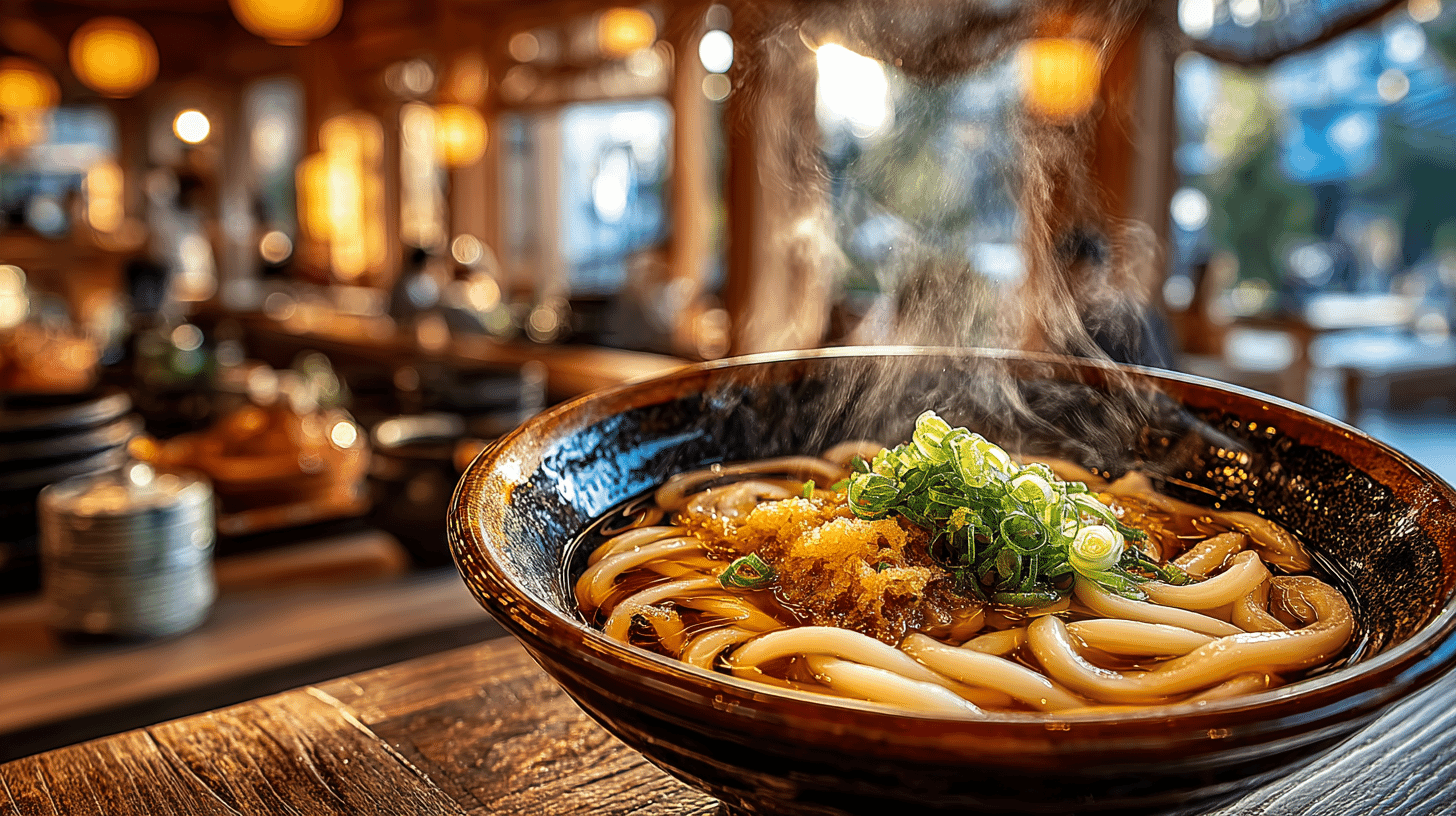
In Japan udon is an everyday meal that costs a few hundred yen. Abroad it has fans who pay 4,000 yen a bowl and go back daily. More than half the customers at one udon shop at Narita Airport are foreign, and Marugame Udon has passed 300 stores overseas. Here is how udon is making its way into the world as Japan's third noodle after sushi and ramen.
A New Era: Japanese Udon Goes Global
For Japanese people, udon is a familiar everyday dish. But today, this humble wheat noodle has evolved into a cuisine that captivates people worldwide. At Narita Airport's food courts, lines of international tourists form from early morning, choosing udon as their final Japanese meal before departure or their first upon arrival.
Remarkably, there are devoted fans who visit udon shops daily even in countries where a single bowl costs $26 (about 4,000 yen). Following the sushi and ramen waves, udon is emerging as Japan's "third noodle boom," steadily permeating global food culture.
Foreign Udon Fans at Narita Airport
Kinreya Mugimaru, an udon chain originating from Osaka, operates in the food court of Narita Airport's Terminal 1, serving customers from early morning. According to the store manager, approximately half of their customers are foreigners, sometimes reaching 60-70% on certain days.
The shop's appeal lies in its freshly made noodles prepared on-site, crispy tempura made to order, and 15 different menu options. Curry udon is particularly popular as a way to experience Japan's unique curry culture.
An interesting phenomenon is the notable preference for udon among tourists from Brunei, a small Southeast Asian nation. This connection traces back to "Soto," Brunei's national noodle dish featuring beef bone broth seasoned with spices and herbs, sharing similarities with udon's dashi culture. The Wagyu beef udon is especially favored by Bruneian visitors because, like Soto, it features beef.
Marugame Udon's Global Expansion, 307 Stores Worldwide
Toridoll Holdings, operator of Japan's udon chain Marugame Seimen, announced that their overseas brand "MARUGAME UDON" surpassed 307 stores as of March 2025. Combined with 861 domestic locations, this creates a network of 1,168 stores worldwide.
Since opening their first overseas store in Waikiki, Hawaii in 2011, Marugame has steadily expanded globally. Notably, the Waikiki store has maintained the highest sales among all locations worldwide. In August 2023, it generated approximately 130 million yen (about $870,000) in a single month.
In Indonesia, partnership with local company Sriboga Group has enabled 127 stores. Taiwan, with its cultural affinity for noodle dishes, hosts 62 locations. On September 15, 2025 it opened its first South Korean store, at Lotte World Tower Mall in Seoul, in partnership with Lotte GRS, part of the Lotte Group. Marugame had been in South Korea from 2012 to 2021 but closed everything during the pandemic, so this is a re-entry. The plan is 35 stores over five years, and the opening takes Marugame to 12 countries and regions.
Why Do Foreigners Fall in Love with Udon?, Five Key Reasons
1. Simple and Healthy Ingredients
Udon is made from just wheat flour, salt, and water. For health-conscious foreigners concerned about additives, this simplicity holds tremendous appeal.
2. Discovering "UMAMI"
Japanese dashi culture is a treasure trove of umami, carefully extracted from dried sardines, kelp, and bonito flakes. Despite its simple appearance, a single sip delivers a profound depth that touches the heart. Experiencing this "fifth taste" provides a fresh surprise for many foreigners.
3. The Joy of Customization
At self-service udon restaurants, customers can choose their noodles and freely combine tempura and toppings. This pleasure of creating "your own bowl" resonates universally.
4. Affordable Satisfaction
Compared to ramen, udon is offered at relatively reasonable prices even overseas. In Thailand, onsen tamago (soft-boiled egg) topped bukkake udon costs around 200 yen ($1.30), while in Hawaii, basic kake udon starts at about 500 yen ($3.30).
5. Deep Cultural Significance
From Kagawa Prefecture's Sanuki udon to Osaka's kitsune udon and Nagoya's miso-stewed udon, each region of Japan boasts its own udon culture. Discovering this diversity serves as a gateway to understanding Japanese culture.
Popular Udon Menus Among Foreigners
Various surveys have revealed which udon dishes are most popular among international visitors:
#1: Curry Udon The combination of thick curry soup with udon noodles represents Japan's unique culinary creativity. The sweet, mild flavor of Japanese curry appeals to international palates.
#2: Kitsune Udon Sweet fried tofu soaked in dashi is a distinctly Japanese flavor. Canadian visitors have noted it reminds them of the "sweet meets salty" combinations using maple.
#3: Niku Udon (Meat Udon) Udon topped with generously sweet-simmered beef or pork is particularly popular in meat-loving cultures.
#4: Tempura Udon The combination of crispy tempura with warm broth offers the quintessential Japanese dining experience in one dish.
However, tsukimi udon (with raw egg) faces resistance due to concerns about consuming raw eggs, and seaweed-based udon can be unfamiliar to those from different food cultures.
The Growing Udon Market, A Global Perspective
Udon's spread abroad shows up in the store count. The 307 overseas MARUGAME UDON outlets took 14 years to build from the first Hawaii store in 2011. Toridoll HD runs roughly 20 brands and about 2,050 outlets across 29 countries and territories, and udon is now one of the pillars.
This growth is driven by increasing interest in Asian cuisine, rising health consciousness, and admiration for Japanese culture. Analysis suggests that Japanese food scenes depicted in anime and movies are heightening younger generations' interest in udon.
Spreading the "Udon Experience" Worldwide
Toridoll Holdings also conducts "Inbound Udon Classes" for foreign tourists visiting Japan. The experience of kneading dough made from simple ingredients, flour, water, and salt, by stepping on it, stretching it, and cutting it into noodles provides continuous moments of surprise and emotion for participants.
"It's so simple, yet so profound", these words from a foreign tourist perfectly capture udon's appeal.
The Future of Japanese Udon
Toridoll Holdings is targeting 3,000 overseas stores by March 2028. That figure is not udon alone: it covers every brand in the group, including the Hong Kong rice-noodle chain Tam Jai and its curry formats. Overseas stores totalled 899 at the end of December 2024.
Work on diverse dietary requirements is under way. Every ingredient at the Dubai store, opened in July 2025, is halal certified, and there is a "spicy mazeudon" made with soy meat for vegetarians. Green chillies sit alongside the usual spring onions and tempura crumbs on the condiment bar. Hold the tradition, bend to the local palate: that is how udon is travelling now.
A Message to Our Readers
In Japan, udon is enjoyed as an everyday meal, with each region having its own unique culture. It's both an affordable comfort food available for a few hundred yen and an art form showcasing craftsmen's skills.
What is udon like in your country?
Have Japanese udon chains expanded to your area? What local adaptations have been made? Or if you haven't tried udon yet, what are your impressions?
We'd love to hear about udon culture in your country and your thoughts on Japanese udon!
References
- https://digitalpr.jp/r/119336
- https://news.yahoo.co.jp/articles/0839061cbfab5edfbcf0f52b8b7ad6eaf0e4e40c
- https://prtimes.jp/main/html/rd/p/000000218.000028440.html
- https://jp.marugame.com/shop/global_shops/index.html
- https://livejapan.com/ja/in-tokyo/in-pref-tokyo/in-akihabara/article-a0000973/
- https://boueki.standage.co.jp/japanese-udon/
- https://www.kinrei.com/fan/news/column/201909/27110000.php





Global Discussion
16 comments